- Featured Image Info
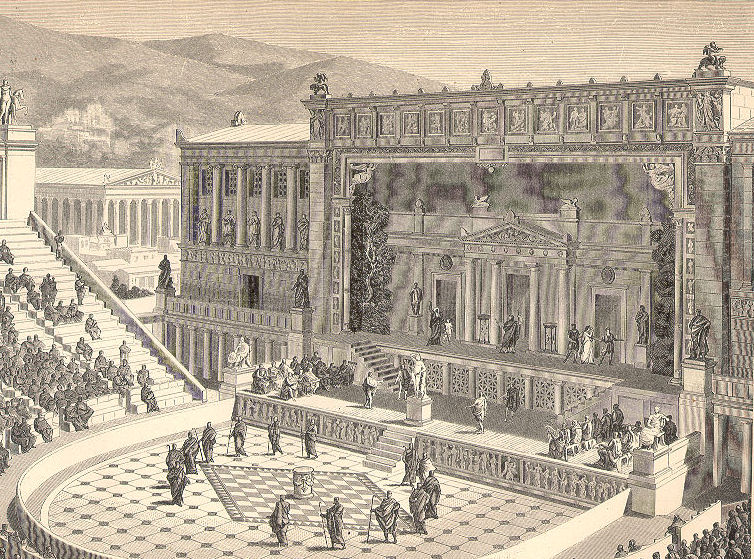
reconstruction of the Theatre of Dionysus in Athens, specifically a widely reproduced late-19th-century wood engraving based on the designs of German artist and architect Georg Rehlender (1845–1892).
Footnote: Georg Rehlender, Reconstruction of the Theatre of Dionysus in Athens, c. 1890, wood engraving, reproduced in Hellas und Rom by Jakob von Falke (1879) or NYPL Digital Collections.
Bibliography: Rehlender, Georg. Reconstruction of the Theatre of Dionysus in Athens. Wood engraving. Late 19th Century. From the Picture Collection of the New York Public Library.
Papastamati-von Moock, C. (2014). “The Theatre of Dionysus Eleuthereus in Athens: New Data and Observations on its ‘Lycurgan’ Phase.” Logeion: A Journal of Ancient Theatre Archeology.
Why it matters: This is the most current and authoritative study on the “stone” phase of the theatre (the phase shown in your image). Access via ResearchGate
Pickard-Cambridge, A. W. (1946). The Theatre of Dionysus in Athens. Oxford: Clarendon Press.
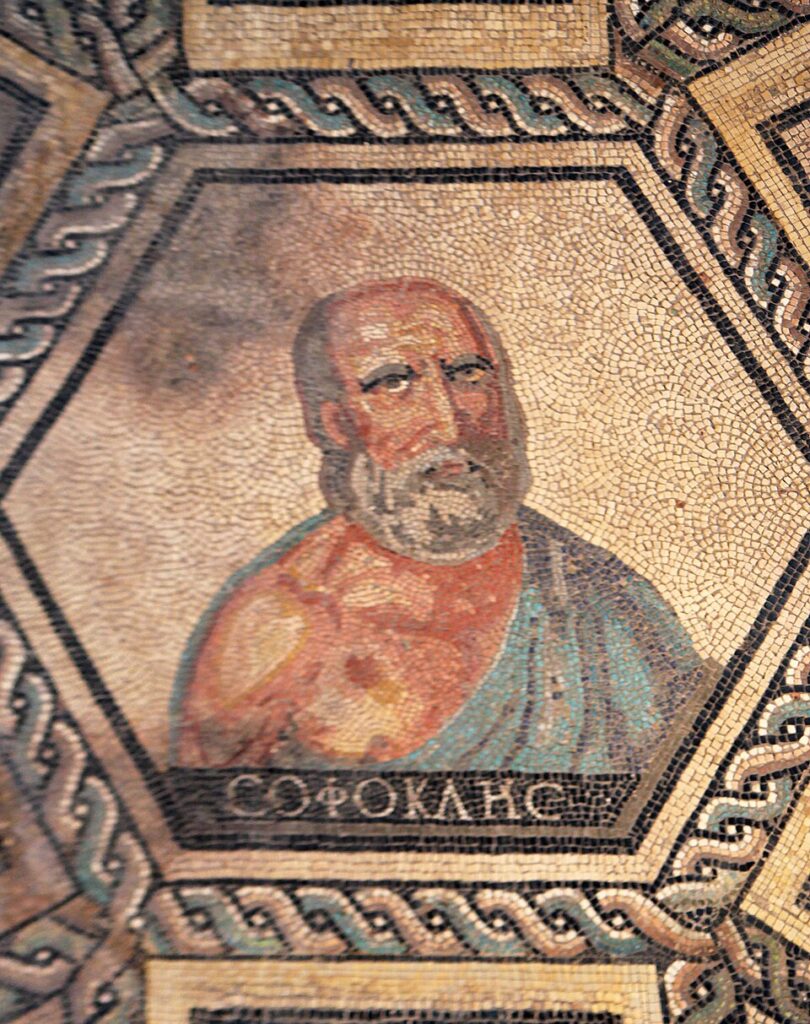
This is on the tile image below
Catalog & Artifact Data
Object Name: Philosophenmosaik (Philosophers’ Mosaic)
Subject of Detail: Sophocles (indicated by the Greek inscription ΣΟΦΟΚΛΗΣ)
Provenance: Found in 1844 in a Roman villa under the garden of the Burgerhospital, Cologne.
Date: circa 320 AD (Late Roman)
Chicago Style (Notes and Bibliography)
Footnote/Endnote: Philosophers’ Mosaic: Detail of Sophocles, Roman, c. 320 AD, mosaic, Römisch-Germanisches Museum, Cologne, Germany.
Bibliography: Römisch-Germanisches Museum. Philosophers’ Mosaic: Detail of Sophocles. C. 320 AD. Cologne, Germany.
Further reading
Wolff, G. (2002). The Roman-Germanic Cologne: A Guide to the Romano-Germanic Museum and the City of Cologne. J.P. Bachem
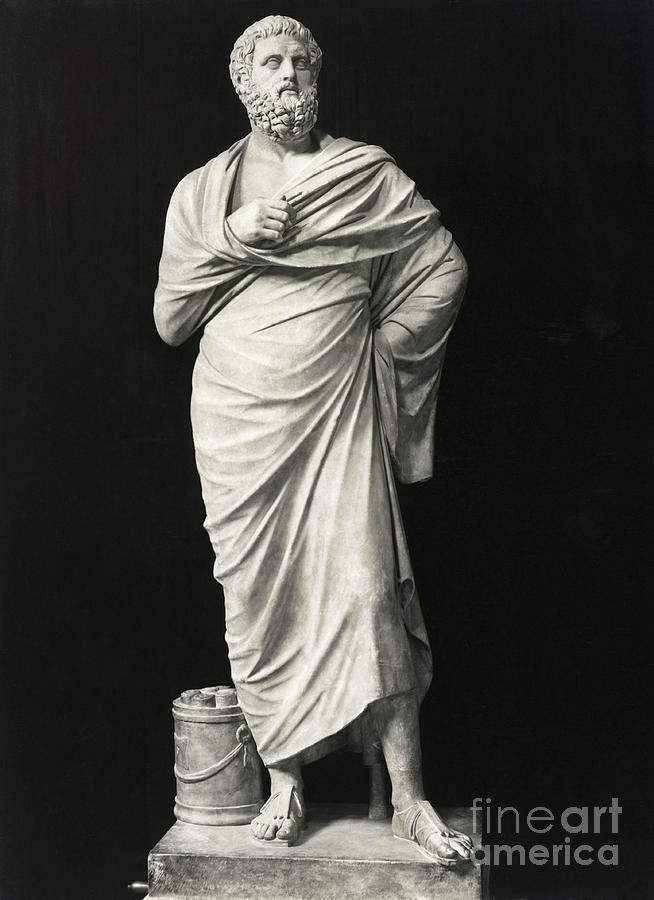
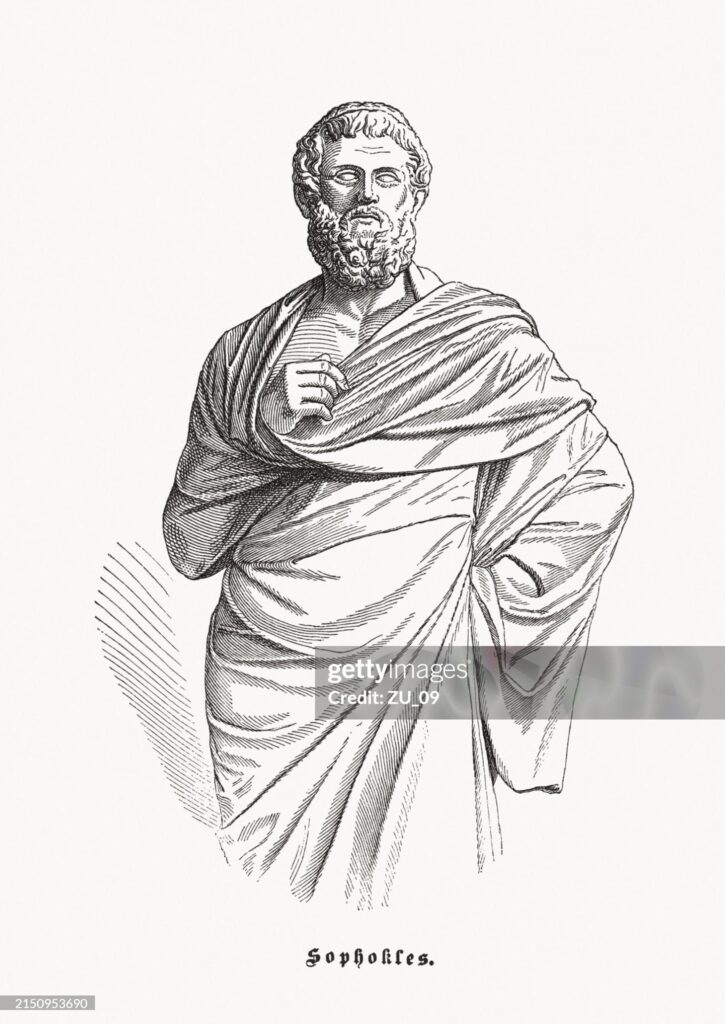
Now our attention turns to the Lateran Sophocles, marble and wood engraving.
Chicago Style: Sophocles (The Lateran Sophocles). Roman marble copy after a Greek bronze original of c. 330 BCE. 2nd century CE. Museo Gregoriano Profano, Vatican Museums, Vatican City. Inv. no. 9973.
Standard Art History Reference: Richter, Gisela M. A. The Portraits of the Greeks. London: Phaidon Press, 1965, pp. 129–130, figs. 675–682.
Current Location: Vatican Museums (specifically the Museo Gregoriano Profano), Vatican City.
Inventory Number: 9973.
Subject: Sophocles (c. 496–406 BCE), the Athenian playwright known for Oedipus Rex and Antigone.
Object Type: A Roman marble copy (dating to the 2nd century CE) of a lost Greek bronze original from the late 4th century BCE (c. 340–330 BCE).
Provenance (History of the Object)
Discovery: The statue was found in 1839 at Terracina, Italy. It was discovered in the remains of a private Roman house or near the town’s ancient theater.
Acquisition: Shortly after its discovery, it was presented by the Antonelli family to Pope Gregory XVI.
Later History: It was originally housed in the Lateran Palace (hence the name “Lateran Sophocles”). In 1970, the collection was moved to its current location in the Vatican Museums.
Restoration: Upon discovery, the statue was restored by the sculptor Pietro Galli, who added the feet, the plinth, the scroll case (scrinium) at the feet, and parts of the face.
The Greek Sculptor & Original Commission
While the statue you see is a Roman marble copy from the 2nd century CE, it is based on a famous lost bronze original.
Circle of Leochares: Art historians generally attribute the style of the original to the circle of Leochares, a prominent Athenian sculptor of the 4th century BCE. Leochares is most famous for the Apollo Belvedere and for working on the Mausoleum of Halicarnassus (one of the Seven Wonders of the Ancient World).
The Lycurgan Commission (c. 330 BCE): The original bronze was likely commissioned by the Athenian statesman Lycurgus (Lykourgos). Around 330 BCE, Lycurgus ordered official bronze statues of the three great tragedians—Aeschylus, Sophocles, and Euripides—to be placed in the Theater of Dionysos in Athens.
Artistic Style: This work represents the “Late Classical” style. It moved away from the stiff, idealized poses of earlier periods toward a more naturalistic, “gentlemanly” pose. Sophocles is shown as the ideal Athenian citizen: dignified, self-controlled (sophrosyne), and draped in a heavy himation (cloak) that restricts his movement to emphasize his intellectual rather than physical nature.
About the Wood Engraving
The specific image you provided is not a photograph of the statue, but a 19th-century wood engraving.
Publication Date: This specific illustration was published in 1879. During the late 1800s, there was a massive boom in “Fine Art” encyclopedias and classical history books (like those by Wilhelm Lübke or similar German and British historians).
The Technique (Wood Engraving): Unlike a woodcut, a wood engraving is made by carving into the “end-grain” of very hard wood (usually boxwood) using a burin. This allowed for incredibly fine, thin lines that could mimic the smooth texture of marble and the deep shadows of the drapery.
Visual Characteristics: * Cross-hatching: If you look closely at the shadows on the cloak, you’ll see thousands of tiny intersecting lines. This was the only way to create “shades of grey” in 19th-century printing.
The “Scrinium”: The engraver took care to detail the scroll case at the feet, which contains eight scrolls—symbolizing the surviving plays or the vast body of work Sophocles produced.
Collection Credit (ZU_09): On modern archives like Getty Images, this is credited to the ZU_09 collection. This is a digital archive specializing in high-resolution scans of Victorian-era “clichés” (printing blocks) and book plates. These were the “stock photos” of the 19th century, used to educate the public about the treasures of the Vatican and other European museums before high-quality photography was affordable for books.
Studniczka, Franz. “The Sophocles Statues.” The Journal of Hellenic Studies 43, no. 1 (1923): 57–67. https://doi.org/10.2307/625868.
The Oxford Handbook of Roman Sculpture. Spain: Oxford University Press, 2015. Chapter 2.2 Marble Carving Workshops, Carvings, Artisans
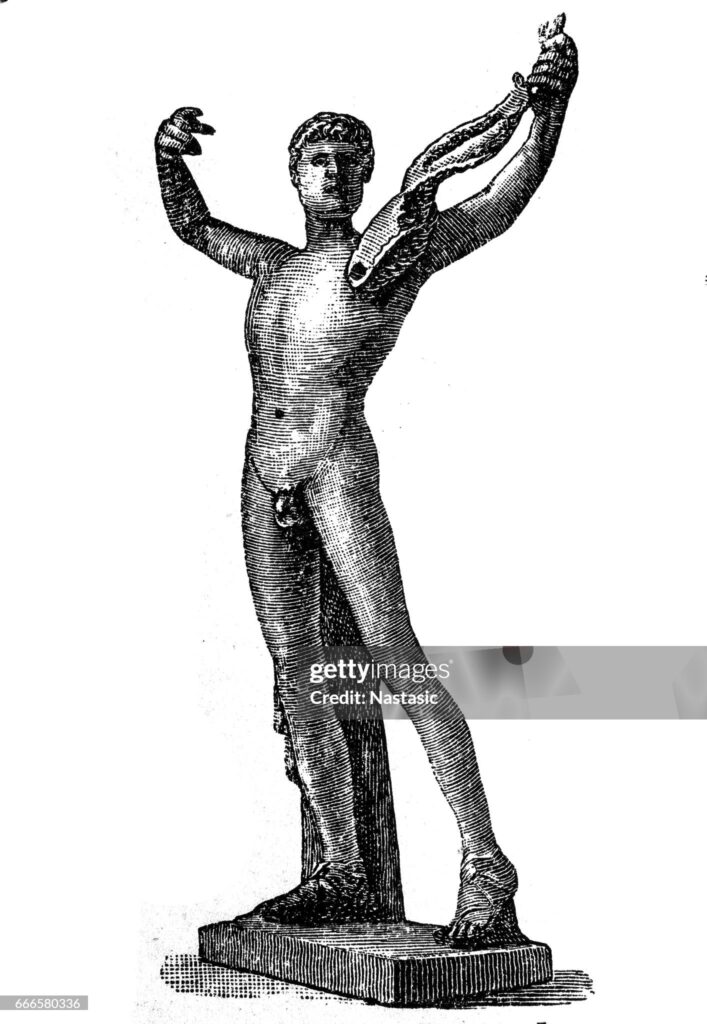
The Young Sophocles Leading the Chorus of Victory after the Battle of Salamis
The third image is a 19th-century wood engraving titled “Young Sophocles“. It depicts the playwright as a youth after the victory at the Battle of Salamis.
Identification: The Young Sophocles Leading the Chorus of Victory after the Battle of Salamis.
Artist: John Donoghue (American, 1853–1903).
Material: Bronze (the original was modeled in plaster in 1885; various bronze casts were made subsequently).
Museum (Major Casts): * Art Institute of Chicago (cast 1911).
Metropolitan Museum of Art, New York (cast 1927).
Isabella Stewart Gardner Museum, Boston.
Provenance: Modeled in Rome in 1885. The plaster version won first prize at the 1893 World’s Columbian Exposition in Chicago.
University of Chicago Citation
Bibliography: Donoghue, John. The Young Sophocles Leading the Chorus of Victory after the Battle of Salamis. 1885 (modeled). Bronze. [Insert Museum Name, e.g., Art Institute of Chicago].
https://www.metmuseum.org/essays/american-sculpture-at-the-worlds-columbian-exposition-chicago-1893
Euben, J. P. (1986). The Battle of Salamis and the Origins of Political Theory. Political Theory, 14(3), 359-390. https://doi.org/10.1177/0090591786014003002 (Original work published 1986)
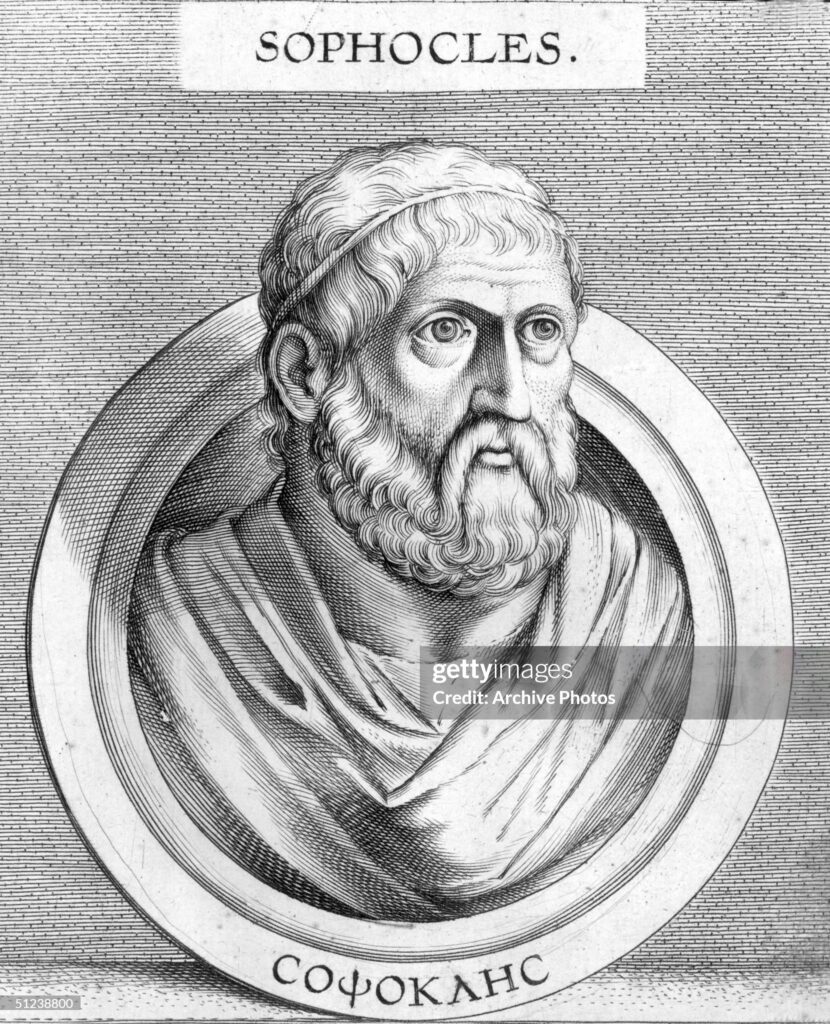
Circa 430 BC, Sophocles (c.496 BC – 406 BC). Greek tragic dramatist, general, and priest. He was the author of ‘Ajax’, ‘Antigone’, ‘Oedipus Rex’ and ‘Electra’. Original Publication: From a statue in the possession of Fulvius Ursinus. (Photo by Archive Photos/Getty Images)
Portrait in Roundel
Artist: Engraved by Paulus Pontius (Flemish, 1603–1658) after a design by Peter Paul Rubens (1577–1640).
Date: Created around 1638.
Origin: This engraving was based on antique busts known during the Renaissance and was part of a famous series of portraits of illustrious men.
University of Chicago Citation:
Bibliography: Pontius, Paulus. Sophocles. 1638. Engraving after Peter Paul Rubens. British Museum, London.
Because this is a print, several original impressions exist in major global collections:
British Museum, London (Museum No. R,4.120).
Metropolitan Museum of Art, New York (Accession No. 2012.136.459).
National Galleries of Scotland, Edinburgh (Accession No. FP I 136.1).
Yale University Art Gallery, New Haven (Accession No. 1986.2.104).
3. Provenance (History)
Source Material: The engraving is based on a drawing Rubens made “Ex marmore antiquo” (from ancient marble). Most scholars believe the original marble herm (a pillar-like bust) was part of Rubens’ own private collection of antiquities at his home in Antwerp.
The Project: This was the final series of antique portraits Rubens supervised before his death. He worked closely with four of his best engravers to ensure the prints captured the weight and texture of the original stone.
Historical Context: In the 17th century, these prints were highly sought after by scholars and collectors who used them to decorate their private libraries, following the Roman tradition of surrounding oneself with the “great spirits” of the past.
4. Correct Citation (Chicago Style)
For academic or formal use, you should cite it as follows:
Bibliography: Pontius, Paulus. Sophocles (Sophili F. Atheniensis). 1638. Engraving after a drawing by Peter Paul Rubens. From the series Twelve Famous Greek and Roman Men. British Museum, London.
Footnote/Endnote:
Paulus Pontius, Sophocles (Sophili F. Atheniensis), 1638, engraving after Peter Paul Rubens, British Museum,London.
Note on the Inscription: If you look at the bottom of the original print, you will see the Latin text: “P.P. Rubens delin. / P. Pontius sculpsit,” which translates to “P.P. Rubens drew it / P. Pontius engraved it.” It also carries a “privilege” (an early form of copyright) from the King of France and the Princes of the Netherlands.
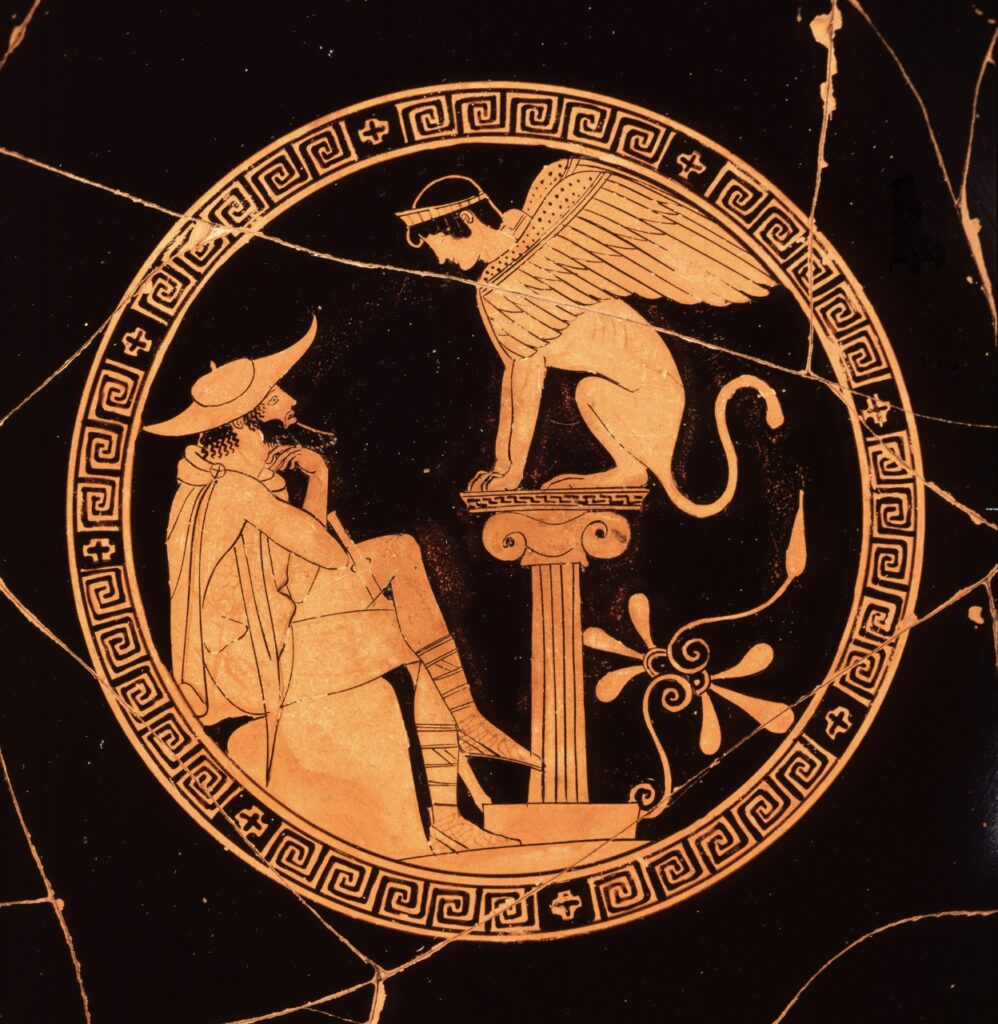
Identification & Museum
Object: Attic Red-figure Kylix (cup).
Subject: Oedipus and the Sphinx. It depicts the hero Oedipus (the subject of Sophocles’ most famous tragedy) solving the riddle of the Sphinx.
Current Location: Vatican Museums (Museo Gregoriano Etrusco), Vatican City.
Inventory Number: 16541 (formerly H 545).
Material: Terracotta (clay) decorated in the red-figure technique.
Artist & Date
Artist: Attributed to the Oedipus Painter (an anonymous Attic vase painter named after this masterpiece).
Date: Created circa 480–470 BCE (the early Classical period).
3. Provenance (History)
Discovery: Found in 1813 in an Etruscan tomb at Vulci, Italy. Vulci was a major site where high-quality Athenian pottery was imported and buried with local elites.
Acquisition: It became part of the Vatican’s collection in the early 19th century as the papacy began formally cataloging and preserving Etruscan and Greek finds from its territories.
4. Archaeological & University of Chicago Citations
In an archaeological or academic context, you should cite it as follows:
Archaeology Citation (Beazley Archive): Vatican, Museo Gregoriano Etrusco 16541. Beazley Archive Pottery Database (BAPD) No. 205184.
Chicago Style Citation: Bibliography: Oedipus Painter. Attic Red-figure Kylix: Oedipus and the Sphinx. c. 480–470 BCE. Terracotta. Vatican Museums, Vatican City. Inv. 16541.
Note:
Oedipus Painter, Attic Red-figure Kylix: Oedipus and the Sphinx, c. 480–470 BCE, terracotta, Vatican Museums, Vatican City.
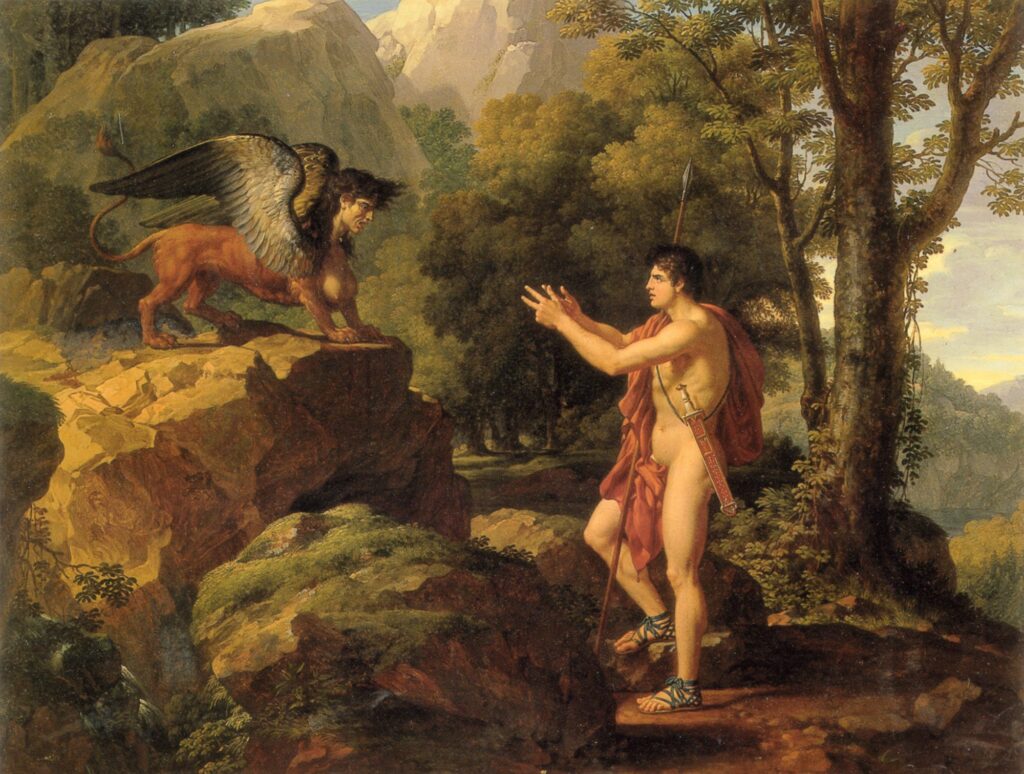
Artist: François-Xavier Fabre (French, 1766–1837).
Title: Oedipus and the Sphinx (Oedipe et le Sphinx).
Date: Created ca. 1806–1808 (sometimes cited up to 1810).
Medium: Oil on canvas.
Dimensions: 50.2 x 66 cm (19 3/4 x 26 in).
Provenance & History
The painting was created while Fabre was living in Italy, having been a pupil of the famous Neoclassical master Jacques-Louis David.
Alterations: At some point in its history, a previous owner found the “gruesome” details of the Sphinx’s victims—specifically a human skull and parts of a skeleton behind the creature—distressing and had them painted over. These details were only rediscovered and restored during a surface cleaning in the late 20th or early 21st century.
Acquisition: The work was acquired by its current institution in 2001.
Current Location
The painting is currently held by the Dahesh Museum of Art in New York City, USA (Accession Number: 2001.3).
Fabre, François-Xavier. Oedipus and the Sphinx. Ca. 1806–1810. Oil on canvas. Dahesh Museum of Art, New York.
https://daheshmuseum.org/portfolio/francois-xavier-fabreoedipus-and-the-sphinx/
Accession Number: 2001.3
WorldCat Link (To find in a library near you): Search WorldCat for ISBN: 0965479387
For a comprehensive study of Fabre’s career and this specific painting’s place in his oeuvre, this is the standard reference used by art historians.
Citation: Bordas, Jean-Luc. François-Xavier Fabre (1766–1837): Peintre d’histoire. Paris: Arthena, 2000.
WorldCat Link: Search WorldCat for ISBN: 2903239268
the following texts provide the “primary” academic framework for the Davidian school in Rome (where this was painted). You can search these on JSTOR or Google Scholar for full-text access:
Picon, Gaëtan. Ingres. Geneva: Skira, 1967. (Discusses the academic environment in Rome ca. 1808 where both Fabre and Ingres painted this subject).
Rosenblum, Robert. “The International Style of 1800.” In Transformations in Late Eighteenth Century Art. Princeton University Press, 1967. [suspicious link removed]
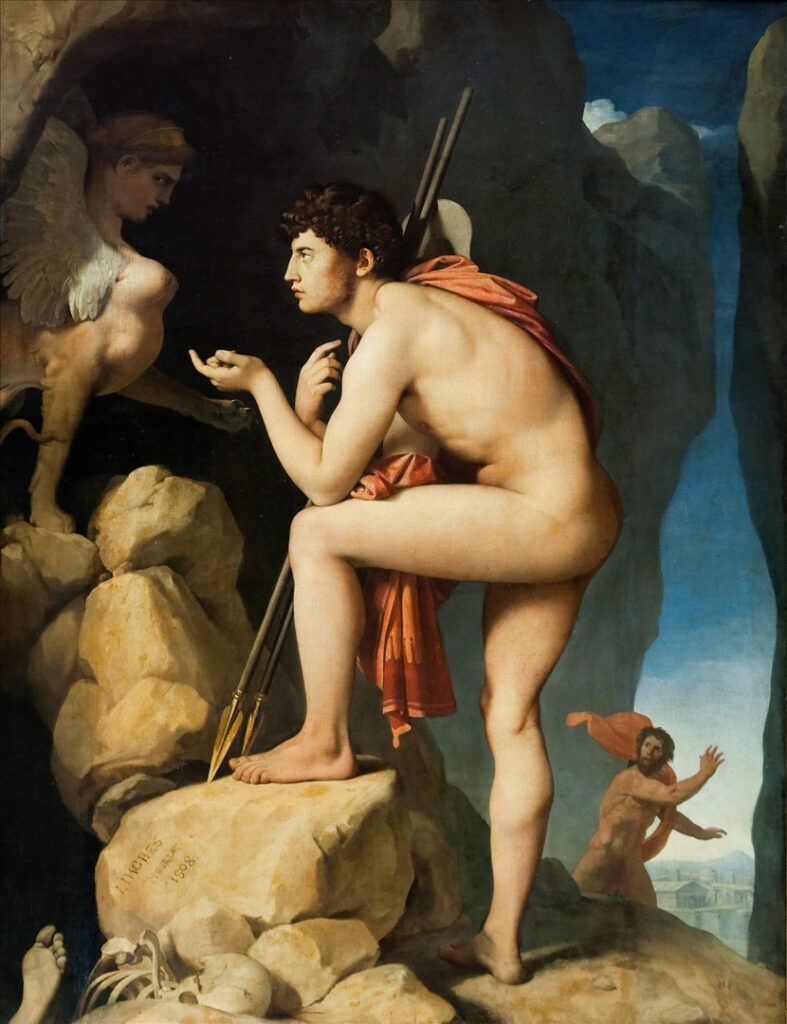
“Oedipus and the Sphinx” by the French Neoclassical master Jean-Auguste-Dominique Ingres.
The image you provided corresponds to the original, large-scale version held by the Louvre Museum (completed 1827).
Current Location: Musée du Louvre, Paris (Accession No. RF 218).
Provenance (Louvre Version): * 1808: Originally painted as a student “envoi” (figure study) while Ingres was at the Villa Medici in Rome.
1825–1827: Ingres reworked and enlarged the canvas to transform it into a narrative history painting.
1829: Sold by the artist to a private collector.
1878: Acquired by the Louvre Museum.
Note: There is a smaller, reversed version (1864) located at the Walters Art Museum in Baltimore, and a small oil sketch (c. 1826) at the National Gallery in London.
🎓 University of Chicago Citation
To cite this artwork in the Chicago Manual of Style (17th ed.) format:
Bibliography:
Ingres, Jean-Auguste-Dominique. Oedipus and the Sphinx. 1808–1827. Oil on canvas. Musée du Louvre, Paris.
Footnote/Endnote:
Jean-Auguste-Dominique Ingres, Oedipus and the Sphinx, 1808–1827, oil on canvas, Musée du Louvre, Paris.
🌐 Primary Websites
For high-resolution images and official museum data, visit:
Musée du Louvre – Official Collection Database: The definitive source for the primary version.
The Walters Art Museum: Documentation for the 1864 Baltimore version.
The National Gallery, London: Information on the compositional sketch.
King, Edward S. “Ingres as classicist.” The Journal of the Walters Art Gallery (1942): 68-113.
Leonard, Miriam. “Freud between Oedipus and the Sphinx.” Arion: A Journal of the Humanities and the Classics 28, no. 3 (2020): 131-155.
Condon, Patricia, Marjorie B. Cohn, Agnes Mongan, and Debra Edelstein. Ingres: in pursuit of perfection: the art of J.-A.-D. Ingres. 1983.
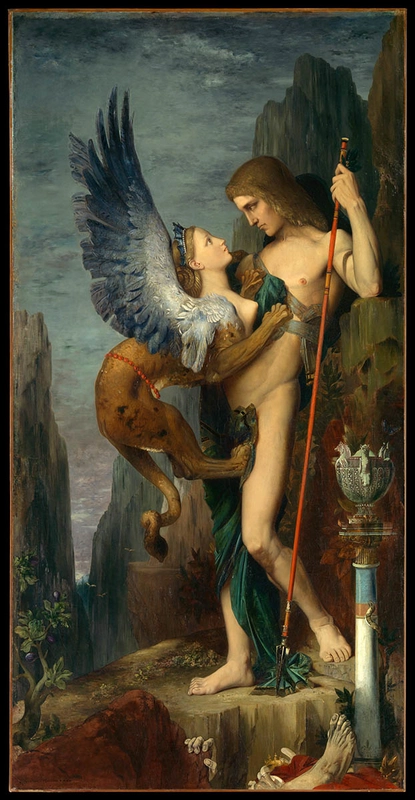
Artist: Gustave Moreau (French, 1826–1898)
Date: 1864
Medium: Oil on canvas
Repository: The Metropolitan Museum of Art, New York
Provenance (History of Ownership)
The painting has a distinguished and relatively short chain of ownership before entering the museum’s permanent collection:
The Artist: Gustave Moreau (1864).
Prince Napoléon (Jérôme Napoléon Bonaparte): Purchased directly from the artist for 8,000 francs following its success at the 1864 Salon.
Paul Durand-Ruel, Paris: The famous Impressionist dealer acquired it in 1868.
William H. Herriman, Rome: Purchased from Durand-Ruel in 1868.
The Metropolitan Museum of Art: Received as a bequest from William H. Herriman in 1920.
Interrogating Gustave Moreau’s Sphinx: Myth as Artistic Metaphor in the 1864 Salon
Cooke, Peter. “Gustave Moreau: history painting, spirituality and symbolism.” (2014).