
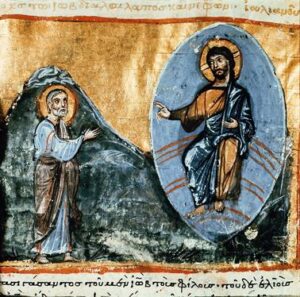
Book of Job
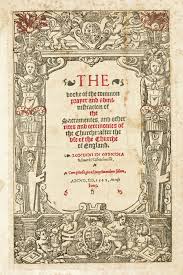
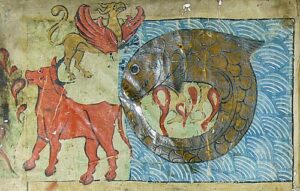
Job 41:1 (The Capture) The Great Bible (1539): “Canst thou drawe out Leuyathan with an angle? or bynde hys tonge with a snare?” The Book of Common Prayer (1604): “Canst
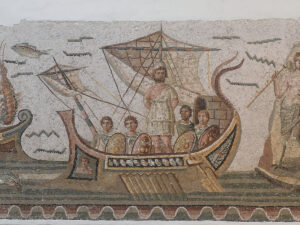
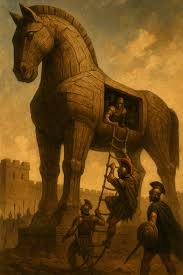
Homer the Illiad
“Let me not then die ingloriously and without a struggle, but let me first do some great thing that shall be told among men hereafter.”
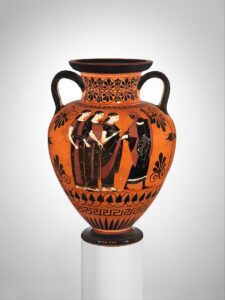
Hesiod Works and Days
“Do not put your work off till to-morrow and the day after; for a sluggish worker does not fill his barn, nor one who puts off his work: industry makes
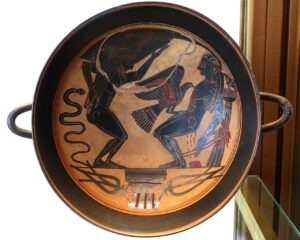
Hesiod Theogony
“We know how to speak many false things that resemble the truth, but we also know, when we are willing, how to proclaim true things.”
Psalter or the book of Psalms
There goe the ships; there is that Leuiathan, whom thou hast made to play therein.

Aeschylus The Suppliants
on earth a godhost gives
order to nature
Which god should I cry to?
Whose acts will answer me?

Aeschylus The Persians
Of all the Persians those in their strong prime, Highest of heart, noblest of lineage, Faithfullest servants of our lord the king, Lie dead in shamed dishonourable graves.
Aeschylus Seven Against Thebes
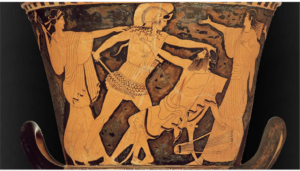
The air, hurtling with spears, maddens withal. How goes it with our city? What is to be? Whither and what the issue that Heaven brings on ?
Aeschylus Agamemnon
“The house reeks of blood-dripping slaughter… the breath of the tomb is in my nostrils.” (Lines 1309–1311)
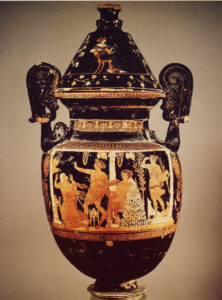
Aeschylus Libation Bearers
“What then becomes of the oracles of Loxias… and the sworn pledges? Count all men your enemies rather than the gods.” (Lines 900–902)
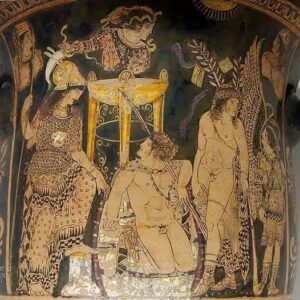
Aeschylus Eumenides
“Hear my decree now, people of Attica—you who are judging the first trial of bloodshed. For the people of Aegeus, this council of judges shall stand forever.” (Lines 681–684)
Aeschylus Prometheus Bound
I track Home to its hidden spring the flowing of fire, By stealth infringe it, drawing what doth charge A reed: the thing, reveal’d to man, is mighty, Teacher of every art, the main of life,
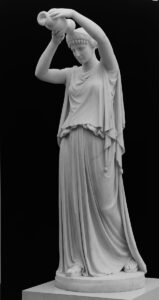
Sophocles Antigone
“What law of the mighty gods have I transgressed? Why look to the heavens any more, tormented as I am? Whom to call, what allies? Devout as I am, they call me impious—and so for my piety, I am destroyed.” — Translated by Robert Fagles
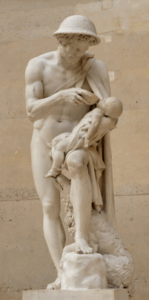
Sophocles Oedipus Rex
“O god—it has all come true. Light, let me look on you for the last time!”
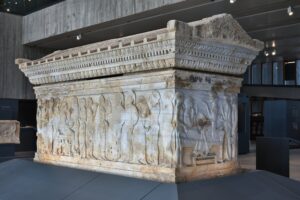
Euripides Hecuba
“O light of day! O shadows of the night! Why do I linger here, a slave, who once was Queen of Troy?”
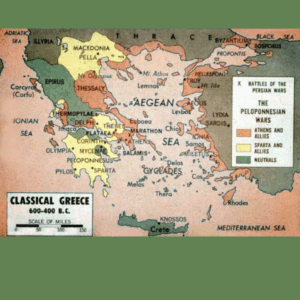
Thucydides, The Peloponnesian War
…since you know as well as we do that right, as the world goes, is only in question between equals in power, while the strong do what the can and the weak suffer what they must. 5.84 – 5.116 pp. 350-357
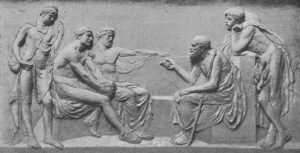
Plato, Apology
Now, the hour to part has come. I go to die, you go to live. Which of use goes to the better lot is known to no one, except the god.
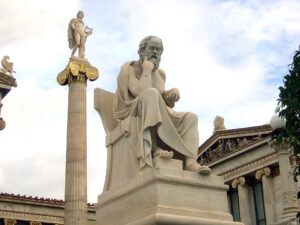
Plato, Euthyphro
Euthyphro: I don’t know him, Socrates. What charge does he bring against you?
Socrates: What charge? A not ignoble one I think, for it is no small thing for a young man to have knowledge of such an important subject. He says he knows how our young men are corrupted and who corrupts them.
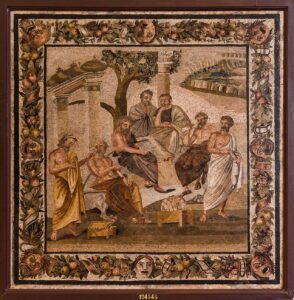
Plato, Crito
Socrates: And that the good life, the beautiful life, and the just life are the same; does that still hold, or not? p.129
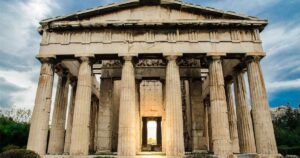
Plato, Gorgias
Polus: Very well, I shall. Tell me, Socrates, since you think Gorgias is confused about oratory, what do you say it is?
Socrates: Are you asking me what craft I say it is?
Polus: Yes, I am.
Socrates: To tell you the truth, Polus, I dont think it’s a craft at all.
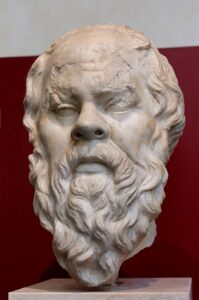
Plato, Meno
Can you tell me, Socrates, can virtue be taught? Or is not teachable but the result of practice, or is it neither of these, but men possess it by nature or in some other way?
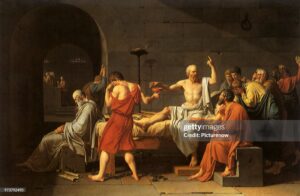
Plato, Phaedo
This way, he said. We surely agree that is anyone recollects anything, he must have known it before?
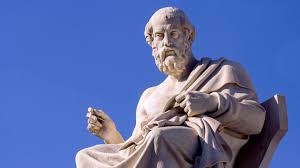
Plato The Republic
The next step, apparently, is for us to try to discover, and point out, what the failings are in cities nowadays, which stop them being run in this way, and what is the minimum change which could help a city arrive at political arrangements of this kind. Ideally a single change. Failing that, two. And failing that, as few as possible in number and as small as possible in impact. 472b p.175
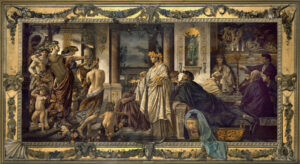
Plato, Symposium
My dear Socrates, that, then, is the nature of the Spirit called Love.
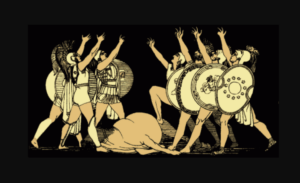
Euripides Phoenician Women
“Equality is what is natural for mankind. The more and the less are always at enmity with one another and begin the day of hatred. It is Equality that established for mankind measures and divisions of weights and defined number. The sightless eye of night and the light of the sun walk the year’s circle on equal terms, and neither of them is envious when it is defeated.” (Lines 538–545)
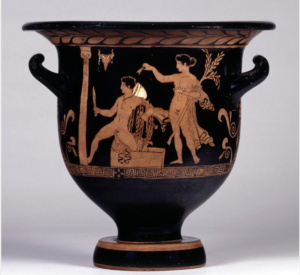
Euripides Oretes
When one with honeyed words but evil min Persuades the mob, great woes befall the state.
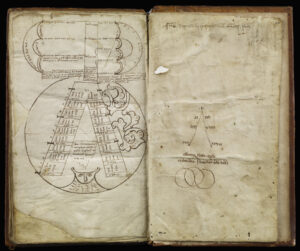
Plato, Timaeus
We may now say that our discourse about the nature of the universe has an end. The world has received animals, mortal and immortal, and is fulfilled with them, and has become a visible animal containing the visible–the sensible God who is the image of the intellectual, the greatest, best, fairest, most perfect–the one only begotten heaven.
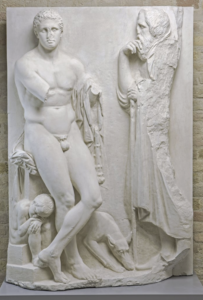
Plato’s Laws
Athenian Stranger. Tell me, Strangers, is a God or some man supposed to be the author of your laws?
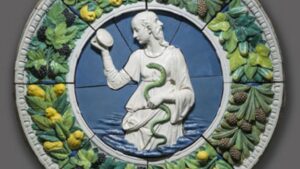
Aristotle Logic the Organon
We suppose ourselves to possess unqualified scientific knowledge of a thing, as opposed to knowing it in the accidental way of the sophist, when we think that we know the cause on which the fact depends, as teh cause of that fact and of no other, and, further, that the fact could not be other than is is.
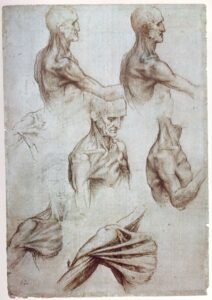
Aristotle Physical and Scientific Works
Nature is a source or cause of being moved and of being at rest in that to which it belongs primarily.
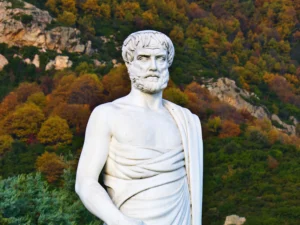
Aristotle, Etique a Eudeme
Telle est donc la règle la meilleure, et tel est le critère le plus beau pour les biens extérieurs : qu’on soit empêché le moins possible par eux de servir et de contempler Dieu.
This, therefore, is the end and the best limit regarding external things, so that the soul may be hindered as little as possible from the contemplation of God and His worship.
Hic igitur finis sit et optimus terminus ad res externas respicienti, ut quam minime impediatur anima a contemplatione dei et cultu eius
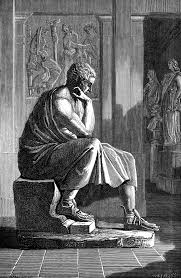
Aristotle Nicomachean Ethics
Thus the virtues arise in us neither by nature nor against nature. Rather we are by nature able to acquire them, and reach our complete perfection through habit. p.673
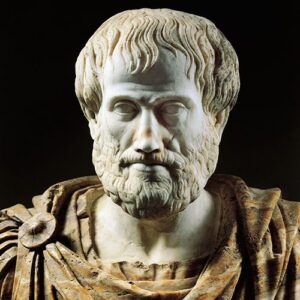
Aristotle, The Politics and the Constitution of Athens
And therefore, if the earlier forms of society are natural, so is the state, for it is the end of them, and the nature of a thing is its end. For what each thing is when fully developed, we call its nature, whether we are speaking of a man, a horse, or a family. Besides, the final cause and end of a thing is the best, and to be self-sufficing is the end and the best. Hence it is evident that the state is a creation of nature, and that man is by nature a political animal. (1252b30 – 1253a3)
Aristotle Other Ethical and Rhetorical Works
Character may almost be called the most effective means of persuasion.
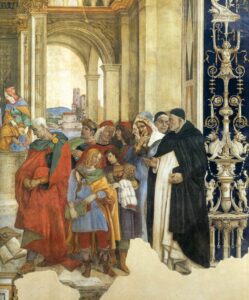
Aristotle Metaphysics
For it is owing to their wonder that men both now begin and at first began to philosophize.
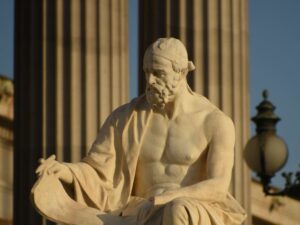
Polybius, Histories
For it is only by observing how each of these constitutions comes into being that one can see when, how, and where the growth, the perfection, the change and the end of each is likely to recur. I believe that the Roman constitution is a better subject than any other for this method of analysis, because its origin and growth have from the very beginning followed natural causes.
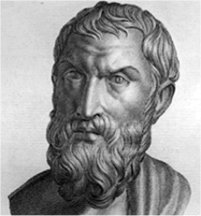
Lucretius On the Nature of the Universe
Next, I maintain that mind and spirit are interconnected and compose between them a single substance. But what I may call the head and the dominant force in the whole body is that guiding principle which we term mind or intellect. This is firmly lodge in the mid-region of the breast. Here is the place where fear and alarm pulsate. He is felt the caressing touch of joy. Here, then, is the seat of intellect and mind. The rest of the vital sprit, diffused throughout the body, obeys the mind and moves under its direction and impulse. The mind by itself experiences thought and joy of its own at a time when nothing moves either the body or the spirit. p.70
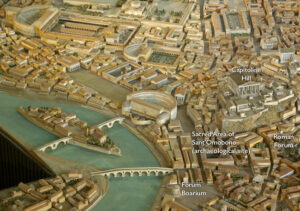
Cicero On the Commonwealth and On the Laws
At this point you will see the political circle turning; you should learn to recognize its natural motion and circuit from the very beginning. This is the essential element of civic prudence (the topic of our entire discussion); to see the paths and turns of commonwealths, so that when you know in what direction any action tends, you can hold it back or anticipate it. Book 2 p.47
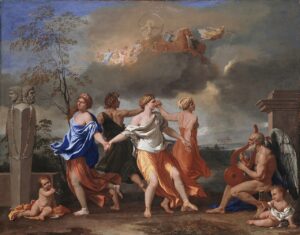
Cicero On the Ends of Good and Evil
“For if the whole of a man’s life is to be measured by the standard of pleasure, you see how much trouble is in store for us. We must consider not what is pleasant, but what is consistent with the dignity of human nature; for there is a certain dignity in man, which the beasts do not share. If we lose sight of this, we shall be unable to maintain any standard of conduct.” (Cicero, De Finibus 2.44).
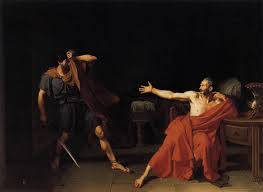
Cicero Tusculan Disputations
“But what is this ‘bearing’? It is the same as the endurance of labor… we must then apply to the soul that which is called fortitude, which consists of two parts, the contempt of pain and the contempt of death. To these we must bring a certain alertness of mind, so that we may not only not fear, but even despise them.” (Cicero, Tusculan Disputations 2.53).
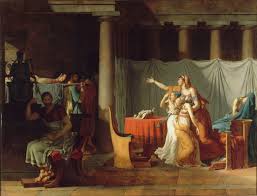
Cicero On Duties
“But when with a rational spirit you have surveyed the whole field, there is no social relation among them all more close and none more dear than that which links each one of us with our country. Parents are dear; children, relatives, friends are dear; but our country has on its own embraced all the affections of all of us together; for which what good man would hesitate to face death, if he could do her a service?” (Cicero, De Officiis 1.57).
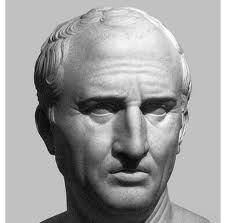
Sallust, Conspiracy of Catiline
Since the occasion has thus brought public morals under my notice, the subject itself seems to call upon me to look back, and briefly to describe the conduct of our ancestors in peace and war; how they managed the state, and how powerful they left it; and how, by gradual alteration, it became, from being the most virtuous, the most vicious and depraved.
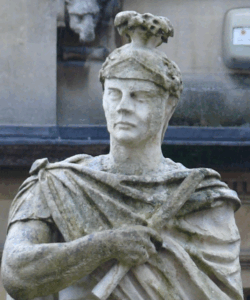
Tacitus, Agricola
…”he had the rare faculty of being familiar without weakening his authority and austere without forfeiting people’s affection.” p. 59
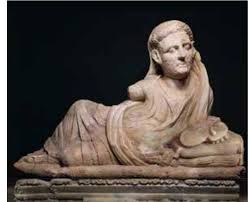
Ovid Metamorphoses
“Whether the creator god, source of a better world, seeded it from the divine, or the newborn earth just drawn from the highest heavens still contained fragments related to the skies, so that Prometheus, blending them with streams of rain, moulded them into an image of the all-controlling gods. While other animals look downwards at the ground, he gave human beings an upturned aspect, commanding them to look towards the skies, and, upright, raise their face to the stars.”
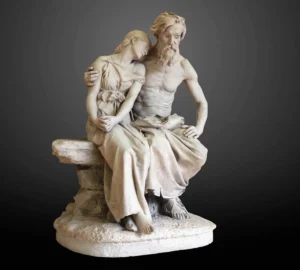
Sophocles Oedipus at Colonus
“Now let the weeping cease; let no one mourn again. These things are bound in fate.”
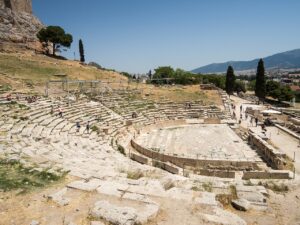
Aristotle On Poetics
For tragedy is an imitation, not of human beings, but of actions and of life.
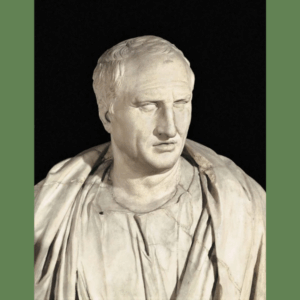
Cicero, In Catilium
When, O Catiline, do you mean to cease abusing our patience? How long is that madness of yours still to mock us? When is there to be an end of that unbridled audacity of yours, swaggering about as it does now? Do not the nightly guards placed on the Palatine Hill—do not the watches posted throughout the city—does not the alarm of the people, and the union of all good men—does not the precaution taken of assembling the senate in this most defensible place—do not the looks and countenances of this venerable body here present, have any effect upon you? Do you not feel that your plans are detected? Do you not see that your conspiracy is already arrested and rendered powerless by the knowledge which every one here possesses of it? What is there that you did last night, what the night before— where is it that you were—who was there that you summoned to meet you—what design was there which was adopted by you, with which you think that any one of us is unacquainted? [2]
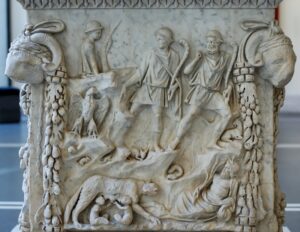
Livy, Histories of Rome
The subjects to which I would ask each of my readers to devote his earnest attention are these-the life and morals of the community; the men and the qualities by which through domestic policy and foreign war dominion was won and extended. Then as the standard of morality gradually lowers, let him follow the decay of the national character, observing how at first it slowly sinks, then slips downward more and more rapidly, and finally begins to plunge into headlong ruin, until he reaches these days, in which we can bear neither our diseases nor their remedies.
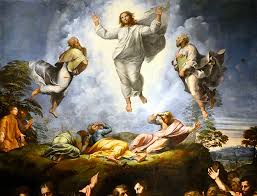
Book of Mark
2 And after six days Jesus took with him Peter and James and John, and led them up a high mountain by themselves. And he was transfigured before them, 3 and his clothes became radiant, intensely
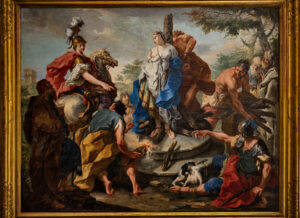
Book of Matthew
28 When Jesus finished speaking, the crowds were surprised at his teaching. 29 He taught them like someone with authority, and not like their teachers of the Law of Moses. Why would a
Book of Luke
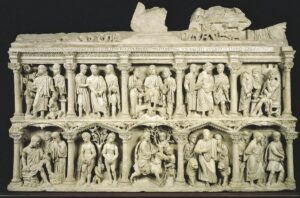
Here in the Gospel of Luke we get the visual of Jesus’ entry into Jerusalem on a donkey, the low being made high. Or the high being made low.
Augustine The Happy Life
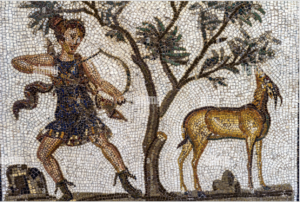
“The happy life is nothing else than perfect knowledge of God. This is the ultimate perfection of the soul, the highest joy, and the only true peace.”
Augustine On Order
“The beauty of the whole is composed of parts, and in this divine arrangement, there is nothing that is not in its own way beautiful, even if it appears otherwise to the limited perception of the observer.” (De ordine, 2.19.50)

Augustine Soliloquies
“Do not go abroad. Return within yourself. In the inward man dwells truth.” (Soliloquia, 1.1.2)
Augustine The Immortality of the Soul
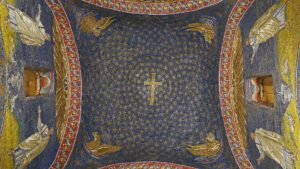
“The truth is eternal; and because the soul is capable of apprehending eternal truth, it must possess a nature that is not confined by the limits of time and physical dissolution.” (De immortalitate animae, 12.19)
Augustine The Magnitude of the Soul
“Do not go outside yourself; return into yourself. Truth dwells in the inner man, and if you find your own nature to be mutable, transcend even yourself.” (De quantitate animae, 33.72)
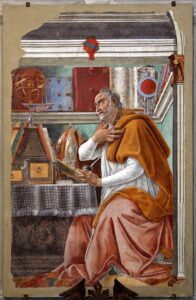
Augustine The Free Choice of the Will
“Evil is not a substance, but a perversion of the will which turns away from the higher things to the lower.” (De libero arbitrio, 2.19)
Book of John
1 In the beginning was the Word, and the Word was with God, and the Word was God. 2 He was in the beginning with God. 3 All things came into being through him, and without him not one thing came into being. What has come into being 4 in him was life,[a] and the life was the light of all people. 5 The light shines in the darkness, and the darkness did not overtake it.
Augustine The City of God
“Two loves have built two cities: the love of self, even to the contempt of God, the earthly city; and the love of God, even to the contempt of self, the heavenly city.” (De civitate Dei, 14.28)
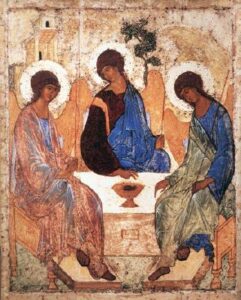
Augustine On the Trinity
“Because the Trinity is ineffable, it is more true to say what it is not than what it is; for our words are but mirrors that break the light of the divine essence into fragments.” (De Trinitate, 5.1.1)
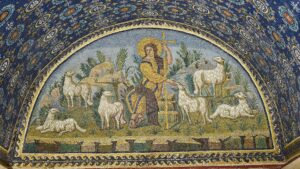
Augustine On the Christian Doctrine
“Anyone who thinks that he understands the divine scriptures or any part of them, but cannot by his understanding build up the double love of God and neighbour, has not yet understood them as he ought.” (De doctrina christiana, 1.36.40)
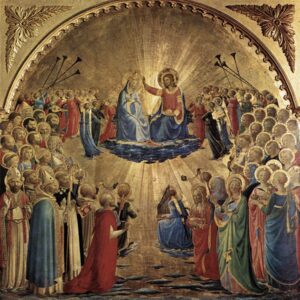
Aquinas On the Principles of Nature
“In order that there be generation three things are required: being in potency which is matter, non-existence in act which is privation, and that through which something comes to be in act which is form.” (Aquinas, c. 1255/1952)
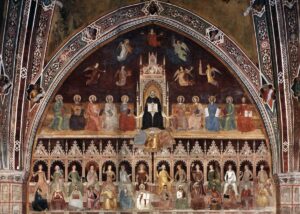
Aquinas On Being and Essence
“Therefore, essence is what is signified by the definition of a thing. But it is clear that for all things whose essence is distinct from their existence, their existence must be caused by something else. For nothing can be the cause of its own existence, if existence is something caused, since then it would exist before it had existence, which is impossible.”
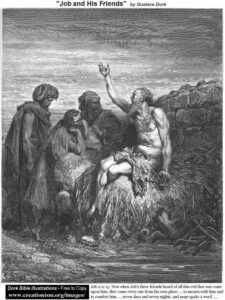
Aquinas Literal Commentary on Job
“Human knowledge, even at its peak, is like a shadow when compared to the light of the divine essence. We struggle to understand the order of the universe, and we are often baffled by the complexities of providence because we see only a fragment of the whole.”
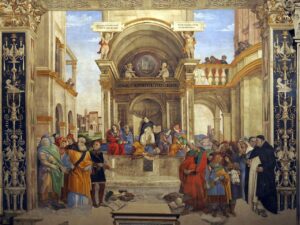
Aquinas Summa Contra Gentiles
“For there are some who have such a presumptuous opinion of their own ability that they deem themselves able to measure the nature of everything; I mean to say that, in their estimation, everything is true that seems to them so, and everything is false that does not. So that the human mind, therefore, might be freed from this presumption and come to a humble inquiry after truth, it was necessary that some things should be proposed to man by God that would completely surpass his intellect.”
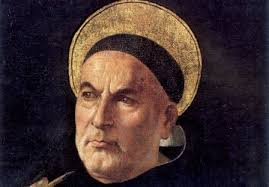
St. Thomas Aquinas, On Kingship
Now the end which befits a multitude of free men is different from that which befits a multitude of slaves, for the free man is one who exists for his own sake, while the slave, as such, exists for the sake of another. If, therefore, a multitude of free men is ordered by the ruler towards the common good of the multitude, that rulership will be right and just, as is suitable to free men. If, on the other hand, a rulership aims, not at the common good of the multitude, but at the private good of the ruler, it will be an unjust and perverted rulership.
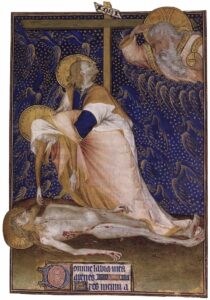
Aquinas On the Eternity of the World
“Whatever is made by God must be made from something or from nothing. If it is made from nothing, it is created. If it is created, it begins to be. But if it is made from something, it is generated. The question is whether it is possible for a thing to be created and yet not have a beginning in time.”
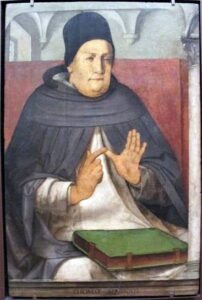
Aquinas Disputed Questions
“Truth is the equation of thing and intellect.” (De veritate, q. 1, a. 1)
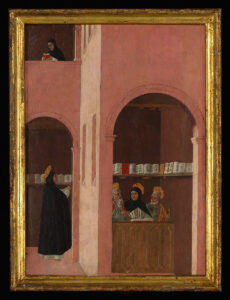
Aquinas Commentaries on Artistotle
“The aim of the philosopher is to attain to the truth of things, not merely to the opinions of others.” (Commentary on the Metaphysics, Introduction)
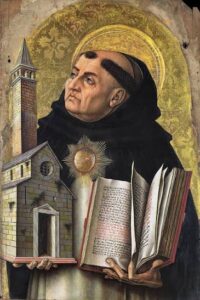
Aquinas Commentaries on the New Testament
“The Word was made flesh that He might make us gods; He became visible in the flesh that He might draw our minds to the invisible God.” (Aquinas, Commentary on the Gospel of John)
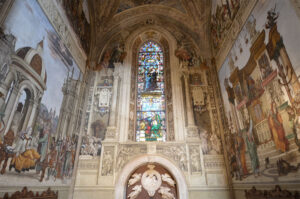
Aquinas Summa Theologiae
“Grace does not destroy nature but perfects it.” (S.Th. I, q. 1, a. 8, ad 2)
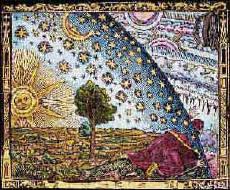
Meister Eckhart The Complete Mystical Works
Truth is not merchandise — Title of chapter 13

Machiavelli, Discourses on Livy
I then only remained to assign its place to the popular element, and the Roman nobles growing insolent from causes which shall be noticed hereafter, the commons against them, when, not to lose the whole of their power, they were forced to concede a share to the people; while with the share which remained, the senate and consults retained so much authority that they still held their own place in the republic. In this way the tribunes of the people came to be created, after whose creation the stability of the State was much augmented, since each the three forms of government had now is due influence allowed it. And such was the good fortune of Rome that although her government passed from the kings to the nobles, and from these to the people, by the steps and for the reasons noticed above, still the entire authority of the kingly element was not sacrificed to strengthen the authority of the nobles, nor were the nobles divested of their authority to bestow it on the commons; but three, blending together, made up a perfect State; which perfection, as shall be fully shown in the next two Chapters, was reached through the dissensions of the commons and the senate.
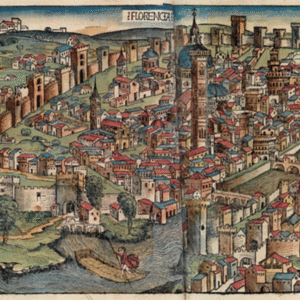
Machiavelli the Florentine Histories
Those serious, though natural enmities, which occur between the popular classes and the nobility, arising from the desire of the latter to command, and the disinclination of the former to obey, are the causes of most of the troubles which take place in cities; and from this diversity of purpose, all the other evils which disturb republics derive their origin. This kept Rome disunited; and this, if it be allowable to compare small things with great, held Florence in disunion; although in each city it produced a different result; for animosities were only beginning with the people and nobility of Rome contended, while ours were brought to a conclusion by the contentions of our citizens. A new law settled the disputes of Rome; those of Florence were only terminated by the death and banishment of many of her best people.
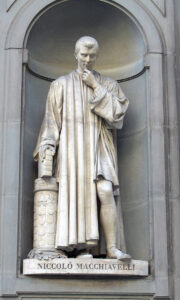
Machiavelli, The Prince
Nor do I want it to be thought presumption if a man from a low and mean state dares to discuss and give rules for the governments of princes. For just as those who sketch landscapes place themselves down int he plain to consider the nature of mountains and high places and to consider the nature of low places place themselves high atop mountains, similarly, to know well the nature of peoples one needs to be prince, and to know well the nature of princes one needs to be of the people.
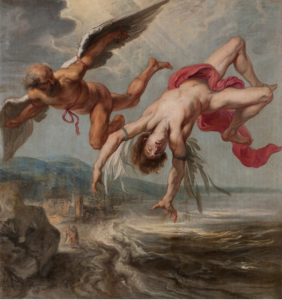
Bacon, Francis The Wisdom of the Ancients
“Mediocrity, or the middle way, is in most cases a virtue, and highly commendable; but in philosophy and the sciences it is a thing of dangerous consequence. For the path of virtue lies straight forward between two extremes; but the way of truth and knowledge lies through a narrow path, between two vast and hazardous rocks, where a man cannot deviate without falling into one or the other of them. […] Thus the mind of man, being impatient of a lingering and progressive inquiry, is apt to take a flight, and to rise up to generalities, as it were upon the wings of Icarus; and so, by a premature and unseasonable flight, falls headlong into errors and false conclusions.” (407–408)

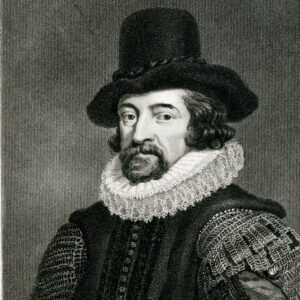
Francis Bacon Novum Organum
LXXXV. Nor is it only the admiration of antiquity, authority, and unanimity, that has forced man’s industry to rest satisfied with present discoveries, but, also, the admiration of the effects already placed within his power. For[63] whoever passes in review the variety of subjects, and the beautiful apparatus collected and introduced by the mechanical arts for the service of mankind, will certainly be rather inclined to admire our wealth than to perceive our poverty: not considering that the observations of man and operations of nature (which are the souls and first movers of that variety) are few, and not of deep research; the rest must be attributed merely to man’s patience, and the delicate and well-regulated motion of the hand or of instruments. To take an instance, the manufacture of clocks is delicate and accurate, and appears to imitate the heavenly bodies in its wheels, and the pulse of animals in its regular oscillation, yet it only depends upon one or two axioms of nature.
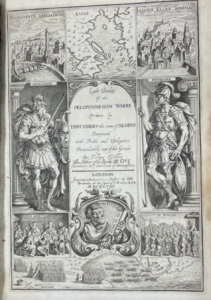
Hobbes Eight Bookes of the Peloponnesian Warre
Moreover, the penning up of the inhabitants of the country into the city was a great grievance to them; and especially to the new comers. For having no houses, but dwelling at that time of the year in stifling booths, the mortality was now without all form, and dead bodies lay inside one upon another, both in the streets and about every conduit, desiring water.
> The temples also where they tented, were full of the dead bodies of them that died within them. For as the disaster passed all bounds, men, not knowing what was to become of them, became utterly careless of everything, whether sacred or profane. And all the laws which they had before used touching funerals were now broken, every one burying where he could find room. And many for want of things necessary, after so many deaths before, used shameless manner of burials. For when one had made a pile, another would come, and throwing down him that he had brought, set fire to it for himself; and some would fling the body they brought upon another that was already burning, and so go their way.
> And the great licentiousness, which also in other kinds was used in the city, began at first from this disease. For that which before any man would dissemble, and not acknowledge to be done for voluptuousness, he durst now do freely, seeing the sudden change of the rich dying, and men worth nothing inheriting their estates. So they resolved to take their present profit and pleasure, holding their lives and their wealth to be alike but for a day.
> And no man was eager to take any pains for that which was accounted honest, as being uncertain whether he should live to attain it or no. But whatsoever was delectable for the present, and whatsoever stood with their profit or pleasure, that was approved both for honesty and profit. Neither the fear of the gods nor the laws of men awed any man. Not the former, because they concluded that it was alike to worship or not worship, seeing all perished alike; nor the latter, because no man expected his life would last till he received punishment of his crimes by judgment. But they thought there was now over their heads some far greater judgment decreed against them, before which fell, it was reason they should enjoy some little part of their lives.”
Hobbes De Cive
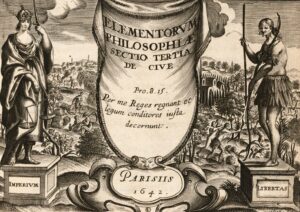
I. The faculties of Humane nature may be reduc’d unto four kinds; Bodily strength, Experience, Reason, Passion. Taking the beginning of this following Doctrine from these, we will declare in the first place what manner of inclinations men who are endued with these faculties bare towards each other, and whether, and by what faculty, they are born apt for Society, and so preserve themselves against mutuall violence; then proceeding, we will shew what advice was necessary to be taken for this businesse, and what are the conditions of Society, or of Humane Peace; that is to say, (changing the words onely) what are the fundamentall Lawes of Nature.
Hobbes Leviathan
Nature (the Art whereby God hath made and governes the World) is by the Art of man, as in many other things, so in this also imitated, that it can make an Artificial Animal. For seeing life is but a motion of Limbs, the beginning whereof is in some principall part within, why may we not say, that all Automata (Engines that move themselves by springs and wheeles as doth a watch) have an artificiall life? For what is the Heart, but a Spring; and the Nerves, but so many Strings; and the Joynts, but so many Wheeles, giving motion to the whole Body, such as was intended by the Artificer? Art goes yet further, imitating that Rationall and most excellent worke of Nature, Man. For by Art is created that great Leviathan called a Common-wealth, or State, (in latine Civitas) which is but an Artificiall Man; though of greater stature and strength than the Naturall, for whose protection and defence it was intended; and in which, the Soveraignty is an Artificiall Soul, as giving life and motion to the whole body…. p.9
John Milton Paradise Lost
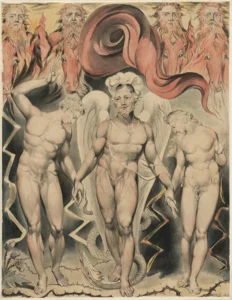
Dove-like satst brooding on the vast Abyss [21] And mad’st it pregnant: What in me is dark Illumine, what is low raise and support; That to the highth of this great Argument I may assert Eternal Providence, [25] And justifie the wayes of God to men. [26]
Spinoza Theological-Political Treatise
However, we have shown already (Chapter XVII) that no man’s mind can possibly lie wholly at the disposition of another, for no one can willingly transfer his natural right of free reason and judgment, or be compelled so to do. For this reason government which attempts to control minds is accounted tyrannical, and it is considered as abuse of sovereignty and a usurpation of the rights of subjects, to seek to prescribe what shall be accepted as true, or rejected as false, or what opinions should actuate men in their worship of God. All these questions fall within a man’s natural right, which he cannot abdicate even with his own consent.
Hobbes trans. Homer’s Odysses
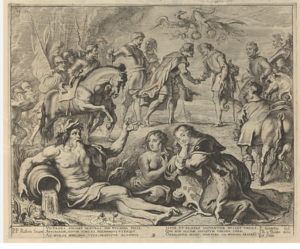
“And Argos, which lay there, pricked up his ear,
And wagged his tail, but could not rise, for he
Was very old, and knew his master near,
Who, unseen, wiped a tear from his own eye.”
(Book 17, lines 282–285)
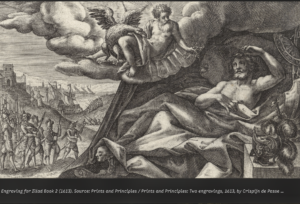
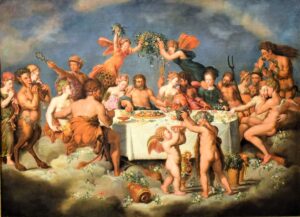
Hobbes trans. Homer’s Illiads in English
“Sleeps the wise son of Atreus? It is wrong
For him to sleep a whole night out, to whom
The care of such a people doth belong,
And has to do so many things to come.
Now listen to me, I from Jove am sent,
Who though he be far off, yet cares for you;
He bids you arm the Greeks, and out of hand
Bring down your forces to the Trojan field.”
Spinoza Ethics
Proof.—A free man is one who lives under the guidance of reason, who is not led by fear (IV. lxiii.), but who directly desires that which is good (IV. lxiii. Coroll.), in other words (IV. xxiv.), who strives to act, to live, and to preserve his being on the basis of seeking his own true advantage; wherefore such an one thinks of nothing less than of death, but his wisdom is a meditation of life. Q.E.D.
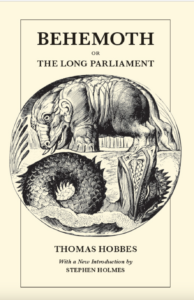
Hobbes Beheamoth
Thirdly, there were not a few, who in the beginning of the troubles were not discoered, but shortly after declared themselves for a liverty in religion, and those of different opinions one from another. Some of them, because they would have all congregations free and independent upon one another, were called Independents. Others that held that basptism to infants, and such as understood not into what theya re baptized, to be ineffectual, were called therefore Anabaptists. Others that held that Christ’s kingdom was at this time to begin upon the earth, were called Fifth-monarchy-men; besides divers other sects, as Quakers, Adamites, &c., whose names and peculiar doctrines I do not well remember. And these were the enemies which arose against his Maject from the private interpretation of the Scripture, exposed to every man’s scanning in his mother-tongue.
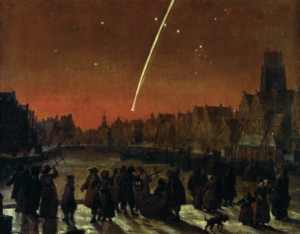
Bayle, Pierre. Various Thoughts on the Occasion of a Comet
Bayle, Pierre. Various Thoughts on the Occasion of a Comet. N.p. State University of New York Press, 2000. On the featured image The Great Comet of 1680 over Rotterdam (Dutch: Staartster (komeet) boven Rotterdam) is an oil painting by the Dutch Golden Age artist Lieve Verschuier, created in 1680 [1.1.3,
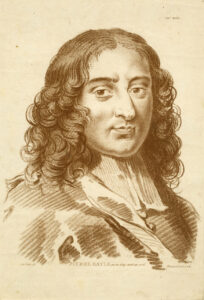
Pierre Bayle, Political Writings
He spoke out very forthrightly against those who maintained that the authority of monarchs was unlimited. He maintained that monarchs cannot impose taxes without the consent of the people, and that they are more obliged than their subject to observe the laws of God and those of nature; and that the covenants which they make impose the same obligations on themselves as on their subjects. p.23-24
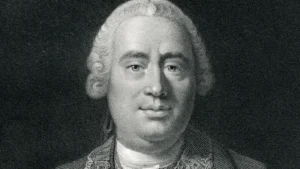
David Hume, Treatise on Human Nature
Reason is, and ought only to be the slave of the passions, and can never pretend to any other office than to serve and obey them. As this opinion may appear somewhat extraordinary, it may not be improper to confirm it by some other considerations.
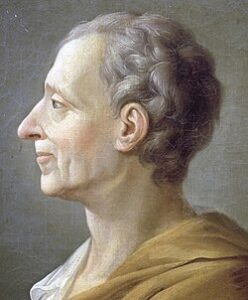
Montesquieu, The Spirit of the Laws
1. For the better understanding of the first four books of this work, it is to be observed that what I distinguish by the name of virtue, in a republic, is the love of one’s country, that is, the love of equality. it is not a moral, nor a Christian, but a political virtue; and it is the spring which sets the republican government in motion, as honour is the spring which gives motion to monarchy. Hence it is that I have distinguished the love of one’s country, and of equality, by the appellation of political virtue.

J.J. Rousseau Discourse on the Sciences and the Arts
But so long as power alone is on one side, and knowledge and understanding alone on the other, the learned will seldom make great objects their study, princes will still more rarely do great actions, and the peoples will continue to be, as they are, mean, corrupt and miserable.
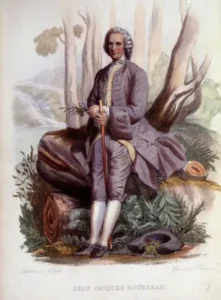
J.J. Rousseau Discourse on the Origin of Inequality
Knowing so little of nature, and agreeing so ill about the meaning of the word law, it would be difficult for us to fix on a good definition of natural law.
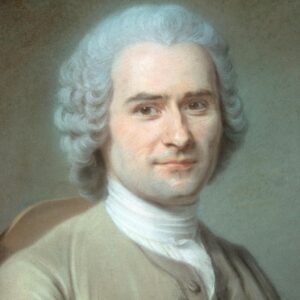
J.J. Rousseau The Social Contract
Rousseau, Jean-Jacques. Rousseau: ‘The Social Contract’ and Other Later Political Writings. United Kingdom: Cambridge University Press, 1997. You know the saying that you have to visualize something before you can make it real? Well if Helen’s face launched a thousand ships, this text inspired the French Revolution. You know you’ve struck a chord when you
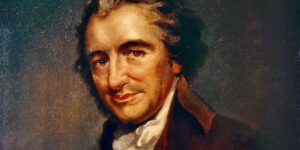
Thomas Paine Common Sense
For as in absolute governments the king is law, so in free countries the law ought to be king; and there ought to be no other. But lest any ill use should afterward arise, let the crown at the conclusion of the ceremony be demolished and scattered among the people, whose right it is. p.32
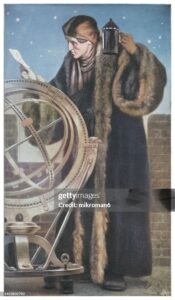
Kant Critique of Pure Reason
From the Norman Kemp-Smith Transcendental Deduction (A) p. 143 We entitle the synthesis of the manifold in imagination transcendental, if without distinction of intuitions it is directed exclusively to the a priori combination of the manifold; and the unity of this synthesis is called tanscendental, if it is represented as a priori necessary in relation to the original unity of apperception. Since this unity of apperception underlies the possibility of all knowledge, the transcental unity of the synthesis of imagination is the pure form of all possible knowledge; and by means of it all objects of possible experience must be represented a priori.
The unity of apperception in relation to the synthesis of imagination is the understanding; and this same unity, with reference to the transcendental synthesis of the imagination, the pure understanding.
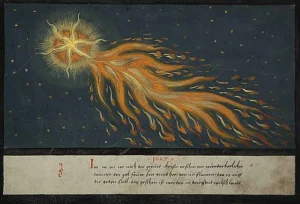
Kant Prolegomena to any Future Metaphysics
First, as concerns the sources of metaphysical cognition, its very concept implies that they cannot be empirical. Its principles (including not only its basic propositions but also its basic concepts) must never be derived from experience. It must not be physical but metaphysical knowledge, i.e., knowledge lying beyond experience. It can therefore have for its basis neither external experience, which is the source of physics proper, nor internal, which is the basis of empirical psychology. It is therefore a priori cognition, coming from pure understanding and pure reason. p.11
Kant What Is Enlightenment?
1. Enlightenment is man’s emergence from his self-imposed immaturity. Immaturity is the inability to use one’s understanding without guidance from another. This immaturity is self-imposed when its cause lies not in lack of understanding, but in lack of resolve and course to use it without buidance from another. Sapere Aude! Have courage to use your own understanding!” — that is the motto of enlightenment.
Kant Groundwork of the Metaphysics of Morals
Ancient Greek philosophy was divided into three sciences: physics, ethics, and logic. This division is perfectly suitable to the nature of the subject and there is no need to improve upon it except, perhaps, to add its principle, partly so as to insure its completeness and partly so as to be able to determine correctly the necessary subdivisions. All rational cognition is either material and concerned with some object, or formal and occupied only with the form of the understanding and of reason itself and with the universal rules of thinking in general, without distinction of objects. Formal philosophy is called logic, whereas material philosophy, which has to do with determinate objects and the laws to which they are subject, is in turn divided into two. For these laws are either laws of nature or laws of freedom. The science of the first is called physics, that of the other is ethics; the former is also called the doctrine of nature, the latter the doctrine of morals.
The Federalist Papers and the Letters of Brutus
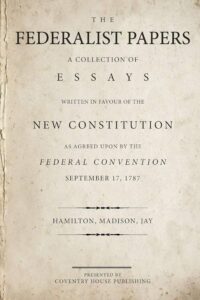
The science of politics, however, like most other sciences, has received great improvement. The efficacy of various principles is now well understood, which were either not known at all, or imperfectly known to the ancients. The regular distribution of power into distinct departments; the introduction of legislative balances and checks; the institution of courts composed of judges holding their offices during good behavior; the representation of the people in the legislature by deputies of their own election: these are wholly new discoveries, or have made their principal progress towards perfection in modern times. They are means, and powerful means, by which the excellences of republican government may be retained and its imperfections lessened or avoided.
Kant Critique of Practical Reason
Practical principles are propositions which contain a general determination of the will, having under it several practical rules. They are subjective, or maxims, when the condition is regarded by the subject as valid only for his own will, but are objective, or practical laws, when the condition is recognized as objective, that is, valid for the will of every rational being.

Kant Critique of Judgment
A singular judgement of experience, e.g., when we perceive a moveable drop of water in an ice-crystal, may justly claim that every one else should find it the same; because we have formed this judgement, according to the universal conditions of the determinant faculty of Judgement, under the laws of a possible experience in general. Just in the same34 way he who feels pleasure in the mere reflection upon the form of an object without respect to any concept, although this judgement be empirical and singular, justly claims the agreement of every one; because the ground of this pleasure is found in the universal, although subjective, condition of reflective judgements, viz., the purposive harmony of an object (whether a product of nature or of art) with the mutual relations of the cognitive faculties (the Imagination and the Understanding), a harmony which is requisite for every empirical cognition. The pleasure, therefore, in the judgement of taste is dependent on an empirical representation, and cannot be bound up a priori with any concept (we cannot determine a priori what object is or is not according to taste; that we must find out by experiment). But the pleasure is the determining ground of this judgement only because we are conscious that it rests merely on reflection and on the universal though only subjective conditions of the harmony of that reflection with the cognition of Objects in general, for which the form of the Object is purposive.
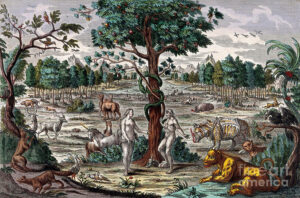
Kant Religion within the Bounds of Reason Alone
However exalted the application of our concepts, and however far up from sensibility we may abstract them, still they will always be appended to image representations, whose proper function is to make these concepts, which are not otherwise derived from experience, serviceable for experiential use.
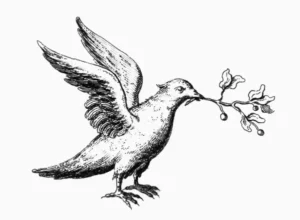
Kant Perpetual Peace
For a state is not a property (patrimonium), as may be the ground on which its people are settled. It is a society of human beings over whom no one but itself has the right to rule and to dispose. Like the trunk of a tree, it has its own roots, and to graft it on to another state is to do away with its existence as a moral person, and to make of it a thing.
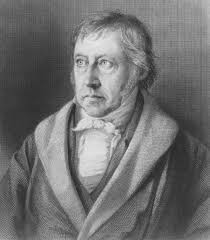
Hegel Phenomenology of Spirit
Φ 89. The experience which consciousness has concerning itself can, by its essential principle, embrace nothing less than the entire system of consciousness, the whole realm of the truth of mind, and in such wise that the moments of truth are set forth in the specific and peculiar character they here possess — i.e. not as abstract pure moments, but as they are for consciousness, or as consciousness itself appears in its relation to them, and in virtue of which they are moments of the whole, are embodiments or modes of consciousness. In pressing forward to its true form of existence, consciousness will come to a point at which it lays aside its semblance of being hampered with what is foreign to it, with what is only for it and exists as an other; it will reach a position where appearance becomes identified with essence, where, in consequence, its exposition coincides with just this very point, this very stage of the science proper of mind. And, finally, when it grasps this its own essence, it will connote the nature of absolute knowledge itself.
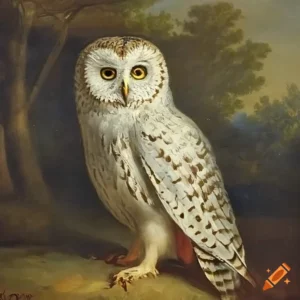
Hegel the Science of Logic
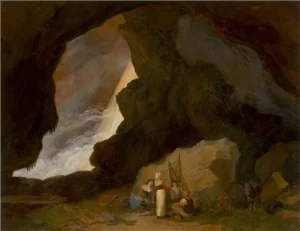
§ 1814 By virtue of the nature of the method just indicated, the science exhibits itself as a circle returning upon itself, the end being wound back into the beginning, the simple ground, by the mediation; this circle is moreover a circle of circles, for each individual member as ensouled by the method is reflected into itself, so that in returning into the beginning it is at the same time the beginning of a new member. Links of this chain are the individual sciences [of logic, nature and spirit], each of which has an antecedent and a successor −− or, expressed more accurately, has only the antecedent and indicates its successor in its conclusion.
Hegel The Encyclopedia of the Philosophical Sciences
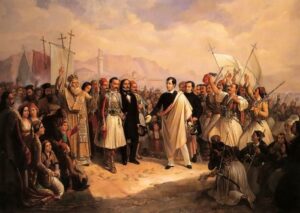
Philosophy thus may definitely presuppose a familiarity with its objects indeed it must do so as well as an interest in them from the outset, if only because chronologically speaking consciousness produces for itself representations of objects prior to generating concepts of them. What is more, only by passing through the process of representing and by turning towards it, does thinking spirit progress to knowing by way of thinking [denkendes Erkennen] and to comprehending [Begreif/m].
Hegel The Elements of the Philosophy of Right
A treatise in philosophy is usually not expected to be constructed on such a pattern, perhaps because people suppose that a philosophical product is a Penelope’s web which must be started anew every day. This treatise differs from the ordinary compendium mainly in its method of procedure. It must be under-stood at the outset that the philosophic way of advancing from one matter to another, the general speculative method, which is the only kind of scientific proof available in philosophy, is essentially different from every other. Only a clear insight into the necessity for this difference can snatch philosophy out of the ignominious condition into which it has fallen in our day.
De Tocqueville Democracy in America
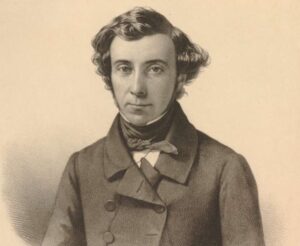
The most natural privilege of man, next to the right of acting for himself, is that of combining his exertions with those of his fellow-creatures, and of acting in common with them. I am therefore led to conclude that the right of association is almost as inalienable as the right of personal liberty. No legislator can attack it without impairing the very foundations of society.
Marx Early Writings
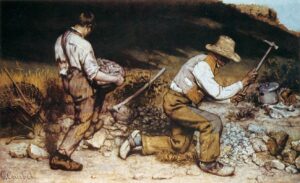
The basis of representation, its essence, turns out to be ‘something wholly superfluous, etc.’ for representation. With one and the same breath Hegel puts forward absolutely contradictory statements: representation is grounded on trust, on the confidence placed by one man in another, and, at the same time, it is not grounded on trust. It is rather a merely formal game.
The object of representation is not the particular interest but man and his citizenship of the state, the universal interest. On the other hand, the particular interest is the material of representation and the spirit of this interest is the spirit of the representative. p.197
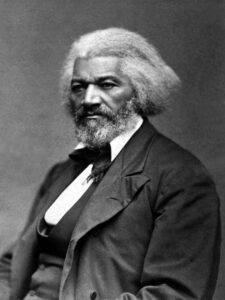
Narrative of the Life of Frederick Douglass
But just as he was leaning over to get the stick, I seized him with both hands by the collar, and brought him by a sudden snatch to the ground.
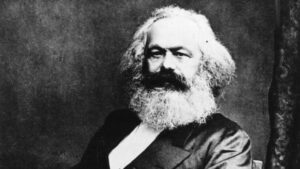
Marx Communist Manifesto
The proletarians have nothing to lose but their chains. They have a world to win. Working men of all countries, Unite!

Thoreau, Henry David Resistance to Civil Government
There will never be a really free and enlightened State, until the State comes to recognize the individual as a higher and independent power, from which all its own power and authority are derived, and treats him accordingly. I please myself with imagining a State at last which can afford to be just to all men, and to treat the individual with respect as a neighbor; which even would not think it inconsistent with its own repose, if a few were to live aloof from it, not meddling with it, nor embraced by it, who fulfilled all the duties of neighbors and fellow-men. A State which bore this kind of fruit, and suffered it to drop off as fast as it ripened, would prepare the way for a still more perfect and glorious State, which also I have imagined, but not yet anywhere seen.
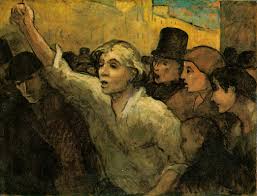
Marx The Revolutions of 1848 Political Writings volume 1
The history of all hitherto existing society is the history of class struggles

Thoreau, Henry David Walden, or A Life in the Woods
A simple and independent mind does not toil at the bidding of any prince. Genius is not a retainer to any emperor,
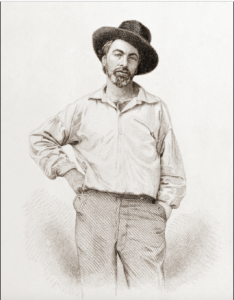
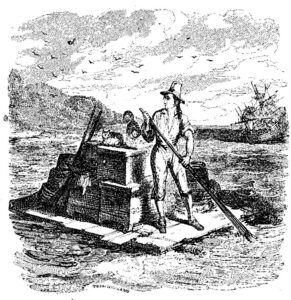
Marx: Grundisse: Foundations of the Critique of Political Economy
“The individual and isolated hunter and fisherman, with whom Smith and Ricardo begin, belongs among the unimaginative conceits of the eighteenth-century Robinsonades, which in no way express merely a reaction against over-sophistication and a return to a misunderstood natural life, as cultural historians imagine. It is no more based on such a naturalism than is Rousseau’s contrat social, which brings naturally independent, autonomous subjects into relation and connection by means of a contract. This is the semblance and only the aesthetic semblance of the Robinsonades, great and small.”
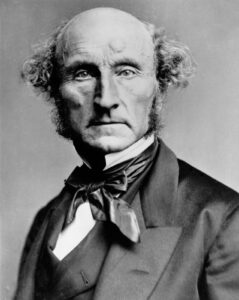
John Stuart Mill On Liberty
The subject of this Essay is … Civil, or Social Liberty: the nature and limits of the power which can be legitimately exercised by society over the individual. A question seldom stated, and hardly ever discussed, in general terms, but which profoundly influences the practical controversies of the age by its latent presence, and is likely soon to make itself recognised as the vital question of the future. It is so far from being new, that in a certain sense, it has divided mankind, almost from the remotest ages; but in the stage of progress into which the more civilised portions of the species have now[Pg 2] entered, it presents itself under new conditions, and requires a different and more fundamental treatment.
The struggle between Liberty and Authority is the most conspicuous feature in the portions of history with which we are earliest familiar, particularly in that of Greece, Rome, and England.

Thoreau, Henry David Walking
I wish to speak a word for Nature, for absolute Freedom and Wildness, as contrasted with a freedom and culture merely civil,—to regard man as an inhabitant, or a part and parcel of Nature, rather than a member of society.
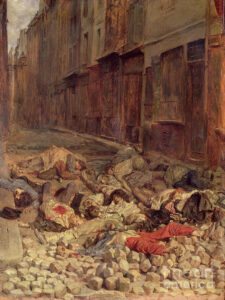
Marx Surveys from Exile Political Writings volume 2
A century earlier, in the same way but at a different stage of development, Cromwell and the English people had borrowed for their bourgeois revolution the language, passions and illusions of the Old Testament. When the actual goal had been reached, when the bourgeois transformation of English society had been accomplished, Locke drove out Habakkuk.
In these revolutions, then, the resurrection of the dead served to exalt the new struggles, rather than to parody the old, to exaggerate the given task in the imagination, rather than to flee from solving it in reality, and to recover the spirit of the revolution, rather than to set its ghost walking again.
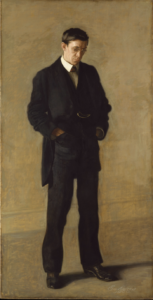
Thoreau, Henry David LIfe without Principle
This world is a place of business. What an infinite bustle! I am awaked almost every night by the panting of the locomotive. It interrupts my dreams. There is no sabbath. It would be glorious to see mankind at leisure for once. It is nothing but work, work, work. I cannot easily buy a blank-book to write thoughts in; they are commonly ruled for dollars and cents.
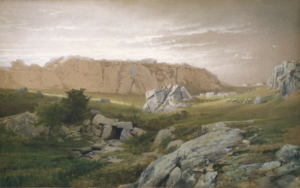
Thoreau, Henry David Excursions
In society you will not find health, but in nature. Unless our feet at least stood in the midst of nature, all our faces would be pale and livid. Society is always diseased, and the best is the most so. There is no scent in it so wholesome as that of the pines, nor any fragrance so penetrating and restorative as the life-everlasting in high pastures. I would keep some book of natural history always by me as a sort of elixir, the reading of which should restore the tone of the system.

Thoreau, Henry David The Maine Woods
At last we glided past the “green isle,” which had been our landmark, all joining in the chorus; as if by the watery links of rivers and of lakes we were about to float over unmeasured zones of earth, bound on unimaginable adventures,
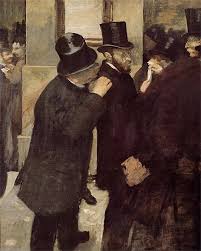
Capital: A Critique of Political Economy Vol 3: The Process of Capitalist Production as a Whole
“In $M — M’$ we have the meaningless form of capital, the perversion and objectification of production relations in their highest degree: the interest-bearing form, the simple form of capital, in which it antecedes its own process of reproduction. It is the capacity of money, or of a commodity, to expand its own value independently of reproduction — which is a mystification of capital in its most flagrant form.”
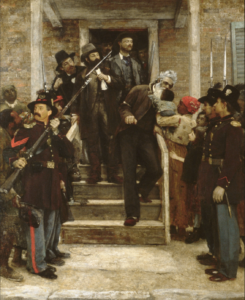
Thoreau, Henry David A Yankee in Canada, with Anti-Slavery and Reform Papers
The English did not come to America from a mere love of adventure, nor to truck with or convert the savages, nor to hold offices under the crown, as the French to a great extent did, but to live in earnest and with freedom.
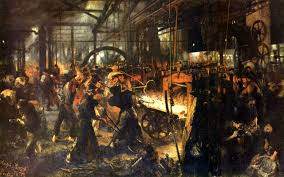
Capital: A Critique of Political Economy Vol. 1
“In handicrafts and manufacture, the workman makes use of a tool, in the factory, the machine makes use of him. There the movements of the instrument of labour proceed from him, here it is the movements of the machine that he must follow. In manufacture the workmen are parts of a living mechanism. In the factory we have a lifeless mechanism independent of the workman, who becomes its mere living appendage.”
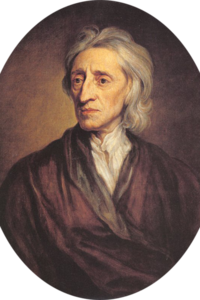
John Locke Second Treatise on Government
212 Besides this over-turning from without, governments are dissolved from within. p.107
Nietzsche The Birth of Tragedy
On this account, if for no other reason, it should be treated with some consideration and reserve; yet I shall not altogether conceal how disagreeable it now appears to me, how after sixteen years it stands a total stranger before me,—before an eye which is more mature, and a hundred times more fastidious, but which has by no means grown colder nor lost any of its interest in that self-same task essayed for the first time by this daring book,—to view science through the optics of the artist, and art moreover through the optics of life….
Nietzsche, Human, All too Human
That which he calls grace and the preliminary of salvation is in reality self-grace, self-salvation.
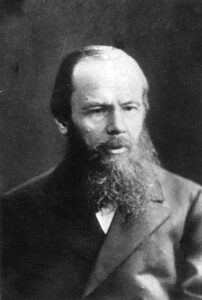
Dostoevsky, The Grand Inquisitor
Besides, Thou hast no right to add one syllable to that which was already uttered by Thee before…. Why shouldst Thou now return, to impede us in our work?
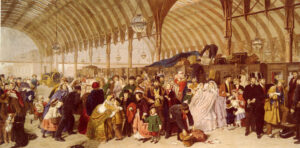
Capital: A Critique of Political Economy Vol 2
“The absolute magnitude of the value added by the transportation of commodities is, other things being equal, inversely proportional to the productive power of the transport industry and directly proportional to the distance traveled… The useful effect is the alteration of the place of the thing… The productive power of transport is inversely proportional to the time it takes to move the commodity from one place to another.”
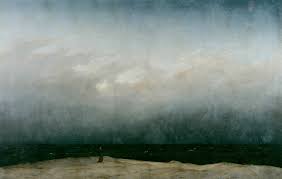
Marx The First International & After Political Writings Volume 3
…I went straight to my business. The world, I said, seemed to be in the dark about the International, hating it very much, but not able to say clearly what thing it hated. Some, who professed to have peered further into the gloom than their neighbors, declared that they had made out a sort of Janus figure with a fair, honest workman’s smile on one of the faces, and on the other a murderous conspirator’s scowl. Would he light up the case of mystery in which the theory dwelt?
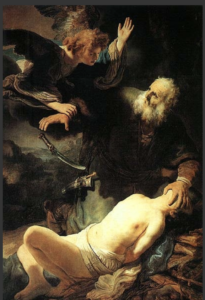
Kierkegaard Fear and Trembling: A Dialectical Lyric
And again, must one not loathe being human? For these millions who on their knees made pilgrimage to His grave, this throng of people which no power on earth was able to overcome: but one thing were necessary, Christ’s return—and all these millions would quickly regain their feet to run their way, so that the whole throng were as if blown away; or would, in a mass, and erect enough, rush upon Christ in order to kill him.
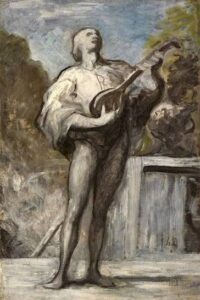
Nietzsche, The Gay Science
I live in my own place,
have never copied nobody even half,
and at any master who lacks the grace
to laugh at himself — I laugh.
OVER THE DOOR TO MY HOUSE
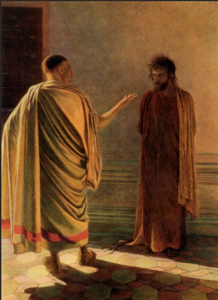
Leo Tolstoy My Religion
I do not now concern myself with theology and the Gospels, but with an inner work of an entirely different nature. I have to do now, with nothing systematic or methodical, only with that sudden light which showed me the Gospel doctrine in all its simple beauty.
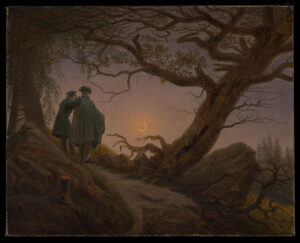
Kierkegaard Either/Or: A Fragment of Life
Moreover, one has much to learn from children in another way. In every child there is something original, and upon that all abstract principles and maxims come to grief.
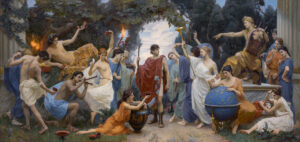
Nietzsche On the Genealogy of Morality
The ascetic priest is the incarnate wish for being otherwise, being elsewhere, indeed, he is the highest pitch of this wish. p.93
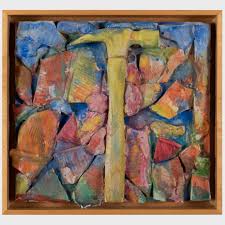
Nietzsche, The Twilight of the Idols
This new law-table do I put over you, O my brothers: Become hard!

Nietzsche, Thus Spoke Zarathustra
They are antithetical to one another, these roads; they directly abut on one another:—and it is here, at this gateway, that they come together. The name of the gateway is inscribed above: ‘This Moment.’
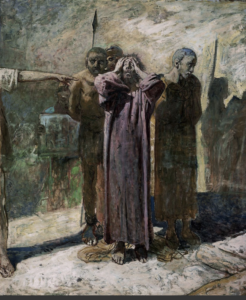
Leo Tolstoy The Kingdom of God Is Within You
“State authority, even if it clears away old injustices, always creates new ones, just because it is state authority. It cannot act otherwise, for it is based on violence, and violence is the negation of love.”
Nietzsche, The Antichrist
What is good? — All that heightens the feeling of power, the will to power, power itself in man. p.127
Husserl Logical Investigations
Husserl, Edmund. Logical Investigations. Translated by J. N. Findlay. 2 vols. London: Routledge & Kegan Paul, 1970.

Muir, John Our National Parks
Thousands of tired, nerve-shaken, over-civilized people are beginning to find out that going to the mountains is going home; that wildness is a necessity; and that mountain parks and reservations are useful not only as fountains of timber and irrigating rivers, but as fountains of life.
James, William Varieties of Religious Experience
This absolute determinability of our mind by abstractions is one of the cardinal facts in our human constitution.

Emerson, Ralph Waldo The Complete Works
To believe your own thought, to believe that what is true for you in your private heart is true for all men,—that is genius.Speak your latent conviction, and it shall be the universal sense; for the inmost in due time becomes the outmost,—and our first thought is rendered back to us by the trumpets of the Last Judgment. Familiar as the voice of the mind is to each, the highest merit we ascribe to Moses, Plato, and Milton is, that they set at naught books and traditions, and spoke not what men, but what they thought. A man should learn to detect and watch that gleam of light which flashes across his mind from within, more than the luster of the firmament of bards and sages. Yet he dismisses without notice his thought, because it is his. In every work of genius we recognize our own rejected thoughts: they come back to us with a certain alienated majesty.
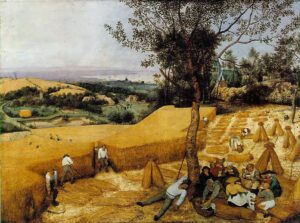
Max Weber The Protestant Ethic and the Spirit of Capitalism
Then the intensity of the search for the Kingdom of God commenced gradually to pass over into sober economic virtue; the religious roots died out slowly, giving way to utilitarian worldliness. Then, the isolated economic man takes the place of the lonely spiritual search for the Kingdom of heaven of Bunyan’s pilgrim, hurrying through the market-place of Vanity. p.176
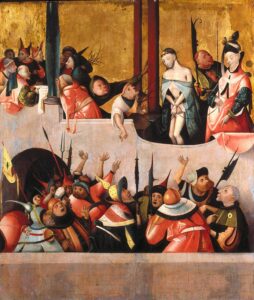
Nietzsche, Ecce Homo
At this point I can no longer evade a direct answer to the question, how one becomes what one is.
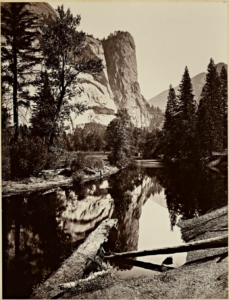
Muir, John My First Summer in the Sierra
Beauty beyond thought everywhere, beneath, above, made and being made forever. I gazed and gazed and longed and admired until the dusty sheep and packs were far out of sight, made hurried notes and a sketch, though there was no need of either, for the colors and lines and expression of this di[Pg 15]vine landscape-countenance are so burned into mind and heart they surely can never grow dim.
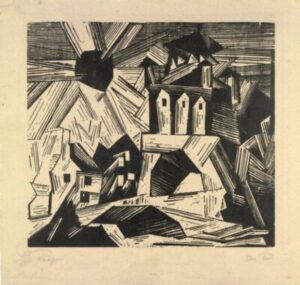

Muir, John. The Yosemite
All the world was before me and every day was a holiday, so it did not seem important to which one of the world’s wildernesses I first should wander.
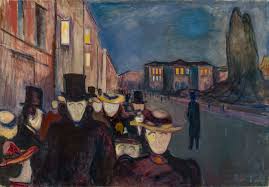
Kafka The Judgment
he said himself that he no longer understood conditions in his homeland
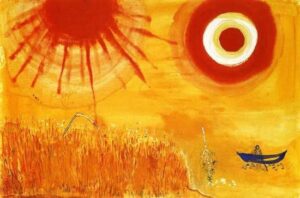
Husserl Ideas
Pure phenomenology, to which we are here seeking the way, whose unique position in regard to all other sciences we wish to make clear, and to set forth as the most fundamental region of philosophy, is an essentially new science, which in virtue of its own governing peculiarity lies far removed from our ordinary thing, and has not until our own day therefore shown an impulse to develop. p.37 Gibson translation.
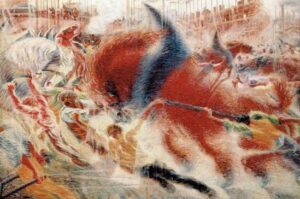
Kafka The Metamorphosis
One morning, when Gregor Samsa woke from troubled dreams, he found himself transformed in his bed into a horrible vermin.
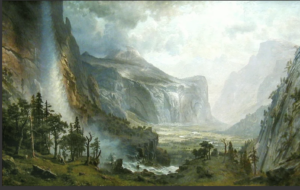
Muir, John. John Muir: The Eight Wilderness Discovery Books.
Would it not be well, therefore, for some one to go back as far as possible and take a fresh start? (Steep Trails)
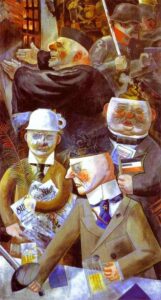
Kafka In the Penal Colony
And now, as the inscription is made on the body, everyone can see through the glass. Don’t you want to come closer and see the needles for yourself.
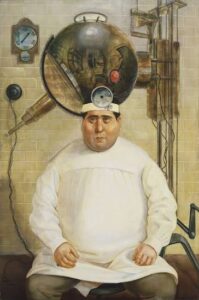
Kafka A Country Doctor
The door is shut. The singing stops. Clouds move in front of the moon.
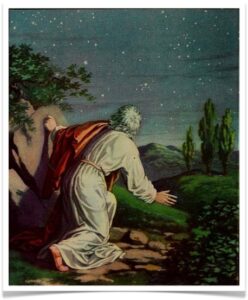
Max Weber Politics as a Vocation
However, in asking for the ‘legitimations’ of this obedience, one meets with these three ‘pure’ types: ‘traditional,’ ‘charismatic,’ and ‘legal.’ These conceptions of legitimacy and their inner justifications are of very great significance for the structure of domination.
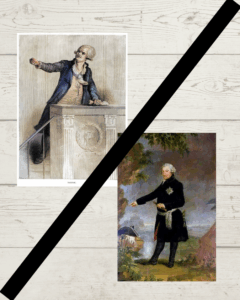
Carl Schmitt Political Romanticism
Every romantic avoid teh definitive choice. He wants to keep all possibilities open, and he changes his point of view from day to day because he is fascinated only by the new. p.65
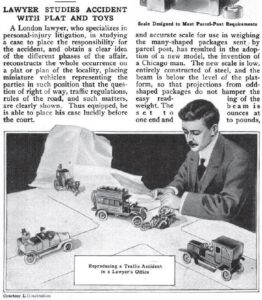
Wittgenstein Tractatus Logico-Philosophicus
The book deals with the problems of philosophy and shows, as I believe, that the method of formulating these problems rests on the misunderstanding of the logic of our language. Its whole meaning could be summed up somewhat as follows: What can be said at all can be said clearly; and whereof one cannot speak thereof one must be silent. The book will, therefore, draw a limit to thinking, or rather not to thinking, but to the expression of thoughts; for, in order to draw a limit to thinking we should have to be able to think both sides of this limit (we should therefore have to be able to think what cannot be thought). The limit can, therefore, only be drawn in language and what lies on the other side of the limit will be simply nonsense.
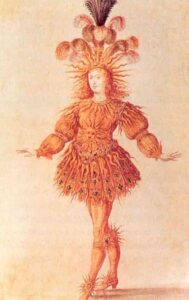
Carl Schmitt Political Theology: Four Chapters on the Concept of Sovereignty
Sovereign is he who decides on the exception.
![Ulysses Deriding Polyphemus 1829 Ulysses Deriding Polyphemus', 1829, (1904). From the collection of the National Gallery, London. From Social England, Volume VI, edited by H.D. Traill, D.C.L. and J. S. Mann, M.A. [Cassell and Company, Limited, London, Paris, New York & Melbourne, 1904] Artist JMW Turner. (Photo by Print Collector/Getty Images)](https://www.baitingthebear.com/wp-content/uploads/2025/12/gettyimages-679510614-2048x2048forjamesjoyceulysses-300x195.jpg)
James Joyce Ulysses
“History, Stephen said, is a nightmare from which I am trying to awake.”
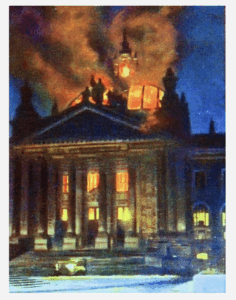
Carl Schmitt The Crisis of Parliamentary Democracy
The essential point for the liberal parliamentary system is that discussion takes the place of force-decision.
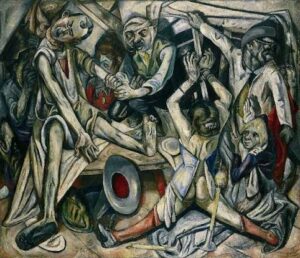
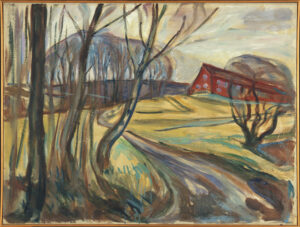
Kafka The Castle
It was late in the evening when K. arrived. The village was deep in snow. The Castle hill was hidden, veiled in mist and darkness, nor was there even a glimmer of light to show that a castle was there. On the wooden bridge leading from the main road to the village K. stood for a long time gazing into the illusory emptiness above him.
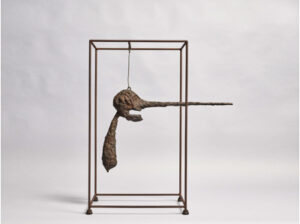
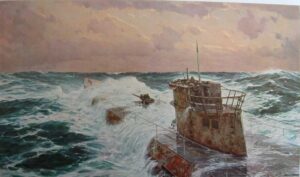
Heidegger Being and Time
“Läßt sich die Zeit selbst als Horizont des Seins offenbaren? Ist die Zeit selbst der Modus der Zeitlichkeit, oder ist diese nur ein Modus der Zeit? Ist die Zeit selbst das Ziel des Entwurfs, oder ist sie nur der Horizont des Seins? Welcher Art ist dieser Unterschied zwischen Sein und Zeit? Die Untersuchung ist auf dem Wege — wohin?”
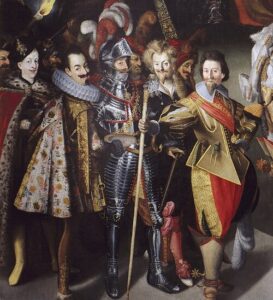
Walter Benjamin The Origin of German Tragic Drama
The intrigue alone would have been able to bring about that allegorical totality of scenic reorganization, thanks to which one of the images of the sequence stands out, in the image of the apotheosis, as different in kind, and gives mourning at one and the same time the cue for its entry and its exit. The powerful design of this form should be though through to its conclusion; only under this condition is it possible to discuss the idea of the German Trauerspiel. In the ruins of great buildings the idea of the plan speaks more impressively than in lesser buildings, however well preserved they are; and for this reason the German Trauerspiel merits interpretation. In the spirit of allegory it is conceived from the outset as a ruin, a fragment. Others may shine resplendently as on the first day; this form preserves the image of beauty to the very last. p.235
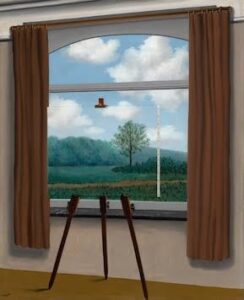
Husserl Cartesian Meditations
Husserl, Edmund. Ideas Pertaining to a Pure Phenomenology and to a Phenomenological Philosophy: First Book. Translated by Fred Kersten. The Hague: Martinus Nijhoff, 1982.
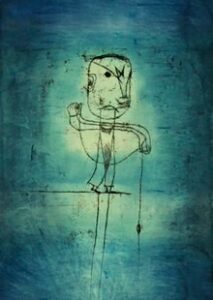
Karl Jaspers Man in the Modern Age
No definite or convincing answer can be given to the question” ‘What is going to happen?” Man, living man, will answer this question through his own being, in the course of his own activities. A forecast of the future (the ‘active forecast’ now in the making, the forecast which will become one of the determinants of the future) can aim only at rendering mankind aware of itself. p. 228

Ortega y Gasset The Revolt of the Masses
The multitude has suddenly become visible, installing itself in the preferential positions in society. Before, if it existed, it passed unnoticed, occupying the background of the social stage; now it has advanced to the footlights and is the principal character. There are no longer protagonists; there is only the chorus. p.13
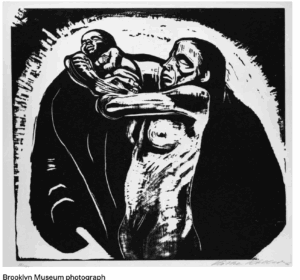
Carl Schmitt The Concept of the Political
The specific political distinction to which political actions and motives can be reduced is that between friend and enemy.
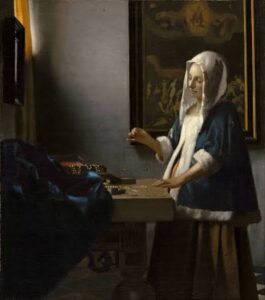
Marcel, Gabriel Being and Having
The difficulty arises from the fact that I think of my relation with my body on the analogy of my relation with my instruments — whereas in fact the latter presupposes the former.
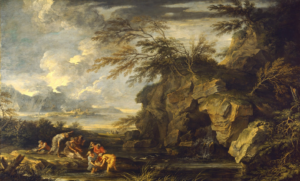
Leo Strauss Political Philosophy of Hobbes: Its Basis and Its Genesis
The fundamental concept of his theory of motion, the concept of conatus, appears first in his analysis of appetite.
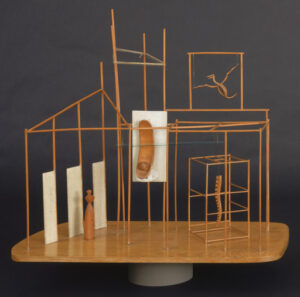
Husserl The Crisis of European Sciences and Transcendental Phenomenology
Husserl, Edmund. The Crisis of European Sciences and Transcendental Phenomenology: An Introduction to Phenomenological Philosophy. Translated by David Carr. Evanston, IL: Northwestern University Press, 1970.
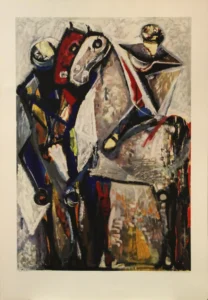
Karl Lowith from Hegel to Nietzsche
Since Hegel. and particularly through the work of Marx and Kierkegaard, the Christianity of this bourgeois-Christian world has come to an end. This does not mean that faith which once conquered the world perishes with its last secular manifestations. For how should the Christian pilgrimage in hoc saeculo ever become homeless in the land where it has never been at home?
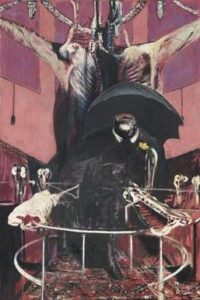
Ernst Cassirer The Myth of State
It is beyond the power of philosophy to destroy the political myths. A myth is in a sense invulnerable. It is impervious to rational arguments; it cannot be refuted by syllogisms. But philosophy can do us another important service. It can make us understand the adversary. In order to fight an enemy you must know him. That is one of the first principles of a sound strategy. To know him means no only to know his defects and weaknesses; it means to know his strength. All of us have been liable to underrate this strenth. When we first heard of the political myths we found them so absurd and incongruous, so fantastic and ludicrous that we could hardly be prevailed upon to take them seriously. By now it has become clear to all of us that this was a great mistake. We should not commit the same error a second time. We should carefully study the origin, the structure, the mehtods, and the technique of the political myths. We should see the adversary face to face in order to know how to combat him. p.296
Adorno & Horkheimer The Dialectic of Enlightenment
Enlightenment, understood in the widest sense as the advance of thought, has always aimed at liberating human beings from fear and installing them as masters.
Merleau-Ponty Humanism and Terror
The human world is an open or unfinished system and the same radical contingency which threatens it with discord also rescues it from the inevitability of disorder and prevents us from despairing of it, providing only that one remembers its various machineries are actually men and tries to maintain and expand man’s relations to man. p.188
Merton, Thomas The Seven Storey Mountain
“For each one of us, there is only one thing necessary: to fulfill our own destiny, according to God’s will, to be what God wanted us to be.”
Weil, Simone On the Abolition of All Political Parties
The second condition is that the people should express their will regarding the problems of public life – and not merely choose among various individuals; or, worse, among various irresponsible organisations (for the general will does not have the slightest connection with such choices)
Weil, Simone Waiting for God
Although today we seem ignorant to it, the formation of thef aculty of attention is the true goal and unique interest of all studies.
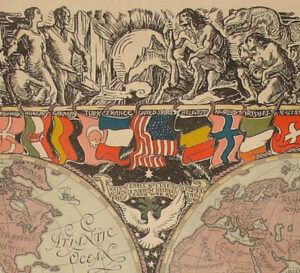
Carl Schmitt The Nomos of the Earth
The earth is bound to the law in three ways; she contains law within herself, as a reward of labor; she manifests law upon herself in fixed boundaries; and she sustains law above herself, as a public sign of order.

Marcel, Gabriel The Mystery of Being
What is the nature of this exigence lying at the origin of philosophic research and in dnager of being smothered by the broken world of techniques and socialization? It is essentially an exigence of transcendence
Marcel, Gabriel Man Against Mass Society
If the reader is fond of analogy, aesthetics can be understood in a Kantian sense – re-examined perhaps by Foucault – as the system of a priori forms determining what presents itself to sense experience. It is a delimitation of [14] spaces and times, of the visible and the invisible, of speech and noise, that simultaneously determines the place and the stakes of politics as a form of experience. Politics revolves around what is seen and what can be said about it, around who has the ability to see and the talent to speak, around the properties of spaces and the possibilities of time.
Leo Strauss Natural Right and History
If there is no standard higher than the ideals of one’s society, there exists no possibility of taking a critical distance from those ideals. But the mere fact that we can raise the question of the worth of the ideals of our society shows that there is something in man that is not altogether enslaved to his society, and therefore that we are able, and even obliged, to look for a standard with reference to which we can judge of the ideals of our society, as well as of any other society. This standard cannot be found in the needs of the society concerned.
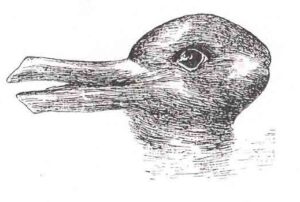
Wittgenstein Philosophical Investigations
The thoughts that I publish in what follows are the precipitate of philosophical investigations which have occupied me for the last sixteen years. They concern many subjects: the concepts of meaning, of understanding, of a proposition and sentence, of logic, the foundations of mathematics, states of consciousness, and other things. I have written down all these thoughts as remarks, short paragraphs, sometimes in longer chains about the same subject, sometimes jumping, in a sudden change, from one area to another. — Originally it was my intention to bring all this together in a book whose form I thought of differently at different times. But it seemed to me essential that in the book the thoughts should proceed from one subject to another in natural, smooth sequence.
After several unsuccessful attempts to weld my results together into such a whole, I realized that I should never succeed. The best that I could write would never be more than philosophical remarks; my thoughts soon grew feeble if I tried to force them along a single track against their natural inclination. — And this was, of course, connected with the very nature of the investigation. For it compels us to travel criss-cross in every direction over a wide field of thought. — The philosophical remarks in this book are, as it were, a number of sketches of landscapes which were made in the course of these long and meandering journeys.
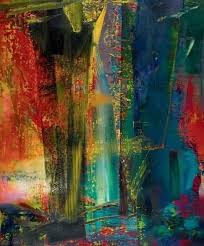
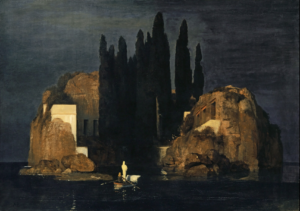
Merton, Thomas No Man Is an Island
“Love is our true destiny. We do not find the meaning of life by ourselves alone—we find it with another.”
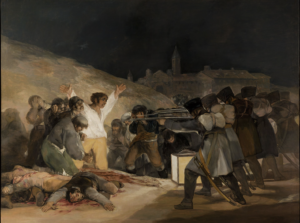
Weil, Simone Oppression and Liberty
If we want to traverse this sombre age in manly fashion, we shall refrain, like the Ajax of Sophocles, from letting empty hopes set us afire.
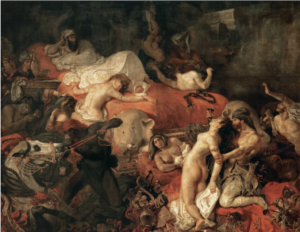
Marcuse, Herbert. Eros and Civilization: A Philosophical Inquiry into Freud
And the past continues to claim the future: it generates the wish that the paradise be re-created on the basis of the achievements of civilization.
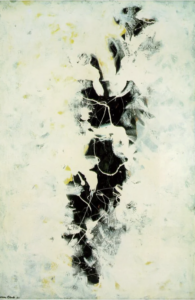
Kerouac, Jack On the Road
I first met Dean not long after my wife and I split up, I had just gotten over a serious illness that I won’t bother to talk about, except that is had something to do with the miserable weary split-up and my feeling that everything was dead.

Merton, Thomas Thoughts in Solitude (1958)
“Solitude is not a place apart, but a way of being. It is the silence of the heart that listens for the word of God in the midst of the world.”
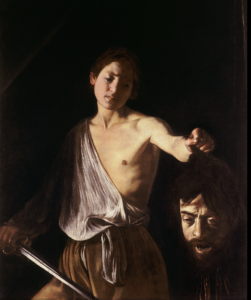
Leo Strauss Thoughts on Machiavelli
It is misleading to describe the thinker Machiavelli as a patriot. He is a patriot of a particular kind: he is more concerned with the salvation of his fatherland than with the salvation of his soul. His patriotism therefore presupposes a comprehensive reflection
regarding the status of the fatherland on the one hand and of the soul on the other.
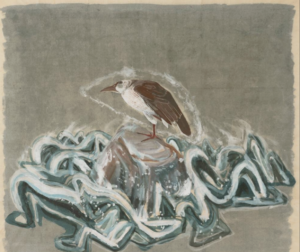
Kerouac, Jack The Dharma Bums
Hopping a freight out of Los Angeles at high noon one day in late September 1955 I got on a gondola and lay down with my duffel bag under my head and my knees crossed and contemplated the clouds as we rolled north to Santa Barbara.
Arendt The Human Condition
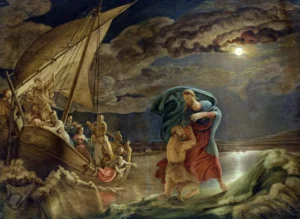
The space of appearance comes into being wherever men are together in the manner of speech and action, and therefore predates and precedes all formal constitution of the public realm and the various forms of government, that is, the various forms in which the public realm can be organized. p.199
Ricoeur, L’Homme fallible, Fallible Man
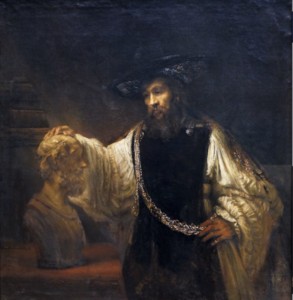
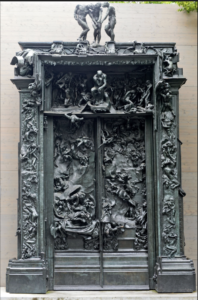
“The human being is a mediation between the finite and the infinite; he is this mediation because he is a disproportion.”

Ricoeur, La Symbolique du mal The Symbolism of Evil
“The symbol gives rise to thought.”
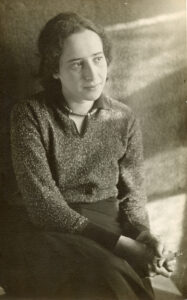
Arendt, What is Freedom?
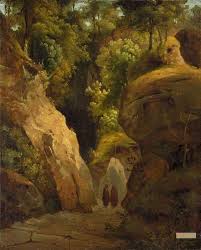
Political institutions, no matter how well or how badly designed, depend for continued existence upon acting men; their conservation is achieved by the same means that brought them into being. Independent existence marks the work of art as a product of making; utter dependence upon further acts to keep it in existence marks the state as a product of action. p.153
Heidegger On Nietzsche
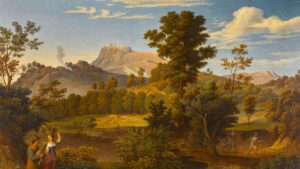
Not only must the thought emerge out of the creative moment of decision in some given individual, but as a thought that pertains to life itself it must also be a historical decision — a crisis. p.154 continued p. 155 This plan culminates in a fifth point entitled “The doctrine of eternal return as hammer in the hand of the most powerful man. Wherever the thought of thoughts is indeed thought, that is to say, is incorporated, it conducts the thinker to supreme decisions in such a way that he expands beyond himself, thus attaining power over himself and willing himself. In this way such a man is as will to power.
René Girard Mensonge romantique et vérité romanesque
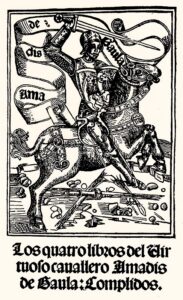
Pour qu’un vaniteux desire un objet il suffit de le convaincre que cet objet est deja desire par un tiers aquel s’attache un certain prestige. La mediateur est ici un rival que la vanite a d’abord suscite qu’elle a pour ainsi dire, appele a son existence de rival avant d’en exiger la defaite. p.20-21
Habermas, Jurgen The Structural Transformation of the Public Sphere
“The public sphere, once a forum for rational-critical debate, has been transformed into a court before which public relations displays its wares. The public is no longer a partner in dialogue, but an audience to be manipulated.” (p. 162)
Oakeshott Rationalism in Politics
As I understand it, the excellence of this conversation (as of others) springs from a tension between seriousness and playfulness. Each voice represents a serious engagement (though it is serious not merely in respect of its being pursued for the conclusions in promises); and without this seriousness the conversation would lack impetus. But in its participation in the conversation each voice learns to be playful, learns to recognize itself as a voice among voices. As with children, who are great conversationists, the playfulness is serious and the seriousness in teh end is only play. pp.201-202
JL Austin How to do things with words
To sum up, we may say that the verdictive is an exercise of judgment, the exercitive is an assertion of influence or exercising of power, the commissive is an assuming of an obligation or declaring of an intention, the behabitive is the adopting of an attitude, and the expositive is the clarifying of reasons, arguments, and communications. p.162
C.B. Macpherson The Political Theory of Possessive Individualism Hobbes to Locke
we cannot now expect a valid theory of obligation to a liberal democratic state in a possessive market society. p.275
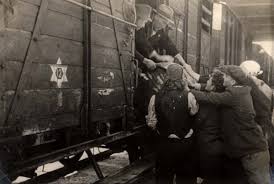
Arendt Eichmann in Jerusalem
This was the way things were, this was the new law of the land, based on the F’s order, whatever he did he did, as far as he could see, as a law-abiding citizen. He did his duty, as he told the police and the court over and over again, he not only obeyed orders, he obeyed the law.
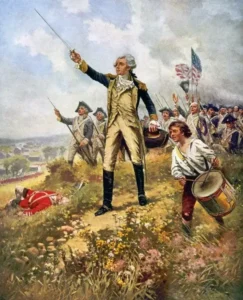
Arendt On Revolution
The question is only whether that which made for stability and answered so well the early modern preoccupation with permanence was enough to preserve the spirit which had become manifest during the Revolution itself. p.231
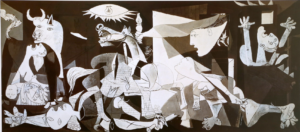
Merton, Thomas Seeds of Destruction (1964)
“We are responsible for the world we live in, not just because we are its inhabitants, but because we are its creators. Every act of injustice, every word of hatred, every silence in the face of wrong, adds a seed to the destruction that we all fear.”
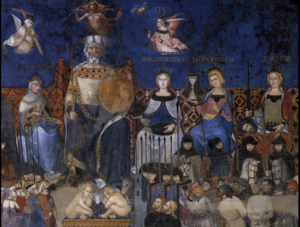
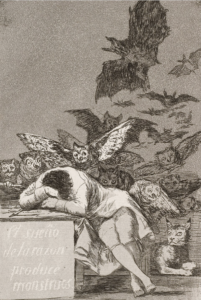
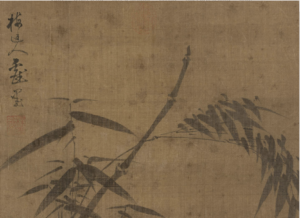
Merton, Thomas The Way of Chuang Tzu (1965)
“The greatest politeness is free of all formality. Perfect conduct is free of concern. Perfect wisdom is unplanned. Perfect love is without demonstrations.”
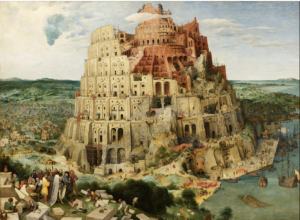
Leo Strauss Socrates and Aristophanes
Our Great Tradition includes political philosophy and thus seems to vouch for its possibility and necessity. According to the same tradition, political philosophy was founded by Socrates.
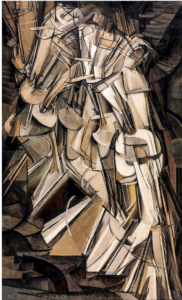
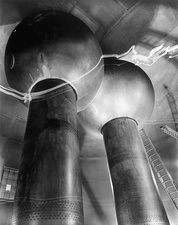
Habermas, Jurgen Knowledge and Human Interests
“The world fashioned by the mass media is a public sphere in appearance only… The public sphere becomes the court before which public relations faces are displayed—a court before which a public opinion is manufactured rather than formed.”
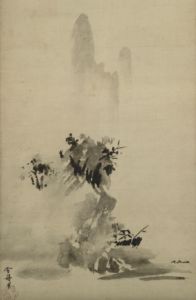
Merton, Thomas Zen and the Birds of Appetite (1968)
“Words are like fingers pointing at the moon. If you stare at the finger, you miss all the heavenly glory.”

Merton, Thomas Faith and Violence (1968)
“Violence rests on the assumption that the enemy and I are entirely different: the enemy is evil and I am good. The enemy must be destroyed but I must be saved. But love sees things differently. It sees that even the enemy suffers from the same sorrows and limitations that I do.”
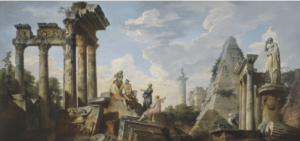
Leo Strauss Liberalism Ancient and Modern
Just government is government which rules in teh interest of the whole society, not just a part.
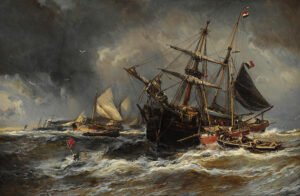
Ricoeur Le Conflit des interpretations The Conflict of Interpretations: Essays in Hermeneutics
“The philosopher trained in the school of Descartes knows that things are doubtful… but he does not doubt that consciousness is such as it appears to itself… Since Marx, Nietzsche, and Freud, this is what is in question. After the doubt about things, we have started to doubt consciousness.”
Arendt On Violence
The technical development of the implements of violence has now reached the point where no political goal could conceivably correspond to their destructive potential or justify their actual use in armed conflict.

John Searle Speech Acts
The problem posed by indirect speech acts is the problem of how it is possible for the speaker to say one thing and mean that but also to mean something else.
Leo Strauss Xenophon’s Socratic Discourse: An Interpretation of the “Oeconomicus”
You remember the statement in the Oeconomicus that one way of getting rich is war and tyranny.
John Rawls Theory of Justice
If men’s inclination to self-interest makes their vigilance against one another necessary, their public sense of justice makes their secure association together possible. Among individuals with disparate aims and purposes a shared conception of justice establishes the bonds of civic friendship; the general desire for justice limits the pursuit of other ends. One may think of a public conception of justice as constituting the fundamental charter of a well-ordered human association. Existing societies are of course seldom well-ordered in this sense, for what is just and unjust is usually in dispute. Men disagree about which principles should define the basic terms of their association. Yet we may still say, despite this disagreement, that they each have a conception of justice. That is, they understand the need for, and they are prepared to affirm, a characteristic set of principles for assigning basic rights and duties and for determining what they take to be the proper distribution of the benefits and burdens of social cooperation.

Heidegger Poetry, Language, Thought
The world’s darkening never reaches
to the light of Being.
We are too late for the gods and too
early for Being. Being’s poem,
just begun, is man.
To head toward a start — this only.
To think is to confine yourself to a
single thought that one day stands
still like a star in the world’s sky.
Leo Strauss Xenophon’s Socrates
free men rule for the sake of freedom, just as in an oligarchy wealthy men rule for the sake of wealth.
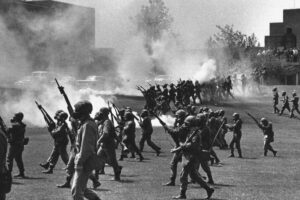
Arendt Crises of the Republic
No doubt even this kind of conscientious objection can become politically signigicant when a number of consciences happen to coincide, and the conscientious objectors decide to enter the marketplace and make their voices heard in public.
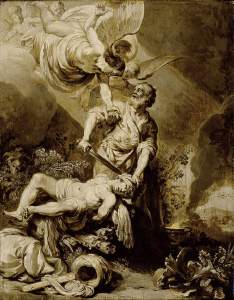
René Girard La violence et le sacré
Dans de nombreux rituels, le sacrifice se présente de deux façons opposées, tantot comme une chose tres sainte dont on ne saurait s’abstenir sans negligence grave, tantot au contraire comme une espece de crime qu’on ne saurait commettre sans s’exposer a des risques également tres graves. p.9
Habermas Jurgen, Legitimation Crisis
“Under ‘democracy,’ the conditions under which all legitimate interests can be fulfilled by way of realizing the fundamental interest in self-determination and participation are no longer understood. It is now only a key for the distribution of rewards conforming to the system, that is, a regulator for the satisfaction of private interests. This democracy makes possible prosperity without freedom.”
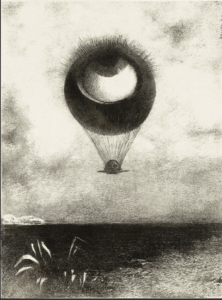
Ricoeur La Metaphor vive The Rule of Metaphor
“The metaphoric ‘is’ at once signifies both ‘is not’ and ‘is like.'”
Leo Strauss The Argument and Action of Plato’s Laws
“The Athenian does not question the divine origin of the Cretan and Spartan laws; he accepts it on the authority of his interlocutors. But he immediately asks for the reason or the end for which those laws were established… He asks, in Socratic fashion, what the lawgiver had in mind in establishing the laws.”
— Chapter I, p. 4
Hans Blumenberg The Genesis of the Copernican World
It is only as an experience of turning back that we shall accept that for man there are no alternatives to the Earth, just as for reason there are no alternatives to human reason. p. 685
Ricoeur Interpretation Theory: Discourse and the Surplus of Meaning
“To understand a text is not to rejoin the author, but to move in the direction of his work, to project oneself before it, to follow the path of the world it opens up.”
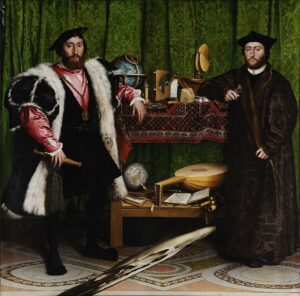
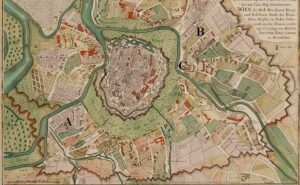
Michel Foucault Society Must Be Defended
A right of sovereignty and a mechanics of discipline. It is, I think, between these two limits that power is exercised. The two limits are, however, of such a kind and so heterogeneous that we can never reduce one to the other. In modern societies, power is exercised through, on the basis of, and in the very play of the heterogeneity between a public right of sovereignty
and a polymorphous mechanics of discipline.
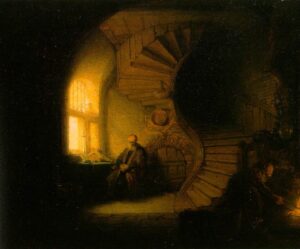
Arendt The Life of the Mind
For the thinking ego and its experience, conscience that “fills a man full obstacles” is a side effect. No matter what thought-trains the thinking ego thinks through, the self that we all are must take care not to do anything that would make it impossible for the two-in-ne to be friends and live in harmony. This is what Spinoza meant by the term “aquiescence in one’s self” (acquiescentia in seipso): “It can spring out of reason [reasoning]. and this contentment is the greatest joy possible.” Its criterion for action will not be the usual rules, recognized by multitudes and agreed upon by society, but whether I shall be able to live with myself in peace when the time has come to think about my deeds and words. Conscience is the anticipation of the fellow who awaits you if and when you come home. p.191
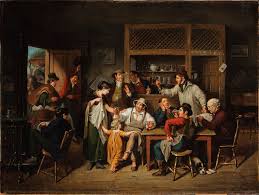
McCarthy, Thomas. The Critical Theory of Jurgen Habermas
“Critical theory is distinguished from the ‘traditional’ sciences by its reflexive character and its practical intent: it seeks not merely to understand or explain, but to transform. Its ultimate goal is a society of self-determining individuals who have achieved freedom from all forms of systemic distortion and illegitimate domination through the medium of unconstrained communication.”

Ernesto Grassi Rhetoric as Philosophy
Philosophy itself becomes possible only on the basis of metaphors, on the basis of the ingenuity which supplies the foundation of every rational, derivative process. p. 34
Ricoeur Essays on Biblical Interpretation
The titles of the essays: Toward a hermeneutic of the Idea of Revelation; The Hermeneutics of Testimony; Freedom in the Light of Hope.
Henceforth, the regeneration of freedom is inseparable from the movement by which the figures of hope are liberated from the idols of the market place, as Bacon put it.
This whole process constitutes the philosophy of religion within the limits of reason alone; it is this process which constitutes the philosophical analogon of the kerygma of the Resurrection. It is also this process which constitutes the whole adventure of freedom and which permits us to give a comprehensible meaning to the expression “religious freedom.” p.180
Ricoeur Hermeneutics and the Human Sciences
“The execution of an action is a text that is written onto the world.”
Jurgen Habermas Theory of Communicative Action
The concept of communicative action is developed in the first set (Chapter III) of “Intermedicate Reflections” [Zwischenbetrachtung], which provides access to three intertwined topic complexes: first, a concept of communication rationality that is sufficiently skeptical in its development but is nevertheless resistant to cognitive-instrumental abridgments of reason; second, a two-level concept of society that connects the “lifeworld” and “system” paradigms in more than a rhetorical fashion; and finally, a theory of modernity that explains the type of social pathologies that are today becoming increasingly visible, by way of the assumption that communicatively structured domains of life are being subordinated to the imperatives of autonomous, formally organized systems of action. Thus the theory of communicative action is intended to make possible a conceptualization of the social-life context that is tailored to the paradoxes of modernity.
Alasdair MacIntyre After Virtue
My own critique of liberalism derives from a judment that the best type of human life, that in which the tradition of the virtues is most adequately embodied, is lived by those engaged in constructing and sustaining forms of community directed towards the shared achievement of those common goods without which the ultimate human good cannot be achieved. Liberal political societies are characteristicallly committed to denying any place for a determinate conception of the human good in their public discourse, let alone allowing that their common life should be grounded in such a conception. On the dominant liberal view, government is to be neutral as between rival conceptions of the human good, yet in fact what liberalism promotes is a kind of instutional order that is inimical to the construction and sustaining of the types of communal relationship required for the best kind of human life. p. xv Prologue
Arendt Lectures on Kant’s Political Philosophy
In the Critique of Pure Reason imagination is at the service of the intellect; in the Critique of Judgment the intellect is “at the service of imagination.”
In the Critique of Judgement we find an analogy to the “schema”: the example. Kant accords to examples the same role in judgments that the intuitions called schemata has for experience and cognition. Examples play a role in both reflective and determinant judgments, that is, whenever we are concerned with particulars. p.84
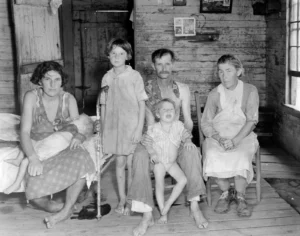
Michael Sandel Liberalism and the Limits of Justice
For justice to be the first virtue, certain things must be true of us. We must be creatures of a certain kind, related to human circumstance in a certain way. We must stand at a certain distance from our circumstance, whether as transcendental subject in the case of Kant, or as essentially unencumbered subject of possession in the case of Rawls. Either way, we must regard ourselves as independent: independent from the interests and attachments we may have at any moment, never identified by our aims but always capable of standing back to survey and assess and possibly to revise them (Rawls 1979: 7; 1980: 544–5).
DEONTOLOGY’S LIBERATING PROJECT
Bound up with the notion of an independent self is a vision of the moral universe this self must inhabit. Unlike classical Greek and medieval Christian conceptions, the universe of the deontological ethic is a place devoid of inherent meaning, a world ‘disenchanted’ in Max Weber’s phrase, a world without an objective moral order. Only in a universe empty of telos, such as seventeenth-century science and philosophy affirmed, is it possible to conceive a subject apart from and prior to its purposes and ends. Only a world ungoverned by a purposive order leaves principles of justice open to human construction and conceptions of the good to individual choice. In this the depth of opposition between deontological liberalism and teleological world views most fully appears.
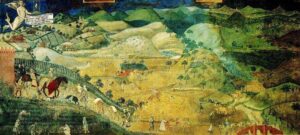
Michael Walzer Spheres of Justice
And equality is simply the outcome of the art — at least for us, working with the materials here at hand. For the rest of the book, then, I shall try to describe those materials, the things we make and distribute, one by one. I shall try to get at what security and welfare, money, office, education, free time, political power, and so on, mean to us’ how they figure in our lives; and how we might share, divide, and exchange them if we were free from every sort of domination.
Foucault, What is Enlightenment?
I shall thus characterize the philosophical ethos appropriate to the critical ontology of ourselves as a historico-practical test of the limits that we may go beyond, and thus as work carried out by ourselves upon ourselves as free beings. p.47
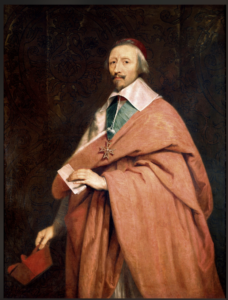
Ricoeur Temps et recit Time and Narrative volumes 1-3
Conversely, a story only holds genuine meaning for us because it mirrors the actual structure of our lived experience. Every narrative relies on temporal coordinates—beginnings, crises, endings, and the weight of waiting—which directly correspond to our mortal condition.
Ricoeur, Du texte a l’action From Text to Action
On the featured image Géricault, Théodore. The Raft of the Medusa. 1818–1819. Oil on canvas, 491 cm × 716 cm. Musée du Louvre, Paris. Museum Collection: Musée du Louvre, Paris – Department of Paintings Provenance: Exhibited at the Paris Salon of 1819 under the title Scène de Naufrage; purchased by
Rancière, Jacques. Le maître ignorant: Cinq leçons sur l’émancipation intellectuelle
the singular art of the explicator: the art of distance. The master’s secret is to know how to recognize the distance between the taught material and the person being instructed, teh distance also between learning and understanding.
Rogin, Michael Paul. Ronald Reagan, the Movie, and Other Episodes in Political Demonology
Exaggerated responses to the domestic Communist menace narrowed th bounds of permissible political disagreement and generated a national-security state. p.68
Wm Connolly Political Theory and Modernity
…it would turn the genealogist of resentment on his head by exploring democratic politics as a medium through which to expose resentment and to encourage the struggle against it. And it would turn periodically to thinkers such as Hobbes, Rousseau, Hegel and Marx…;to locate the myriad ways and means by which the twin drives to mastery and realization have lodged themselves inside modern formations; and to listen to subdued sounds of strife and resistance emanating from these integrated systems of modern thought. p.175
Sheldon Wolin The Presence of the Past
These writings are intended as a contribution to a renewed democratic discourse, one that can be disentagled from the disillusions bred by recent neoconservative rhetoric and the cheap flattery of cynical demagogues of right-wing populism. That discourse must confront the meaning of the state and of its cohabitation with corporate power. Facing up to the state means recognizing that the dominant forms of power in the society, both public and private, are inherently antidemocratic in their structure and objectives and that if democracy is to be practiced and extended, teh conditions of politics will have to be transformed. (1989)

Ricoeur, Soi-meme comme un autre Oneself as Another
“The self cannot be thought without the other, but rather is linked to the other in a relationship of mutual recognition and responsibility.”

E.J. Hobsbawm Nations and Nationalism
However, in post-communist societies ethnic or national identity is above all a device for defining the community of the innocent and identifying the guilty who are responsible for ‘our’ predicament. p.174

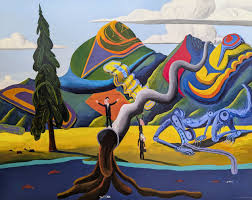
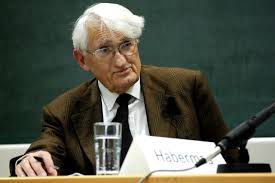
Jurgen Habermas Between Facts and Norms
Moreover, a moral-practical self-understanding of modernity as a whole is articulated in the controversies we have carried on since the seventeenth century about the best constitution of the political community. This self-understanding is attested to both by a universalistic moral consciousness and by the liberal design of the constitutional state. Discourse theory attempts to reconstruct this normative self-understanding in a way that resists both scientistic reductions and aesthetic assimilations.
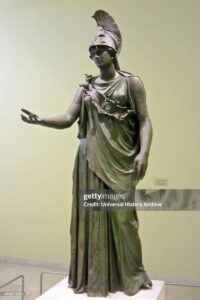
Bonnie Honig Political Theory and the Displacement of Politics
The lesson of the contest between virtue and virtú, is that politics never gets things right, over, and done with. The conclusion is not nihilistic but radically democratic. To accept and embrace the perpetuity of contest is to reject the dream of displacement, the fantasy that the right laws or constitution might some day free us from the responsiblity for, (and, indeed, the burden of) politics.
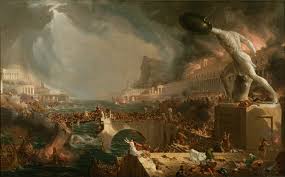
Ricoeur, Le Juste The Just
“Let us define ‘ethical aim’ by the following three terms: aiming at the ‘good life’ with and for others, in just institutions.”
Rancière, Jacques. La mésentente: Politique et philosophie
Is there such thing as political philosophy? The question seems incongruous for two reasons. First theorizing about community and its purpose, about law and its foundation, has been going on ever since our philosophical traditional kicked off and has never ceased to keep it vital. Second, for awhile now, political philosophy has been loudly trumpeting its return with a new lease on life.
Quentin Skinner Reason and Rhetoric in the Philosophy of Hobbes
Finally, there is the still more rhetorically minded view associated with Renaissance humanism: that our watchword ought to be audi alteram partem, always listen to the other side. This commitment stems from the belief that, in moral and political debate, it will always be possible to speak in utramque partem, and will never be possible to couch our moral or political theories in deductive form. The approprate model will always be that of a dialogue, the appropriate stance a willingness to negotiate over rival intuitions concerning the applicability of evaluative terms. We must strive to reaching understanding and resolve disputes in a conversational way. p. 15-16

Quentin Skinner Liberty before Liberalism
The history of philosophy, and perhaps especially of moral, social and political philosophy, is there to prevent us from becoming too readily bewitched. The intellectual historian can help us to appreciate how far the values embodied in our present way of life, andd our present ways of thinking about those values, reflect a series of choices made at different times between different possible worlds. This awareness can help to liberate us from the grip of any one hegemonal account of those values and how they should be interpreted and understood. p.117
Michael Hanchard Afro Modernity: Temporality, Politics, and the African Diaspora
These encounters remind us, I believe, that there are many vantage points from which one can view and experience this thing known as modernity: as nightmare or utopia; as horrible past or future present. These contrasting views caution us against modernity’s reification and implore us to view modernity as a process of lived experience, with winners and losers, as well as strivings for redemption, recovery, retribution, and revolution, each experience tumbling into another and becoming—dare I say—history.

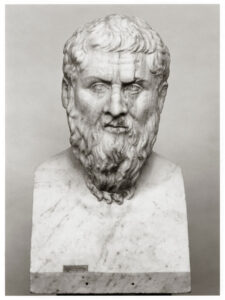
S. Sara Monoson Plato’s Democratic Entanglements
Plato’s depictions of intellectual labor in his dialogues contain a puzzle. On the one hand, the dialogues voice some of the most aggressive attacks on the intellectual merit of theatrical enterprises in all of Western litera-ture. Most famously, the Republic banishes poetry from the ideal city(607a–e). In the Laws, moreover, the Athenian Stranger decries the deterioration of democratic politics into a “wretched theatocracy” (theatro-
kratia, 701a1). On the other hand, Plato likens serious intellectual toil, including philosophic understanding, to being a theater-goer. Through-out his dialogues he sustains a delicate metaphor: “Intellectual labor is like
the activity of being a theate¯s,” where theate¯s refers to an audience memberat the theater, during the dramatic competitions held on grand civic festival occasions.
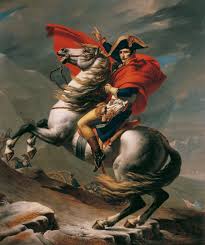
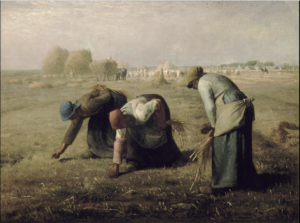
Rancière, Jacques. Le partage du sensible: Esthétique et politique
If the reader is fond of analogy, aesthetics can be understood in a Kantian sense – re-examined perhaps by Foucault – as the system of a priori forms determining what presents itself to sense experience. It is a delimitation of [14] spaces and times, of the visible and the invisible, of speech and noise, that simultaneously determines the place and the stakes of politics as a form of experience. Politics revolves around what is seen and what can be said about it, around who has the ability to see and the talent to speak, around the properties of spaces and the possibilities of time.
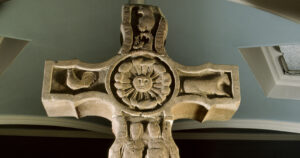
Jorge Luis Borges This Craft of Verse
And when the fact that poetry, language, was not only a medium for communication but could also be a passion and a joy—when this was revealed to me, I do not think I understood the words, but I felt that something was happening to me. It was happening not to my mere intelligence but to my whole being, to my flesh and blood.

Sheldon Wolin De Tocqueville Between Two Worlds
Democracy is perpetuated as philanthropic gesture, contemptuously institutionalized as welfare, and denigrated as populism. p.572
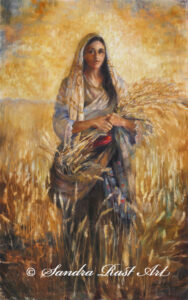
Bonnie Honig Democracy and the Foreigner
I take foreignness as a topic, a question, rather than a problem. What does it mean? What sort of work does it do in cultural politics?
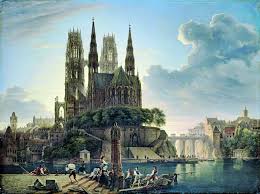




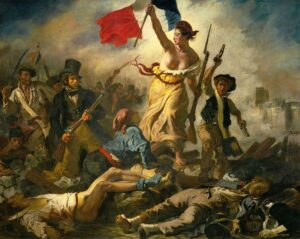
Linda M.G. Zerilli Feminism and the Abyss of Freedom
A freedom centered feminism would strive to bring about transformation in normative conceptions of gender without returning to the classical notion of freedom as sovereignty that all three waves of feminism have, in their different ways, at once accepted and rejected. Such feminism would be a world-building practice that changes political freedom from the “I-will” into the “I-can”. This I-can is nothing other than the public persona described earlier, what Arendt called “the mask” of citizenship and the rights and duties that correspond to being a member of a political community. I-can belongs to women neither as a sex nor a gender, neither as “natural” nor a social group. I-can belongs, rather, to women as a political collectivity, and it obtains in the practice of speaking women’s name (which involves speaking for others, being spoken for, and speaking back). I-can is the non-soverign freedom of feminists as citizens engaged in word and deed, who are committed to the irreducibly non natural basis of political membership. p.180

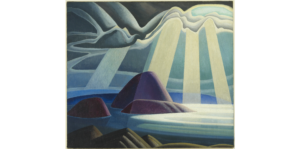
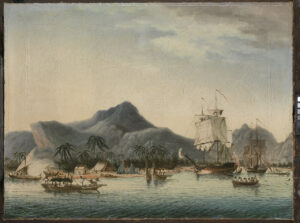






Pinkard, Terry. Hegel’s Phenomenology of Spirit: A Guide
Pinkard, Terry P.. Hegel’s Phenomenology of Spirit: A Guide. United Kingdom: Oxford University Press, 2023. Find it at Oxford University Press
Honneth, Axel The Working Sovereign
Honneth, Axel. The Working Sovereign: Labour and Democratic Citizenship. United Kingdom: Polity Press, 2024. Honneth, Axel. Der arbeitende Souverän: Eine normative Theorie der Arbeit. Berlin: Suhrkamp Verlag, 2023. On the featured image Gates, Theaster. Minority Majority. 2012. Decommissioned fire hoses and vinyl on plywood, 66 × 111 1/2 × 3 3/4 in. (167.6 × 283.2