The purpose of re reading the Bible, now, is due to the change in what I am bringing to it has changed.
Before approaching the Western History of Political Thought I studied the Bible in the context of listening to it in church services and going to Bible study at Kanakomo.
As such faith was associated with a peculiar socialization that was extremely fun, but also too obviously about creating a well behaved person. It was an emphasis on habitus, not a great articulation of doctrine.
Inspired by all of the positivity I went further and found a group of Christians doing a workbook in my hometown. It was all about knowing and doing the will of God. It was my first time feeling like I was in a small society of seekers outside of my high school debate friends.
The main idea of the workbook was the subjugation of one’s own will to God’s, and so the question was how to know God’s will. So there was an emphasis on obedience, fervency, trust, weaving it all through the day and every thought in it.
Then I went to college and read William James’s Variety of Religious Experience, which shines a light on the experiential dimension of God.
I knew there were so many religions and that some of them had far fetched ideas and there were cults.
I was interested in the history of philosophy and so had approached Dostoyevsky’s critique of institutionalized religion.
Learned about Buddhism and the Tao.
Approached the problem of evil.
So the experience of the divine, became an interesting thing wonder about, but with wonder comes silence.
When we read Exploring the Philosophy of Religion we looked at Mircea Eliade’s concept of the ineffable. So if the experience I’m really interested in is ineffable, I don’t need to circle around it with a million words if they won’t even point to the pith.
Back to the study of the history of philosophy Christianity so dominated the imagination even of philosophers that the materialism vs idealism debate takes angels as its centerpiece.
That’s pretty much like throwing a metaphysical question on top of a question so good luck with that.
First, the metaphysical status of an angel is dubious. Are they in the ether. What is ether? They don’t have bodies but they appear like bodies with at least enough definition to appear.
Then there’s the question of whether everything is just products of our imagination, idealism, which says the origin is us, or the materialist that says the study of what is can begin with its materiality as a better point of beginning.
The idealism versus materialism arising in the Middle Ages, leads to the question how many angels can dance on the head of a pin being the major question of the era.
So I noticed that within the history of philosophy which you know, is supposed to be about following reason and not requiring faith, here we come with the Biblical imaginary being of an angel.
We also read American Religion and Religions.
The teachings of the compassionate Buddha.
There are communities of remembrance founded around stories with rituals and calendars. Each one claims special access to truth with a capital T, yet disagrees with every similar person to him.
And then I just got into the History of Philosophy as taught in a philosophy department.
The search for knowledge as opposed to true belief by happenstance became the object of inquiry. And then how metaphysics and epistemology of an given epoch have a relation.
Testimony, the usual approach to the ineffable, had a dubious epistemic status, especially when you start factoring in self interest. Here we are with subjectivity vs. objectivity. If you say that knowledge comes from a subject of knowing, then it is liable to all the critiques of the subject, self interest, partiality, culturally limited vision, lack of objectivity. But if you want to say ok we are going for objectivity, who decides when that is achieved?
Something Hobbes said resonated with my reading of American Religions. And that was something of the joke of anyone with a walking stick and a Bible can be a travelling preacher. In the US it seemed like any man with a few acres and some charisma could start his own religion.
And then we get to early modern political thought, to seekers of knowledge not true belief.
You think now we are getting some laughs at the expense of religion in Hobbes and straight up atheism in Spinoza, and Bayle.
At the same time when it came to the question of the origin of states, out come the Biblical references.
Moses as lawgiver is used as an example by many.
Covenanting, entering into a covenant together as an account of the origin of political community.
We keep getting reminded to go back to the beginning. Begin at the beginning when you give an account.
Read the primary text, not summaries of it. Get it from the library. Photocopy the relevant chapters. Underline things.
Plato’s Timaeus, Aristotle’s Metaphysics, Book of Genesis, all trying to get at the beginning.
So while I was into experience, not religion I came upon some insights by reading Nietzsche together with Santa Teresa and hearing about some buddhists all practicing aesticism.
The poems of Santa Teresa learning something new about asceticism being a path to divine union, and thinking about how sensual her words sounded and wondered how she was experiencing her own body.
For my own path I chose a hedonism that threw water on itself and read books enough to become epicureanism.
Early modern political thinkers employing covenanting to explain social and political organization were radical in the sense of changing the dominant biblical tropes in political science from what they had been.
Before the covenanting period there were the theories of divine right. In these explanations of sovereignty the likeness to God was the ground of authority.
So, theories of divine right are doing something for or invoked for reasons by thinkers formulating the early modern concept of sovereignty.
So we have powerful action of promising from below, but they also use the language of authority from above inherited from an earlier epoch.
Hobbes had the recent historical horizon of the Thirty Years War, which was basically applying this outdated logic of political rule to spiritual leaders after the Reformation.
Being godlike or imitative of God or Jesus thereby gives one or ought to give him an implicit demand for political obedience and claim to rightful rule.
If being correct about one’s confession creates the legitimacy of rule, then every person who claims to be authoritative in matters of faith or reading the Bible ought therefore also have the authority to lead politically. So churches twist into competing political parties vying for power. See excurses on the Thirty Years War and Reformation to explore how this leads to violence.
Machiavelli bore witness to power struggles involving the Pope and sovereigns. The Papacy had functioned like a ‘bloc’ as it would later be referred to in international relations theory. A power in international relations to be reckoned with specifically because it had some rule in legitimating earthly powers.
Spinoza is coming from the Jewish tradition, makes you want to learn more about the Torah.
Deism from the mechanical sciences. What is the political consequence of deism?
Critique of the Catholic Church from Dostoyevsky
A critique of a Christian type of attitude from Nietzsche. Really an analysis of guilt as a negative emotion that is disempowering. Suggests that his account of self overcoming is in a disjunctive relation with Christian soteriology.
Nietzsche also attacks the sheep trope in the Bible, in a similar way to Dostoyevski, its basically saying there is something wrong with the idea that people are sheep to be shepherded. Weakness, conforming, unaware, reliant on a shepherd for direction.
So oddly, the critiques from aethists of the influence of the Bible are a spiritual critique, that it ruins the spirit in man for him to feel guilty or be sheepish.
When we crack the spine of Max Weber we have to go back to the Bible because he is talking about a calling.
He also talks about the Protestant Work Ethic and its expression in American culture. Here’s where things get really interesting to me.
Where does this protestant work ethic come from in the Bible? Well, the book of John.
Ok, so the. book of John and its reception into American culture can be an angle for understanding. Could be a beginning.
The Book of John is also a major tie between Christianity and Greek philosophy.
Debate between works and grace as it manifests in American culture throughout the 20th century.
Going into the future in the history of political thought you run into Leo Strauss who poses a disjunct Athens or Jerusalem, Reason or Revelation as the beginning of political thought.
This makes me want to reach back into my library and pull out my Augustine and Aquinas are review their approaches to the relation between the pursuits.
Earlier when reviewing Augustine we get the City of God versus the Pagans
Aquinas writing in a way that was reconciling Aristotle into Christianity.
Alasdair MacIntyre brings Aquinas into modern times with his book After Virtue. In that book in the epilogue he talks about the Dominican Monks as the community type most conducive to ethical life. At the same time, the Religions professor was focused on Monastic Communities.
The Bible keeps coming up.
Arendt tries to resurrect some ideas about Love in St. Augustine.
Ricoeur and others discuss forgiveness as a model of how a people comes to grips with its past or heinous social history.
Challenge of Multiculturalism
One legal system over a society where member communities hold something to be the ultimate truth that conflicts with what another group believes. Incommensurate world views I think they are called.
I would not say that the Bible belongs in philosophy — its an other to that in some ways.
Its not about giving an account, or is it?
The terms aren’t defined, the language overly flowery.
It lacks a cohesiveness that would be an ideal of a philosophical work.
There are still some questions at the end so I’m not sure it reaches a resolution.
It stretches credulity and veers off into the mythological.
To be a philosophical text would require some criteria, and would probably exclude types of utterances that are found in the bible like predictions, prognostications, and also a philosophical text would not keep calling on faith which is mapped on a vertical axis in my mind while giving an account is more horizontal.
Nevertheless, the Bible does go in the Western History of Political Thought just as the Iliad and the Odyssey do.
Faith is something like an attitude a suspension of the questioning of authority while reading more like a thinking along with the author. A suspension of disbelief versus an investigation into it.
So, as a text that informs one’s faith it makes sense we didn’t read it in philosophy class.
The way the church approaches it, adding an attitude of obedience to authority can cause an issue if some professor were to say this is a bunch of mythology.
So it doesn’t fit in the department of philosophy, but don’t want to discard it as “just mythology” because its not just anything.
Mythology we are finding out has a huge impact on the imagination.
In the first place, this little project also concerns art. Its about drawing into relation pieces in the history of art with texts in the history of political philosophy.
Now, we are centering Hobbes Leviathan and we don’t want to leave any primary text un turned in the threads that weave back and forth to the ancients. Some of the mythologies in the Bible are part of Hobbes’s imagination.
I’m in it for what I can learn about meaning making across centuries, rather than the epistemological status or question of historical correctness versus mythological tinge.
Next, there are a lot of bricks on this path between the first century and the mid seventeenth century and there is no way to traverse that distance without the Middle Ages. What has been left to us about their thoughts on life, community, peace, soteriology has been left in architecture and art. And all of this art refers to the Bible as its primary source and sometimes other sources are added in.
And one question we are going to be tracing, is that why is it when a culture starts to experience some revolutionary foment they go back to the ancients.
When I re read the gospels this time for this purpose I am going to pick out verses that speak to themes in the history of political thought like life, social status, revolution, conversion and community. I want to observe how Greek philosophy, Roman rhetoric, and Jewish themes are woven together.
So far we have Psalms and The Book of Job because those are the books in which the Leviathan is mentioned.
Hobbes’ mention of the Leviathan, the atheist Spinoza, and all the mentions of Moses are going to have us heading back in the Jewish tradition as well.
But for the purposes of this project I want to choose articles coming from a place of the academic study of the Bible and not apologetics. I don’t want the motive to be reconciling every contradiction or convincing me of some belief. I just want Biblical scholarship.
One of the most if not the most interesting parallel between the History of Political Thought and the Bible is that in both contexts readers are seeking to know how the story ends to know what is the shape of history.
On the one hand you have the warning of reason Prognostications are not to be believed, Prophetic language is suspect. Why? Because it has no epistemic status. Its not knowledge. It someone saying something about what cannot be known in order to reap the social reward of appearing to be a person upon whom special knowledge powers have been given. While exciting, this type of claim lacks the account giving we are looking for in philosophical inquiry.
How were the Biblical characters preoccupied with how the story end?
What is a Messiah for the Jewish tradition.
What were John the Baptist and Jesus other saying about the end times in their time.
Do either of these traditions have something to propose on the shape of time or how we can understand history in a philosophical way.
We have an example with the Odyssey of a very satisfying ending. He came back again to where he started from. This shape of the Odyssey inspired TS Eliot to set out and find yourself back where you started. So we have the shape of a circle.
We have the shape of a circle also due to the concept of eternity.
Then with Polybius we have a circle. But with the description of a republic we get a triangle.
Then we have the idea of a conversion which reminds me of cosign, and then the idea of ups and downs and so sine waves.
When the circle breaks or moves where down becomes up that’s Revolution one of the central topics.
Back to the Bible.
Who am I to go back to the Bible?
Person that wants to, coming from fervor, from that into reading and critique, atheism.
Back into a new appreciation of faith.
Re reading in the history of political thought.
Thinking of all the Biblical references in the history of political thought. Going back to do my own re reading. With whatever academic resources I can find. So I can re read texts in the history of political thought, with this review of the Bible in mind.
Apocalytical themes in Jesus’ time
Eschatology
Interpretations of how the story ends.
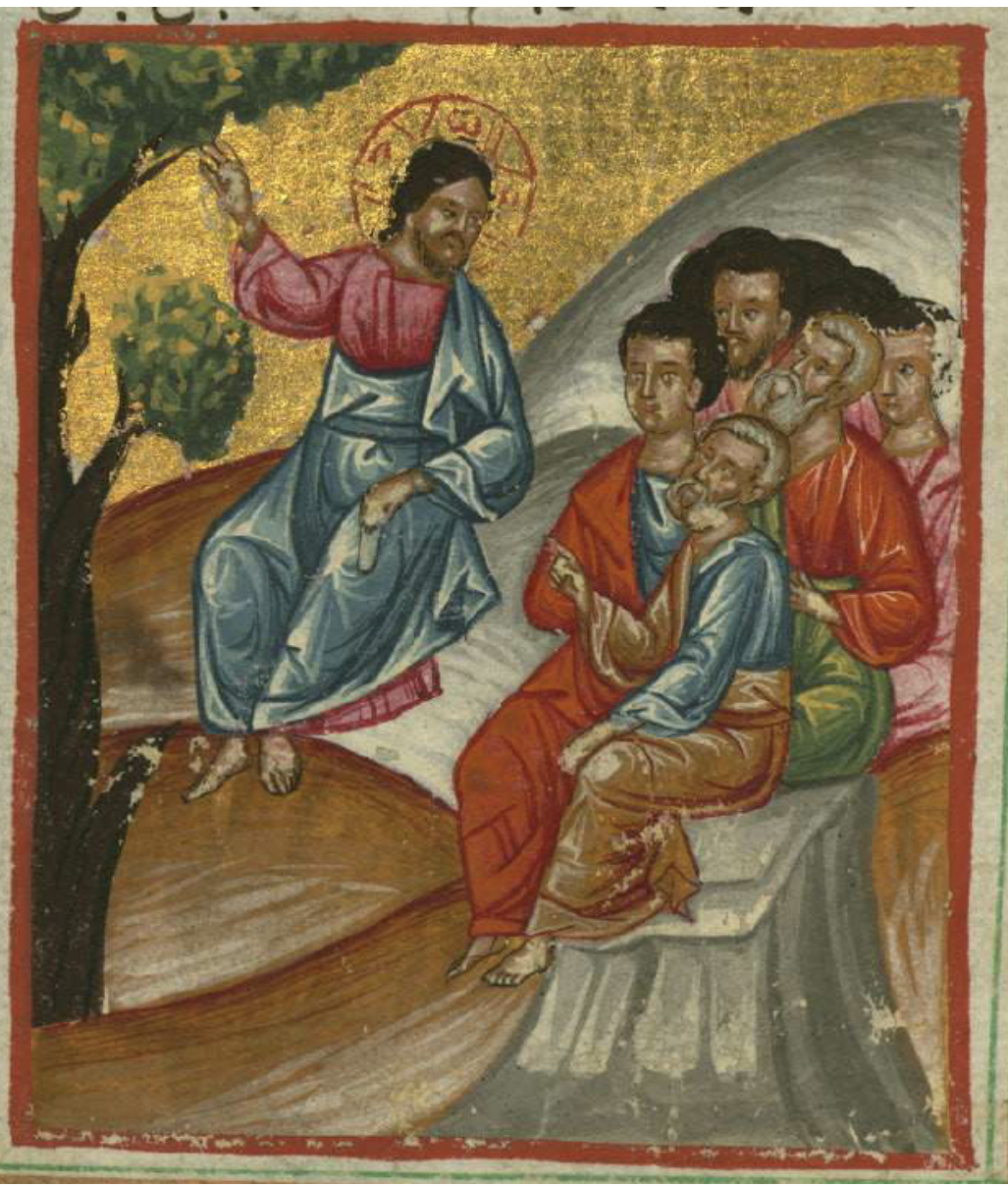
On the featured image
One of the most enduring depictions of Jesus in his role as a teacher is the traditional Eastern Orthodox Byzantine depiction of Christ the Teacher (often associated with the Christ Pantocrator tradition).
In this iconographic tradition, Jesus is shown holding a book of the Gospels in his left hand—symbolizing his teachings and the divine law—while his right hand is raised in a gesture of blessing, which also mirrors the classic rhetorical gesture of an orator or teacher addressing an audience in the ancient Greco-Roman world.
Mathews, Thomas F. The Clash of Gods: A Reinterpretation of Early Christian Art. Princeton: Princeton University Press, 1993.
Demus, Otto. Byzantine Mosaic Decoration: Aspects of Monumental Art in Byzantium. London: Kegan Paul, Trench, Trubner & Co., 1947.
Maguire, Henry. The Icons of Its Saints: Byzantium and the Images of Christ. Washington, D.C.: Dumbarton Oaks Research Library and Collection, 1996.