We know from the introduction this text is going to dive into the question of the internal revolution, known as conversion.
For thirty-five years of my life I was, in the proper acceptation of the word, a nihilist,-not a revolutionary socialist, but a man who believed in nothing. Five years ago faith came to me ; I believed in the doctrine of Jesus, and my whole life underwent a sudden transformation. What I had once wished for I wished for no longer, and I began to desire what I had never desired before. What had once appeared to me right now became wrong, and the wrong of the past I beheld as right. My condition was like that of a man who goes forth upon some errand, and having traversed a portion of the road, decides that the matter is of no importance, and turns back. What was at first on his right hand is now onhis left, and what was at his left hand is now on his right; instead of going away from his abode, he desires to get back to it as soon as possible. My life and my desires were completely changed ; good and evil interchanged meanings. Why so? Because I understood the doctrine of Jesus in a different way from that in which I had understood it before.
He re-read the Gospels, or read them anew as though for the first time.
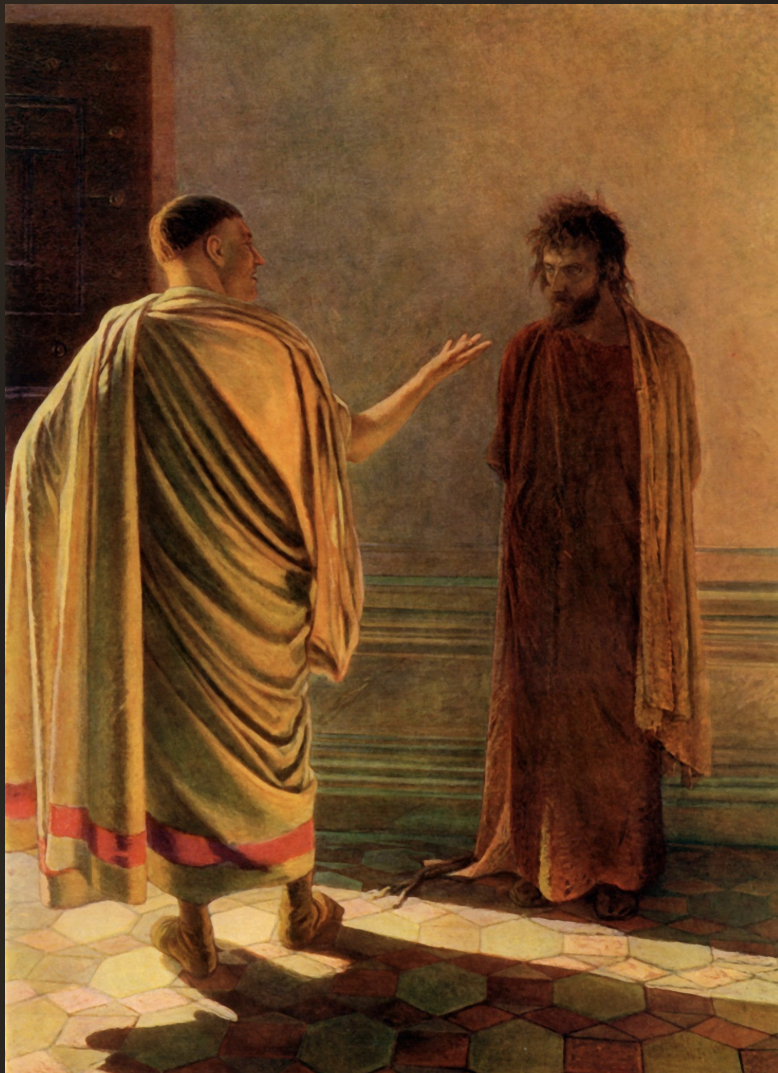
On the featured image:
Nikolai Ge was an active member of the Peredvizhniki (The Wanderers), a cooperative of Russian realist painters who rejected the formal, idealized constraints of the Imperial Academy of Arts. Following Tolstoy’s severe spiritual crisis and subsequent excommunication, Ge became one of the author’s closest disciples, abandoning his earlier academic style to forge what Tolstoy hailed as “a new epoch in Christian art.”