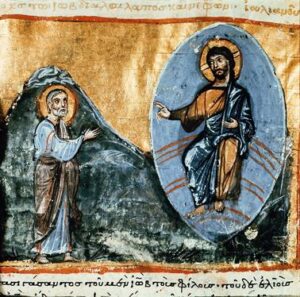
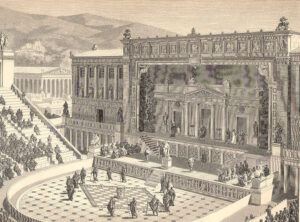
Leo Strauss goes back to the beginning and says well, at the real beginning you have to decide Faith or Reason; Jerusalem or Athens.
Hobbes’s incorporation of the Hebrew Tradition with the Title.
Its an mythical beast that says something about the end of the story.
Covenant law giver Moses as an example.
Connection to Athens, pursuit of reason, knowledge
critical of slavish inheritance of Aristotle
inheriting the drive to Logos but open to reading differently.
while advocates for the unity of the executive power, he completely criticizes the theory of divine right’s idea of personation.
Instead he puts theatrical and legal notions of person in its place. So, here we get to the humanist influence, the Rome.
The hills in the one depiction of the frontispiece an allusion to the Roman tradition.
The citations, the perspicuity, the interplay of word and image, in the spirit of Rome.
So, now we have gone over spirits of Jerusalem, Athens, and Rome.
But there’s another Jerusalem or rather a Bethlehem when he alludes to the Book of John with Jesus is the Christ being cast as the minimum state religion.
Then when you go back and look at the emblem, the people are like the scales.
Emblem is the symbol you look at, at the beginning and end. Reference to the New Testament is at the end, always refers back to the Old Testament. Christ, the New.
But in beginning/ending it with the Leviathan as the emblem, it displaces the other attempt at an ending, the Wedding Banquet. The Wedding Banquet is expounded upon by the theorists of divine right he rejects.
Why that matters is the picture of community that the different images suggest.
So, how Leviathan falls on the question of philosophico-spiritual capitals, is very Athenian in spirit — prizing the Logos, a story about coming out of unreason to reason, and the Jerusalem part comes in at the beginning and the end.
So, its not reason or revelation, how the story ends, the feast on the Leviathan, that is what is left to revelation.
The spark at the beginning, and the how of the imitation of God, that is all Roman inspired, or Promethean.