Conclusion: Mimesis in Thomas Hobbes’s Leviathan: a new approach to constitutive power and citizenship
Leviathan is the first text in the history of political thought that portrays a mechanical world picture, employing Gabriel Harvey’s view of the mechanistic nature of the human body to analyze human passions.485 Hobbes championed the goals and methods of science in his praise of certainty, evidence, and logic.486 He was uniquely positioned historically to have enjoyed the benefit of an extensive education in the humanistic disciplines, as well as access to conversation with revolutionary scientific thinkers.487 In this dissertation, I have argued that only attention to mimetic dynamics in Leviathan can illuminate how Hobbes answers the question of the know-how through which the future subject-citizens can construct the political authority under which they will live.
Understanding the mimetic dynamics in the text is a way of balancing the resonances of Hobbes’s invocation of the world as both mechanical and theatrical. It makes sense for a thinker who adopts a mechanistic worldview to also revalorize theatrical mimesis. A correlate of accepting the mechanistic world picture, is that the ontological hierarchy between the real and appearing world is no longer tenable.488 This hierarchy is posited by Plato’s critique of the arts, and is the problem around which Aristotle devises his cosmology.
485 Aloysius Martinich, Hobbes a Biography (Cambridge, UK ; New York: Cambridge University Press,1999).
486 Hobbes and Tönnies, The Elements of Law, Natural & Politic. Hobbes and Tuck, Leviathan.
487 John Aubrey and Richard W. Barber, Brief Lives, First Person Singular, (Woodbridge, Suffolk, UK ; Rochester, NY: Boydell Press, 2004). Noel Malcolm, Aspects of Hobbes (Oxford New York: Clarendon Press; Oxford University Press, 2002). Skinner, Reason and Rhetoric in the Philosophy of Hobbes.
488 Blumenberg, The Genesis of the Copernican World. Koyré, From the Closed World to the Infinite Universe.
mimesis illuminates the humanistic aspects of early modern science, working against the suggestion that science and humanism can be discretely divided from one another.
Another approach to elaborating this second line of research, to show the relationship between scientific and humanistic texts through the relevance of mimetic
dynamics to the development of science, is to examine Hobbes’s anthropology more closely. Anthropology has to do with what men are like ‘by nature’ and in the state of
nature. In my view, the mimetic dynamics of the state of nature show that this anthropology also presupposes the general men share a cultural horizon. In other words
the problem of mimetic desire, which involves interpreting socio-cultural signs and gestures may be what men do ‘by nature.’ Hobbes would then no longer be considered a
social contract theorist like Rousseau, who becomes embroiled in an untenable nature culture distinction. Instead, Hobbes could be considered a thinker of how mimetic
dynamics affect men’s passions, and therefore their ability to create and recreate norms and laws by shaping one anothers passions and perceptions through engaging in
mimetic dynamics. Hobbes can be considered an anthropologist—one who is both scientific and humanistic, and his anthropology one in which man’s nature is necessarily imbricated with his culture, and a man who can be depicted in terms drawn both from the mechanical sciences and classical literature.
extent the mechanical worldview is related to Hobbes’s political thought.489 While it is documented that Hobbes visited Galileo, and read Euclid in his study Hobbes’s scientific views are difficult to interpret because in the years in which he was writing Leviathan he was not completing many scientific projects he had previously laid out for himself.490 Further, Hobbes’s mathematics have been criticized for their incoherence.491 In terms of textual evidence, the allusions to classical literature are far easier to identify than the exact contours of Hobbes’s scientific world picture.
My argument is that if we accept that Hobbes indeed attempted to adopt a mechanistic worldview, his revalorization of mimesis sensibly follows from this, because the classical critique of mimesis is based on the ontological hierarchy which collapses with Galileo’s geometrization of space.492 In other words, Hobbes’s revalorization of
mimesis is related to adoption of the mechanistic worldview, because figuring the knowledge/power required for the constitution of the modern commonwealth in the
imitative arts, implies a rejection of Plato’s ontological hierarchy between real and appearing worlds. For Hobbes the world is mechanistic, and people appear to one
another in it. Hobbes does not suggest that there is a real beyond this. Once the hierarchy between real and appearing worlds collapses, there is no basis to criticize the
theatre of the world. Hobbes has a mixed relationship to classical citations of mimesis, revalorizing critiques of mimesis and continuing in the tradition of reflecting on the positive possibilities of mimesis.
489 Watkins, Hobbes’s System of Ideas. Spragens, The Politics of Motion; the World of Thomas Hobbes.
490 Quentin Skinner, “The Ideological Context of Hobbes’s Political Thought,” The Historical Journal 9, no. 3 (1966).
491 Watkins, Hobbes’s System of Ideas.
492 Rossi and Nelson, Philosophy, Technology, and the Arts in the Early Modern Era. Koyré, From the Closed World to the Infinite Universe.
I have argued that Hobbes revalorizes mimesis against Plato’s critique, and that he clearly continues with the valorization of mimesis where it was praised among classical thinkers.493 For example, I have argued that Hobbes extensively borrows the techniques of plot structure defining poetic mimesis outlined by Aristotle.494 Furthermore, the vivid, imagistic language use Hobbes valorizes had been previously lauded in classical poetry criticism, and in the Latin rhetorical tradition.
Hobbes revalues mimesis where it had been criticized, and he continues employing mimesis as it had been recommended in classical texts.
Mimesis was not unrelated to the goals of science, since reversal and recognition teaches logic, and since mimetic language use is a way of making evident in words what
is evident to the eyes.495 Logic and evidence were central to the scientific standards developing in the early modern period. The poetic dimension of mimesis reconciles the
historical texture of the text with its “logic.” The poetic dimension of mimesis clarifies Hobbes’s approach to normative theorizing, the content of his normative philosophy as
involving self-knowledge, and the norm creating possibilities inhering in poetics. The linguistic dimension of mimesis demonstrates that men can act as agents in the
constitution of their political authority. While the mechanical metaphors emphasize Hobbes’s scientific aspirations, only a focus on the relevance of mimesis reveals that
Leviathan is a text about norms and how men can create them as much as it is about the mechanization of the world picture. The centrality of mimesis arises in relation to
Hobbes’s interest in mechanizing the world picture, because revalorizing mimesis makes sense in light of the collapse of the ontological hierarchy between real and appearing
worlds.
493 Gray, “Mimesis in Greek Historical Theory.” Quintilian and Butler, The Institutio Oratoria of
Quintilian. Marcus Tullius Cicero, James M. May, and Jakob Wisse, Cicero on the Ideal Orator (De Oratore)
(New York: Oxford University Press, 2001).
494 Aristotle, Benardete, and Davis, Aristotle on Poetics.
495 Cave, Recognitions : A Study in Poetics.
While mimesis belongs to the tradition identified as part of humanistic studies it also plays an important role in the development of the normative standards of science.
Mimesis belongs to both the history of science and the humanistic studies. Hobbes draws on dimensions of mimesis blending a view of the passions from classical
humanistic texts with a new understanding of force and motion informing his view of how the passions operate. The meanings of mimesis and how they work in Leviathan
suggest that there cannot be a hard and fast line between science and humanism, or the study of nature and the study of man. A great deal of Leviathan is dedicated to how the passions move, and this explanation involves both the mechanical views of force and motion and humanistic views of how men interpret one another’s social performances.
In my view, Hobbes’s central contribution to political thought is his replacement of Aristotelian praxis and prudence with the imitative arts as the power and knowledge required for the formation of the polity. This brings the question of the movement from a state of nature or anarchy to a norm and law governed society away from mythologies of demiurgical founders who miraculously appear to the question of the constitutive power of the multitude.496
The imitative arts, or involving oneself in mimetic dynamics as the knowledge/power required to constitute the polity counts as a significant departure from the aristocratic prejudice, because these arts do not require a specific economic status, even while they cannot guarantee substantive equality. Hobbes contributes to the history of political thought in employing dimensions of mimesis because he turns to mimesis in order to solve a problem of human motivation, but does not want to rely on the Platonic notion of the soul or a Christian Aristotelian view of the will. Reading Leviathan according to the imitative arts is the only way to take seriously the following two ideas: that Hobbes attempts to move
496 Cicero et al., “De Inventione.”
beyond classical and scholastic concepts of the will, and the idea that men are agents. Interpreters who focus on the mechanical movements of the passions, portray
Hobbesian men as reactive, rather than agents in the formation of the commonwealth.497 On the other hand, interpreters who recover Hobbes’s humanistic influences, reattribute a traditional concept of the will to the Hobbesian man, arguing that the formation of the commonwealth is a matter of the morally correct intention.498 A focus on the mimetic dynamics at play in the formation of the commonwealth by contrast, remains true to the sense in which the formation of the polity is a process, but a process in which men are not totally reactive, but agents in the ongoing outcomes. Understanding the mimetic dynamics at play in Leviathan, leads to a different interpretation of men’s passions. While conceding that for Hobbes, passions are formed by force and follow trajectories of motion, I have argued that Hobbes also draws upon the force of theatrical, poetic, and linguistic mimesis as ways that men can act as agents employing force on the formation of their own and others’ passions. As a result, the force which compels men to covenant cannot be reduced to mechanics alone. The reason that this distinction between the mechanico-materialist psychology and mimesis is necessary, is to the way in which it allows the interpreter to distinguish Hobbes’s two separate accounts of how men respond to what they perceive. According to the mechanico-materialist psychology, men react with appetite or aversion to objects in their empirical field of vision, moving towards the objects of their appetites and away from their aversions.499
497 Ball, “Hobbes’ Linguistic Turn.” Wolin, Hobbes and the Epic Tradition of Political Theory. Kottman, A Politics of the Scene.
498 Strauss, The Political Philosophy of Hobbes : Its Basis and Its Genesis. Oakeshott, “The Moral Life in the Writings of Thomas Hobbes.”
499 Hobbes and Tuck, Leviathan, Chapters 1 and 2.
This account of perception which relates vision to the mechanical motions of themind and body, leaves out the mimetic dynamics of perception, which are certainly
“forces” that escalate the state of nature.500 In order to assess how others’ may be honoring or dishonoring him, the general man has to have a shared horizon of meaning
with his fellows as to what constitutes an honor. This means that reading signs of honor presupposes a socio-cultural horizon that men in the state of nature share in
common. The problem of mimetic desire central to Leviathan’s anthropology reveals that Hobbes does not assume that nature is autonomous from culture. When the general
man reads the gestures of honor and dishonor in others’ comportment towards him, he “perceives” the other, or sees him, but he does so through a lens of interpretation that
cannot be reduced to reactions within the mechanico-materialist psychology. Men are not “responsible” in the traditional sense for their appetites and aversions, but they can
be held responsible for what they see in others, i.e., how they respond to the signs of honor and dishonor they perceive in others’ comportment. In sum, there are two kinds of perceiving in Leviathan, but only perception in the context of mimetic dynamics is the kind of perception for which men are responsible. While the mechanico-materialist psychology is a fundamental aspect of man, mimesis is central to Hobbes’s anthropology, so can be considered just as fundamental. I have argued that while the mechanico-materialist interpretations have merit, they can obscure Hobbes’s response to the problem of agency. Identifying the mimetic dynamics is a way of showing how men are responsible for the constitutive power Hobbes attributes them with. Hobbes overcomes the aristocratic prejudice by departing from accounts of founding in which the authority figure miraculously appears to constitute
500 Ibid., Chapter 10.
the commonwealth. He also leaves the aristocratic prejudice behind in his description of citizenship and the law as incorporating the concept of equality. The mechanico-materialist interpretation alludes to mythical foundings, because it suggests the multitude is forced to covenant through a spectacular appearance. This has to be reconciled with the idea that Hobbes also argues that the multitude has constitutive power.501 I have argued that Hobbes presents dimensions of mimesis as the forms of power/knowledge the future subject-citizens employ to form a normative consensus and give themselves the law. Leviathan is indeed a text about how might makes right, but this is not a reason to dismiss the text as irrelevant for contemporary political philosophy. Hobbes innovates in asking the question of what kind of power or force exerted by the multitude can “make” a polity. His response is that the imitative arts can be considered constitutive power. Through an analysis of the imitative arts, I have argued that
citizens of a Hobbesian commonwealth may be able to create a political space in which to pose questions of legitimacy. This means that while it is true that might makes right
in Leviathan, Hobbes’s analysis of might is novel and interesting. When we attribute the power or force to move people towards normative consensus in order to found a
legal system to mimetic dynamics, then there is an account of how men working together can be held responsible for the norms and laws of their polity, without thereby
positing that this responsibility is located in the will. While Leviathan can be reduced to the adage that might makes right, if we consider “right” to be synonmous with a political authority and might with constitutive power then it becomes clear that only through an analysis of the mimetic dynamics, can
501 Cicero et al., “De Inventione.”
we understand what might makes right could mean. Typically it means that authority consists in the concentration of power, and alludes to a pacified citizenry, as though
citizenship opportunities were totally precluded by the sovereign’s might.502 It typically also means that the laws of nature cannot be considered a robust ethical philosophy
because ethics is usually considered to include a set of behaviors one would do when not forced.503 If we reinterpret might makes right according to the mimetic dynamics I
have identified in the Leviathan, then a different picture of this adage emerges. The might involved is the imitative arts as constitutive power, in other words, the ways in
which the theatrical, poetic, and linguistic dynamics of mimesis can exert a force equal to the task of forming a commonwealth out of a state of nature. The “makes right” half
of the adage can be illuminated by the idea that the theatrical mimetic dynamics of citizenship mean that the consitutive power can be exercised in the context of the
commonwealth. I have argued that theatrical mimetic dynamics of citizenship leave open the possibility citizens could create a space in which to raise questions of legitimacy or right, in and through acting and critical spectatorship. The idea that might makes right when read through the lens of the mimetic dynamics does not preclude ethics as usually supposed. I have argued that Hobbes advises his readers to know themselves as an ethical principle, and depicts the general men attempting to know themselves through the problem of mimetic desire. This problem is overcome when the general man listens to his conscience, recognizes the laws of nature and covenants. Although this moment can be read without an ethical valence, as simple normative conformity, it can also be read through the lens of the idea
502 Oakeshott, Hobbes on Civil Association. Wolin, Hobbes and the Epic Tradition of Political Theory. Kottman, A Politics of the Scene.
503 Gauthier, The Logic of Leviathan: The Moral and Political Theory of Thomas Hobbes. Jaume, Hobbes Et L’etat Représentatif Moderne.
that Hobbes suggests that ethical action involves a coming to self-knowledge concomitant with listening to one’s conscience. This ethical lesson has a continued relevance at the level of theatrical mimesis, because in order to create the peace that is Hobbes’s aim, actors would have to be self-conscious of their performances in order to achieve the desired effect of peace.504 An analysis of the theatrical dynamics of citizenship also reveals Hobbes’s failure in writing Leviathan, if his aim was to show that the ends of peace, unity, and felicity can be unambigously reconciled in a modern commonwealth.505 The unbelievable aspect of Leviathan’s plot is the idea that each man’s conscience would recognize the same set of ethical precepts at the exact same moment.506 In other words it is difficult to believe that a multitude would unify completely and every person is also simultaneously listening to his own conscience. The trouble with explaining the unity of the commonwealth also arises in the context of Hobbes’s solution to the problem of maintaining unity, the sovereign definer.507 It is also not plausibile that the sovereign definer would be able to dictate the meaning of terms unequivocally. An analysis of
Leviathan through poetic mimesis reveals that Hobbes has depicted a scene of normative conformity at the same time he presents the lesson that ethics involves self-knowledge through listening to one’s conscience. The normative agreement that is the precondition of politics, does not necessarily mean that a commonwealth can facilitate
ethical action, peace and unity without conflict. Hobbes recognizes this when he notes
504 Frost, Lessons from a Materialist Thinker : Hobbesian Reflections on Ethics and Politics.
505 Hobbes and Tuck, Leviathan.
506 Ibid.
507 Ibid.
that new truths would be able to bustle in despite the sovereign definer, leaving open the possibility that discord and war could still erupt from within a civil context.508
The dynamics of theatrical mimesis illuminate the problem of whether or not Hobbes’s ends of peace, unity, and felicity are necessarily complementary political aims.
Through performances and critical spectatorship, citizens can interpret and reinterpret norms and law, so the constitution of the commonwealth is not immune to historical
development. In arguing that a Hobbesian politics amounts to the effects of theatrical mimesis, this does not mean that the commonwealth would necessarily be authoritarian, liberal, or republican in character, it means that the character of the commonwealth is dependent upon citizen performances and critical spectatorship. Mimesis in Thomas Hobbes’s Leviathan is relevant for contemporary democratic political theory because it is a novel account of constitutive power. The theatrical dimension of mimesis illuminates the sense in which citizens may still be able to employ their constitutive power after the covenanting moment. If the sovereign is comprised of many offices, wherein subject citizens play roles in which they bear the person of the state, then Leviathan prefigures the modern bureaucratic state. While this has been considered a development which makes democratic participation more difficult and less relevant, Hobbes’s depiction of a politics of theatrical mimesis leads to a reconsideration
of how and why citizenship can be an effective practice despite the context of a modern bureaucratic commonwealth.509 Can the theatrical dimension of mimesis be employed to change dominant interpretations of norms and laws from within governmental bureaucracies? Can bureaucracies be transformed into political spaces through citizen
508 Ibid.
509 Max Weber, Politics as a Vocation, Facet Books. Social Ethics Series, 3 (Philadelphia,: Fortress Press, 1965).
participation? Recognizing the mimetic dynamics at play in Leviathan illuminates the sense in which Hobbes addresses the question of the constitutive power of the multitude
and citizens. Attention to mimesis also reveals that Hobbes ought to be considered a significant thinker of the practice and powers of citizenship. The anthropological, poetic, linguistic, and theatrical dimensions of mimesis suggest two future lines of research. The first concerns a fuller account of theatrical mimetic dynamics for citizenship, including how performance and critical spectatorship work to shift norms and laws. This line of research would be interesting because it would result in a fuller account of how citizens can be agents responsible for the contours of the norms and laws governing their commonwealth, without using the concept of the will in order to attribute this responsibility to the citizens. The second line of research this dissertation suggests is a closer examination of the humanistic aspects of early modern science. The mimetic aspects of Hobbes’s account of power, suggest significant humanistic influences are at work in texts now classified as science. Examining Leviathan according to the scientific account of man alone obscures Hobbes’s account of agency and participatory citizenship. The interpretations resisting this temptation have usually ascribed a non-Hobbesian view
of the will to the general man in order to account for changes in his passionate makeup. Mimesis illuminates agency and citizenship through tracing Leviathan’s relationship
with classical texts, and so counts as the humanistic aspect of the text. At the same time, the mimetic dynamics implicated are ultimately attributable to Hobbes’s
anthropology, and he consistently declared that his view of ‘man’ was scientific. Reading Leviathan through the mimetic dynamics facilitates a rejection of the false
dichotomy between the scientific and humanistic aspects of Hobbes’s thought. Rather, mimesis illuminates the humanistic aspects of early modern science, working against the suggestion that science and humanism can be discretely divided from one another. Another approach to elaborating this second line of research, to show the
relationship between scientific and humanistic texts through the relevance of mimetic dynamics to the development of science, is to examine Hobbes’s anthropology more
closely. Anthropology has to do with what men are like ‘by nature’ and in the state of nature. In my view, the mimetic dynamics of the state of nature show that this
anthropology also presupposes the general men share a cultural horizon. In other words the problem of mimetic desire, which involves interpreting socio-cultural signs and
gestures may be what men do ‘by nature.’ Hobbes would then no longer be considered a social contract theorist like Rousseau, who becomes embroiled in an untenable nature culture distinction. Instead, Hobbes could be considered a thinker of how mimetic dynamics affect men’s passions, and therefore their ability to create and recreate norms and laws by shaping one anothers passions and perceptions through engaging in mimetic dynamics. Hobbes can be considered an anthropologist—one who is both
scientific and humanistic, and his anthropology one in which man’s nature is necessarily imbricated with his culture, and a man who can be depicted in terms drawn both from
the mechanical sciences and classical literature.
Things this dissertation makes me think of.
Imitate is the action verb in the sentence, which is why I went after it.
The covenanting moment is reminiscent of the sacrifice.
Its a textbook description of what is later termed alienation. something is taken from you, and then held over you, as an authority, and unreachable object of desire.
Spectatorship belongs to the demos since the Greeks. What is the founding moment equivalent of catharsis.
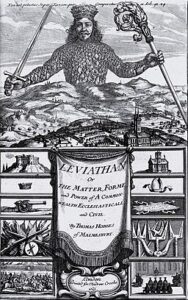
The Leviathan is so thoroughly humanist. The citational style, use of emblematic frontispiece, the rhetorical tradition. Whenever we go to Rome, we ask what was the lesson for a Republic? How do the imitative arts inform the citizenry’s ability to maintain the triangles (executive, legislative, judicial or king, nobles, plebs). And the maintenance of the Republic it was always supposed to be eternal. Classical prejudice against change was due to fear of disorder, change is always towards disorder.
The fear of the face of the sovereign that is everyone’s face combined echoes the sublime, and creates the passive position, and epic distance. From the interplay of the powers of the imitative arts to overcome by the sublime. Active to passive. Motion to stop.
Comment on Strauss: he locates the lamentable historicization of political thought (which is bad because it leads to relativism) in the text.
Valorization of the eternal from a Republican perspective, or from a Straussian invocation of the eternity of the classical forms, leads to the question of Hobbes’s commentary on it.
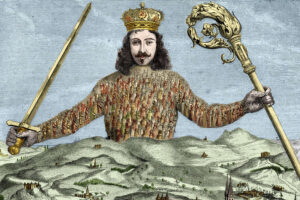
What is Hobbes’s comment on this. Well Frontispiece is still. Leviathan is the title, that is at the beginning. And its also at the end. Its a myth about the end of the world, and also when you finish the book you look again at the Frontispiece.