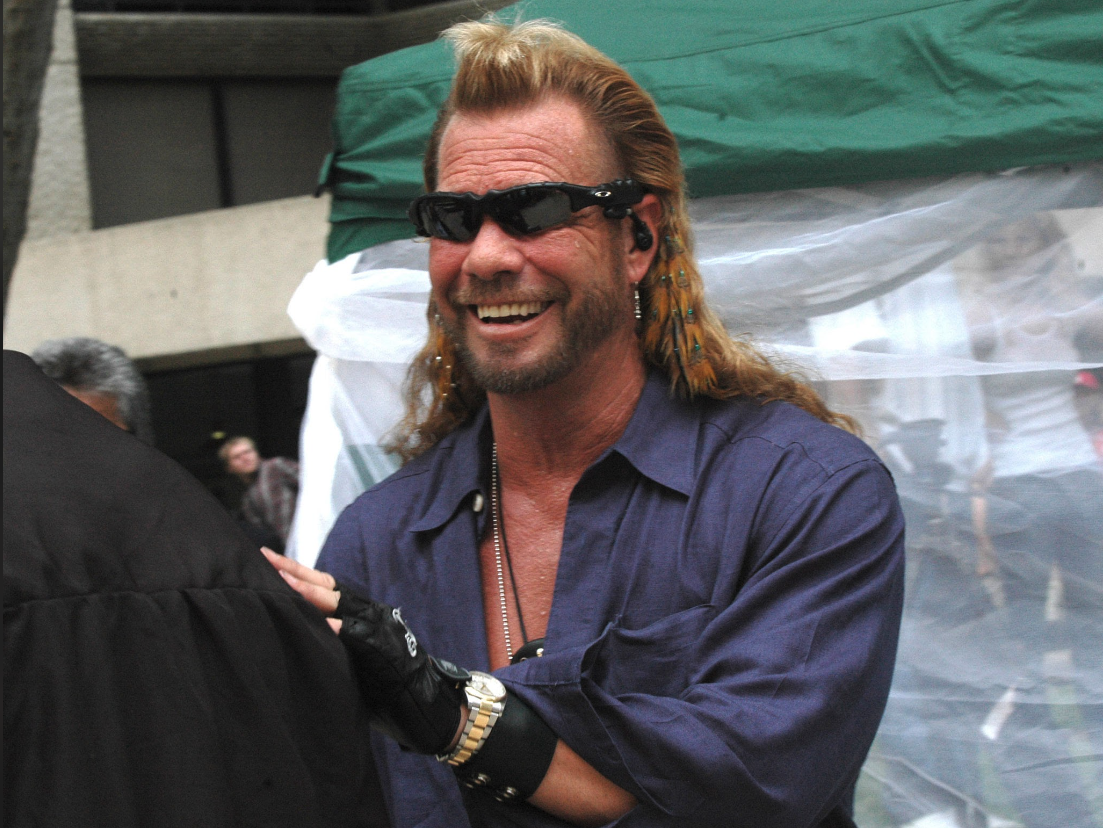
This is in no way any kind of exposé on Duane Chapman. I don’t know the man, I have no interest in being libelous, and I’m not about putting negativity into the world.
Watching Dog is how I noticed the contradictions that all citizens are wrapped up in, come to the fore specifically for him, due to his line of work.
One of the preoccupations we keep coming back to is the relationship between life and the law.
Law points to authority then you have to turn around that in your mind.
Authority can be institutionalized, fall within the purview of organizational logic, and require processes to be followed.
The mind wanders to questions of justice.
So you may be wondering or asking after the right relationship between your life and your law, and it seems that this question comes up in Dog’s show.
This article should be titled, Dog the Bounty Hunter, Inside and Outside the Law
I became interested in Dog the Bounty Hunter I believe in the summer of 2006 or 2007 to verify. Right before I went to Paris for the first year of my Chateaubriand. I was in Kansas at my parents house and I saw Dog the Bounty hunter on tv.
I was also reading Freud at the time and found out about the DSM. I was also reading
The comedian I was into at the time was definitely Bill Hicks.
They say that contradictions are running through each one of us. Each persons life is a wrestling with the contradictions their being inhabits.
The vanguard of the proletariat is an example of a contradiction e.g., the difference between the social class of Marx’s setting and the point of view he wrote from.
But Dog the Bounty Hunter caught my attention because of the precise nature of the contradiction running through his life.
I’m circling around these characters and topics where it seems like there is some intersection of life and law, a limit case, an exemplar, a case study.
Inside the law
Dog the Bounty Hunter’s character is contradictory because he wears the costume of an outlaw, but being a bounty hunter in itself, is an inside the law job.
Definition of Bounty Hunting
There’s the insurance aspect of bond.. Its a bet on someone’s appearance. Bounty Hunting is required when people do not appear before the law on a certain day. Bond is set, in part, by the liklihood of the appearance. Bounty hunting is a type of law enforcement. It is an apprehending of a person to bring them before the law. It is internal to the logic of the law, which is universal in scope.
Academic discourse around bounty hunting
Nieto, Marcus, and Margaretetta Johnston. The Regulation and Control of Bail Recovery Agents: A Fifty-State Review. Sacramento: California Research Bureau, 2007.
Cubellis, Michelle A., and Bryce E. Peterson. “Bail Bondsmen.” In The Encyclopedia of Crime and Punishment, edited by Wesley G. Jennings, 1–5. Hoboken, NJ: John Wiley & Sons, 2016.
Relationship between private insurance company and a person’s relation to the law. Now there is another interested party.
Outside the Law
While Dog’s role is crucial for validating the insurance company’s bet and bringing the alleged criminal before the law, he carries out the duties in outlaw garb.
Be able to go into outlaw communities useful when looking for outlaws.
Borrows the cool vibe of the outlaw.
Enforcing the law while appearing like a person who disregards the law.
What is outlaw bravado? Brave to stand outside the law, but bravado is also like hutz pah. The daringness. There is also a bravado to the judicial branch.
This same type of daringness can cause prickish behaviour which results in little skirmishes with the law, the the police being called during heated interactions, or threats of interpersonal violence when not relevant to the legal situation. I’m not saying anyone in particular has done this you can just sort of see how the law enforcement personality can bleed over into domestic situations.
When a law enforcement figure is caught doing something illegal he would claims special status or privilege to avoid being treated like criminal despite transgressions.
Logic of exception to the law.
Whose Judgment is it anyway
Inside the law: lots of places to throw the judgment
You violated parole, blame the parole officer.
Parole officer following judge’s orders; blame the judge.
So and so gave skewed testimony, blame the witness.
In the end, when facing Dog, must face the wrongdoing that got them in this situation.
Sinner coming in. Reinforces the law as savior. Receive your earthly judgment, admit your sinful nature.
In enforcing the law, Dog finds himself re-enacting this savior mythos.
Outside the law: listen to this elaborate rationale, that only I could come up with, about why my very special circumstance puts my case outside the field of those cases to which this law is applicable.
So what are these contradictory attitudes at play? At times needing to be recognized as the law incarnate to complete the enforcement activity; at others attempts to fall outside the purview of the law.
Being seen as the law; not being seen by the law. Embodiment, escape
You Can Run but you Can’t Hide was the first one of Dog’s books I read.