
Michael Hanchard Afro Modernity: Temporality, Politics, and the African Diaspora

These encounters remind us, I believe, that there are many vantage points from which one can view and experience this thing known as modernity: as nightmare or utopia; as horrible past or future present. These contrasting views caution us against modernity’s reification and implore us to view modernity as a process of lived experience, with winners and losers, as well as strivings for redemption, recovery, retribution, and revolution, each experience tumbling into another and becoming—dare I say—history.

Continue ReadingMichael Hanchard Afro Modernity: Temporality, Politics, and the African Diaspora

Linda M.G. Zerilli Feminism and the Abyss of Freedom

A freedom centered feminism would strive to bring about transformation in normative conceptions of gender without returning to the classical notion of freedom as sovereignty that all three waves of feminism have, in their different ways, at once accepted and rejected. Such feminism would be a world-building practice that changes political freedom from the "I-will" into the "I-can". This I-can is nothing other than the public persona described earlier, what Arendt called "the mask" of citizenship and the rights and duties that correspond to being a member of a political community. I-can belongs to women neither as a sex nor a gender, neither as "natural" nor a social group. I-can belongs, rather, to women as a political collectivity, and it obtains in the practice of speaking women's name (which involves speaking for others, being spoken for, and speaking back). I-can is the non-soverign freedom of feminists as citizens engaged in word and deed, who are committed to the irreducibly non natural basis of political membership. p.180

Continue ReadingLinda M.G. Zerilli Feminism and the Abyss of Freedom

S. Sara Monoson Plato’s Democratic Entanglements

Plato’s depictions of intellectual labor in his dialogues contain a puzzle. On the one hand, the dialogues voice some of the most aggressive attacks on the intellectual merit of theatrical enterprises in all of Western litera-ture. Most famously, the Republic banishes poetry from the ideal city(607a–e). In the Laws, moreover, the Athenian Stranger decries the deterioration of democratic politics into a “wretched theatocracy” (theatro- kratia, 701a1). On the other hand, Plato likens serious intellectual toil, including philosophic understanding, to being a theater-goer. Through-out his dialogues he sustains a delicate metaphor: “Intellectual labor is like the activity of being a theate¯s,” where theate¯s refers to an audience memberat the theater, during the dramatic competitions held on grand civic festival occasions.

Continue ReadingS. Sara Monoson Plato’s Democratic Entanglements

Arendt Lectures on Kant’s Political Philosophy

In the Critique of Pure Reason imagination is at the service of the intellect; in the Critique of Judgment the intellect is "at the service of imagination." In the Critique of Judgement we find an analogy to the "schema": the example. Kant accords to examples the same role in judgments that the intuitions called schemata has for experience and cognition. Examples play a role in both reflective and determinant judgments, that is, whenever we are concerned with particulars. p.84

Continue ReadingArendt Lectures on Kant’s Political Philosophy

Arendt The Life of the Mind

For the thinking ego and its experience, conscience that "fills a man full obstacles" is a side effect. No matter what thought-trains the thinking ego thinks through, the self that we all are must take care not to do anything that would make it impossible for the two-in-ne to be friends and live in harmony. This is what Spinoza meant by the term "aquiescence in one's self" (acquiescentia in seipso): "It can spring out of reason [reasoning]. and this contentment is the greatest joy possible." Its criterion for action will not be the usual rules, recognized by multitudes and agreed upon by society, but whether I shall be able to live with myself in peace when the time has come to think about my deeds and words. Conscience is the anticipation of the fellow who awaits you if and when you come home. p.191

Continue ReadingArendt The Life of the Mind
Read more about the article On Marx
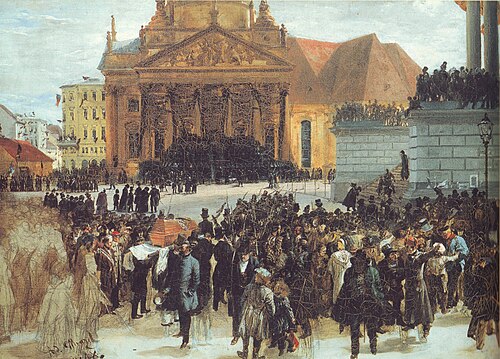
Aufbahrung der Märzgefallenen (1848) Adolf Friedrich Erdmann von Menzel (Hamburger Kunsthalle)Layingouthedead

On Marx

Marx's texts belong in the tradition because they are in asking the questions about a just social and political organization, the question of is there a pattern to history that…

Continue ReadingOn Marx
Read more about the article Hegel The Encyclopedia of the Philosophical Sciences
forhegelcopyright german circa 1830 group of f 1WAEY 570

Hegel The Encyclopedia of the Philosophical Sciences

Philosophy thus may definitely presuppose a familiarity with its objects indeed it must do so as well as an interest in them from the outset, if only because chronologically speaking consciousness produces for itself representations of objects prior to generating concepts of them. What is more, only by passing through the process of representing and by turning towards it, does thinking spirit progress to knowing by way of thinking [denkendes Erkennen] and to comprehending [Begreif/m].

Continue ReadingHegel The Encyclopedia of the Philosophical Sciences