Hobbes, Thomas. Hobbes: On the Citizen. N.p.: Cambridge University Press, 1998.
Hobbes, Thomas. De Cive. Edited by Howard Warrender. Oxford: Clarendon Press, 1983
De Cive (On the Citizen) is frequently considered a rough draft of the Leviathan.
Written in 1641 it was not published and distributed widely until 1647.
Hobbes was planning to write a trilogy.
Elementa Philosophiae, to be published, preceding De Corpore and De Homine.
So an investigation of physics, of human being, and then of the political body.
But he started circulating De Cive.
1642: The First Edition (Paris)
Hobbes, Thomas. Elementorum philosophiae sectio tertia de cive. Paris: [Privately printed], 1642.
Publisher: Privately printed for Hobbes by a small press in Paris, often associated with the circle of Marin Mersenne.
Provenance: This edition was extremely limited (roughly 50 copies). Many surviving copies originated from the personal libraries of 17th-century scholars such as John Selden and Pierre Gassendi.
Museum/Library Holdings: * The British Library, London (General Reference Collection C.115.b.24).
Bibliothèque nationale de France, Paris (MFICHE R-38955).
The Bodleian Library, Oxford.
Bibliothèque nationale de France (BnF): Digital Facsimile via Gallica. This is the primary digital surrogate for the Paris edition.
The British Library: Main Catalog Entry. Note: The shelfmark for the 1642 edition is C.115.b.24.
Houghton Library, Harvard: Catalog Record. Harvard holds a notable copy with the shelfmark *EC65.H6525.642e.
The editio princeps was published in Paris under the title Elementorum Philosophiae Sectio Tertia de Cive. This was a private, limited edition intended for a small circle of scholars and peers. Hobbes moved the publication of this third section forward due to the escalating political tensions in England, believing his theories on sovereign power were urgently relevant.
Hobbes, Thomas. Elementorum philosophiae sectio tertia de cive. Amsterdam: Apud Ludovicum Elzevirium, 1647.
1647 Amsterdam Edition (Elzevir Edition)
Publisher: Louis Elzevir. This edition made the work famous throughout Europe and included the famous engraved title page.
Provenance: These were mass-produced for the “Republic of Letters.” Many copies in American museums arrived via 19th-century academic collections.
Museum/Library Holdings:
The Metropolitan Museum of Art, New York (Department of Drawings and Prints, Accession 53.630.29 — specifically for the engraved title plate).
The Rijksmuseum, Amsterdam (Object number RP-P-OB-61.942).
The Huntington Library, San Marino.
The Metropolitan Museum of Art: Accession 53.630.29. This link directs to the specific entry for the Jean Matheus engraved title page in the Department of Drawings and Prints.
Rijksmuseum, Amsterdam: Object RP-P-OB-61.942. A high-resolution view of the frontispiece plate.
Folger Shakespeare Library: Catalog Record. The Folger holds several copies of the 1647 edition; search for Call Number H2215.
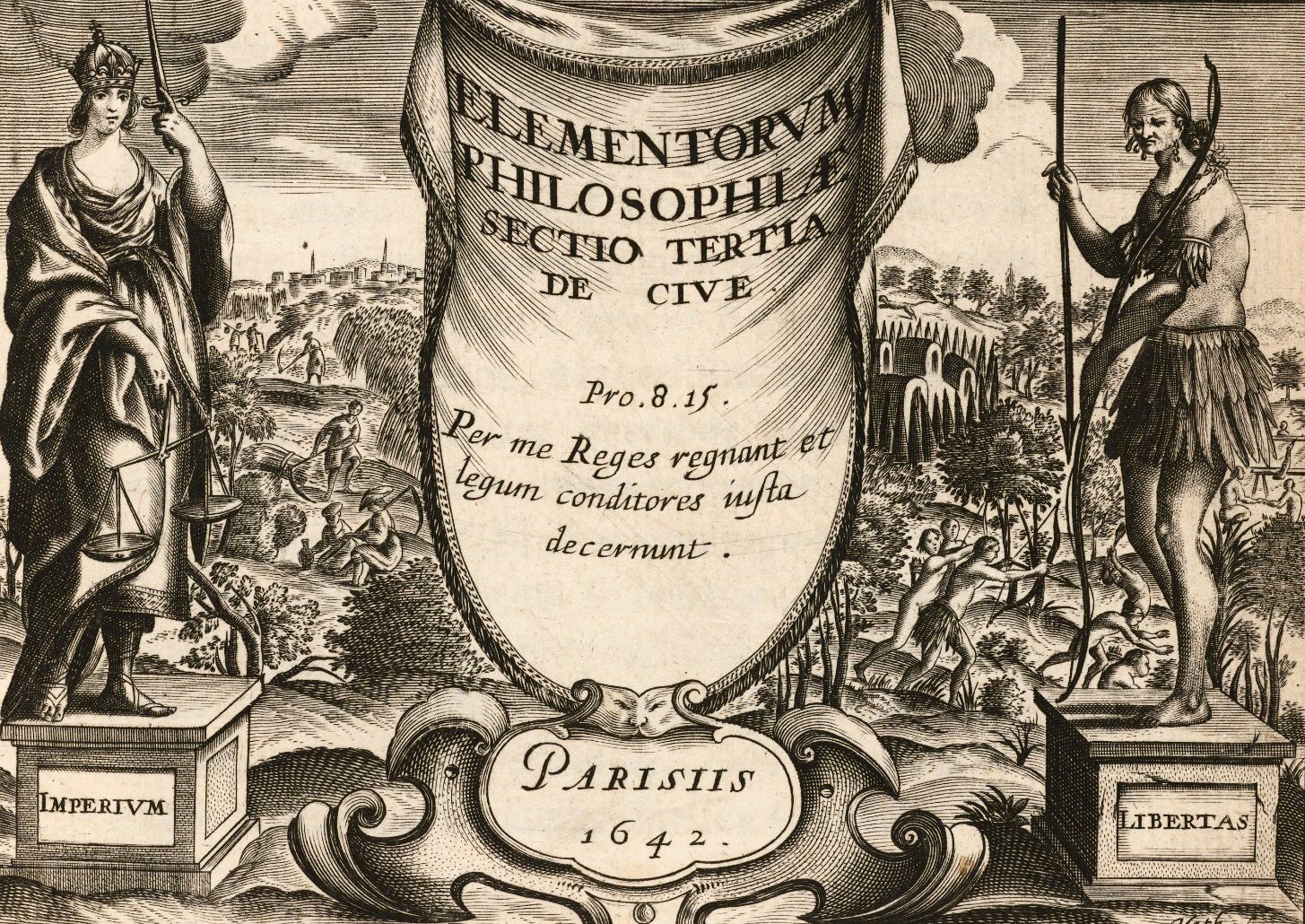
On the Frontispiece of De Cive
“Per me Reges regnant et legum conditores iusta decernunt” (By me kings reign, and lawgivers decree just things) — Proverbs 8:15
Imperium (Left Figure)
Visual Elements: An idealized female figure wearing a crown, holding a sword and a pair of scales.
Background: A peaceful, walled city with a cathedral, people walking in the streets, and farmers tilling fields.
The sword is the “Sword of Justice” (protection/coercion),
the scales represent the law.
Libertas (Right Figure)
Visual Elements: A “savage” figure (often interpreted through the lens of 17th-century colonial views of Native Americans) holding a bow and arrow.
Background: A wild, uncultivated landscape. In the distance, one figure is seen hunting another, illustrating the “war of all against all.”
Religio (Top Scene)
Visual Elements: A depiction of the Last Judgment or “Heavenly Kingdom.”
Symbolism: Placed above the earthly divide between Imperium and Libertas, it reminds the viewer that while the Sovereign is the supreme power on earth, there is a higher spiritual realm.
Bredekamp, Horst. “Thomas Hobbes’s Visual Strategies.” In The Cambridge Companion to Hobbes’s Leviathan, 29–60. Cambridge: Cambridge University Press, 2007. (Examines the 1642 and 1647 plates in the context of European “Image-Acts”).
Malcolm, Noel. “The Title-Page of Leviathan, Seen in the Light of De Cive.” In Aspects of Hobbes, 200–233. Oxford: Oxford University Press, 2002. (A critical comparison of the Matheus engraving versus the Bosse engraving for Leviathan).
Loxley, James. “The State of Nature and the Nature of the State: The Frontispiece to De Cive.” Word & Image 12, no. 2 (1996): 213–230. (An in-depth art-historical analysis of the “savage” iconography in the Libertas figure)