This might sound funny, but learn French to get in touch with your U.S.A. heritage. Learn French so you might have a tiny percentage chance of being invited to climb in the Pyrenees.
And learn French so you can go to Paris and have communicative encounters with other people.
French was the second foreign language I learned, but its the one I had the most confidence I could learn.
On the last visit with my paternal grandma, she had forgotten how to speak English after having spoken it 65 years or so, a retold her story of the day she became an orphan in Quebecoise.
My dad spoke French and was a Ricoeur scholar so my brother was in France for some formative preschool years.
At the dinner table when my parents wanted to talk about us in front of us they spoke French another little realization that the ability to understand what is being said is communicated with so much more than words.
I do not recall what I was reading in college when I decided my lack of French fluency could not stand. De Tocqueville, Montesquieu, Sartre, de Bouvoir are the likely suspects.
Back to a more recent context, I enjoy watching Cajun content on insta.
Once again, I took college classes in French, spent a summer in Montpellier, spent a summer in Middlebury, VT at the language school working on it.
On the featured poem:
Reading and reciting poetry is a major draw into languages for me. I saw this poem in a fashion magazine ad somewhere around 1996-8. Does it make the perfume smell great? No. Is a poem a great way to sell perfume. Yes, why, not sure, something about romance, subtly, desire. This poem smells kind of sad, though.
Paul Elouard
I Love You
I love you for all the women I haven’t known
I love you for all the times in which I haven’t lived
For the scent of the (wide) open sea and the scent of warm bread
For the melting snow, and for the first flowers
For the pure animals that man doesn’t haven’t yet been frightened by men
I love you for loving
I love you for all the women I do not don’t love
Who reflects me if not (you) yourself I see myself so little
Without you — I see nothing but an extended desert (empty expanse)
Between the past (those other days) and today
There have been all those deaths that I crossed on the straw
I have not been able to pierce (break through) the wall of my mirror
I had to learn life word by word
(How) As one forgets
I love you for your wisdom which is not mine
For health
I love you against everything that is but only illusion
For this immortal heart that I do not possess
You believe you are doubt and you are only (just) reason
You are the great powerful sun that goes (rushes) to my head
When I am sure of myself.
Éluard, Paul. Alternances. Paris: Le Sagittaire, 1950.
[you see, I was able to correct this translation because I had the better one memorized from the magazine. I recited it to myself. So when I read this translation, I knew it wasn’t the best. I knew it could sound better, just as I remembered.
So what we learned here is that the gemini ai gives an illusion of competence. It gave me a translation of the poem, but not the best translation. And the confidence I have, I know which translation is better — because I trust my ears, what I think sounds better in English. And also because my memory was trustworthy I knew when the translation fell upon bad choices.
Je t’aime
Je t’aime pour toutes les femmes que je n’ai pas connues
Je t’aime pour tous les temps où je n’ai pas vécu
Pour l’odeur du grand large et l’odeur du pain chaud
Pour la neige qui fond pour les premières fleurs
Pour les animaux purs que l’homme n’a pas effrayés
Je t’aime pour aimer
Je t’aime pour toutes les femmes que je n’aime pas
Qui me reflète sinon toi-même je me vois si peu Sans toi je ne vois rien qu’une étendue de désert Entre autrefois et aujourd’hui
Il y a eu toutes ces morts que j’ai franchies sur de la paille
Je n’ai pas pu percer le mur de mon miroir
Il m’a fallu apprendre mot par mot la vie
Comme on oublie
Je t’aime pour ta sagesse qui n’est pas la mienne
Pour la santé
Je t’aime contre tout ce qui n’est qu’illusion
Pour ce cœur immortel que je ne détiens pas
Tu crois être le doute et tu n’es que raison
Tu es le grand soleil qui me monte à la tête
Quand je suis sûr de moi.
I find that last line so powerful.
The other poem that is in itself a whole inspiration to learn French is from Victor Hugo.
Demain, dès l’aube, à l’heure où blanchit la campagne,
Je partirai. Vois-tu, je sais que tu m’attends.
J’irai par la forêt, j’irai par la montagne.
Je ne puis demeurer loin de toi plus longtemps
Je marcherai les yeux fixés sur mes pensées,
Sans rien voir au dehors, sans entendre aucun bruit,
Seul, inconnu, le dos courbé, les mains croisées,
Triste, et le jour pour moi sera comme la nuit.
Je ne regarderai ni l’or du soir qui tombe,
Ni les voiles au loin descendant vers Harfleur,
Et quand j’arriverai, je mettrai sur ta tombe
Un bouquet de houx vert.
This poem to me, has the quality of the universal in the particular. His daughter died at a particular moment, so he went on this walk one time.
On the other hand, the one walk could be a synecdoche of the walk of life as a whole.
Its a short poem, but at the end it feels a bit like the Odyssey.
On the featured image by now you have noticed that each of the featured images for the languages are so iconic they are obvious (in the blah way) choices to represent the cultures in which the languages are spoken, as if one painting or sculpture could do so.
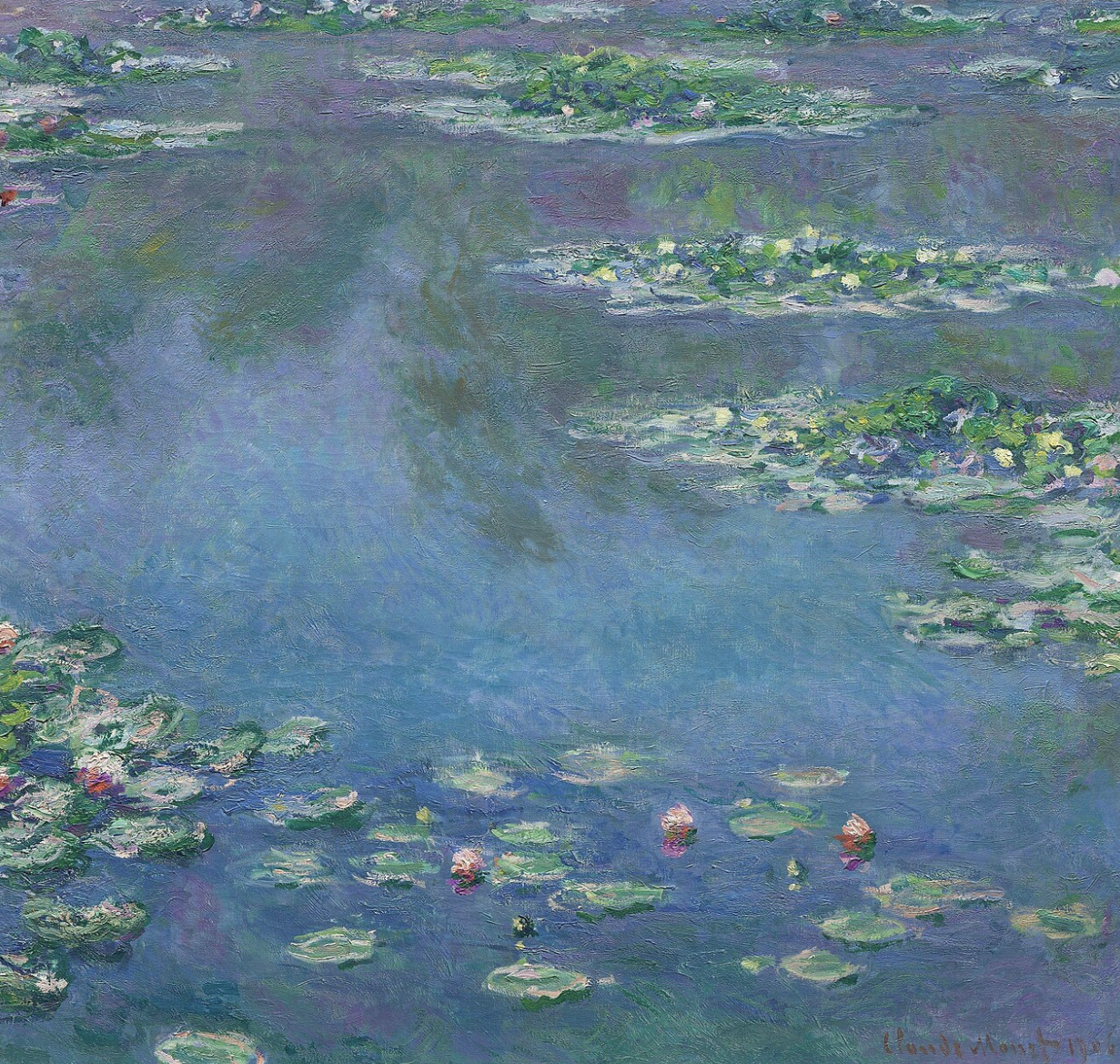
Here we are, arriving at the mass produced poster on my wall of the Water Lillies by Claude Monet. But for my thirteen year old self this was, a way in, an introduction, a place to begin, what was available to me at the time.
I learned about artists making series of paintings. There are 250 water lilies paintings by Monet.
Here are some of the Water Lilies at the Met
1919–1920: Retained by the artist, Claude Monet, at his studio in Giverny.
1920: Sold to the art dealership Bernheim-Jeune, Paris, in November 1920.
1920–1921: Jointly owned by Bernheim-Jeune and Durand-Ruel, Paris.
1921: Acquired by the prominent collector Henri Canonne, Paris, in February 1921.
By 1977: Acquired by the independent dealer/collector Alexander Margulies, London.
Until 1982: Held by Marlborough Fine Art, London.
1982–1998: Acquired by the American publishers and philanthropists Walter H. and Leonore Annenberg, Rancho Mirage, California.
1998: Gifted by Walter H. and Leonore Annenberg to the Metropolitan Museum of Art (with partial interest retained until the complete bequest in 2002).
Tucker, Paul Hayes. Monet in the ’20s: New Impressions. New Haven: Yale University Press, 1998.
Wildenstein, Daniel. Monet: Catalogue Raisonné / Werkverzeichnis. Vol. IV: Nos. 1596–1983. Cologne: Taschen, 1996. (This specific painting is registered and authenticated under catalog entry W. 1891)