Since Leviathan is at the center of this project, I’m interested in where Hobbes may have read about the animal in the first place.
So we turn to references to the Leviathan in the books of psalms.
The Great Bible: The Byble in Englyshe, That Is to Saye the Content of All the Holy Scrypture, Bothe of Ye Olde and Newe Testament. Edited by Thomas Cranmer. London: Rychard Grafton and Edward Whitchurch, 1539.
Museum Collection: The British Library: The Great Bible
The Book of Common Prayer: The Book of Common Prayer: And Administration of the Sacraments and Other Rites and Ceremonies of the Church. London: Robert Barker, 1604.
Museum Collection: The British Library: First Book of Common Prayer
Digital Archive: The Folger Shakespeare Library: Book of Common Prayer 1604
Liturgical Archive: Justus.Anglican.org: The Book of Common Prayer Archive (Contains digital transcriptions of all historical versions).
Current Location: The British Library, London (Shelfmark: C.25.l.14).
The King James Bible: The Holy Bible: 1611 Edition: King James Version. Edited by Alfred William Pollard. Reprint, Oxford: Oxford University Press, 1911.
Digital Archive: The Folger Shakespeare Library: King James Bible First Edition
Psalm 74:14
The Great Bible (1539): “Thou brakest the heades of Leuyathan in peces, and gauest hym to be meate for the people in the wylderness.”
The Book of Common Prayer (1604): “Thou brakest the heads of Leviathan in pieces: and gavest him to be meat for the people in the wilderness.”
The King James Bible (1611): “Thou brakest the heads of Leuiathan in pieces, and gauest him to bee meate to the people inhabiting the wildernesse.”
Psalm 104:26
The Great Bible (1539): “There go the shyppes, and there is that Leuyathan, whom thou hast made, to take his pastyme therein.”
The Book of Common Prayer (1604): “There go the ships, and there is that Leviathan: whom thou hast made to take his pastime therein.”
The King James Bible (1611): “There goe the ships; there is that Leuiathan, whom thou hast made to play therein.”
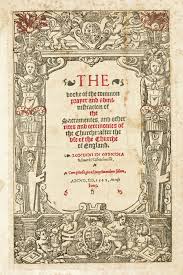
The feature photo is of the Book of Common Prayer
The Booke of the Common Praier and Administracion of the Sacramentes, and Other Rites and Ceremonies of the Churche: After the Use of the Churche of England. London: Edvardi Whitchurche, 1549.
Artwork: Title-page of the First Edition of The Book of Common Prayer.
Artist: Woodcut border attributed to the workshop of Edward Whitchurch (the King’s Printer).
Current Location: The British Library, London (Shelfmark: C.25.l.14).
Provenance: This specific title page marks the 1549 “First Prayer Book” of Edward VI. It was the first time the liturgy was mandated in English for the entire realm. The visual framing—using architectural columns and the Royal Arms—established the book as an official instrument of the State.
The following works by art historians analyze the visual architecture and typographic design of this specific 1549 title page:
King, John N. “The Reformation of the Bible.” In The Cambridge History of the Book in Britain: Volume III, 1400–1557, edited by Lotte Hellinga and J. B. Trapp, 394–408. Cambridge: Cambridge University Press, 1999. (Focuses on the woodcut border as a visual signal of royal authority).
Driver, Martha W. “The Image in Print: Book Illustration in Late Medieval England and its Survival.” The Gazette of the Grolier Club 49 (1998): 5–23. (Examines the reuse of traditional woodcut motifs in early Protestant publications).
MacCulloch, Diarmaid. “The Common Prayer: The Liturgy and Its Critics.” In The Boy King: Edward VI and the Protestant Reformation, 141–158. Berkeley: University of California Press, 1999. (Discusses the shift in “visual liturgy” from the priest to the vernacular book).
Watt, Tessa. “The Bible and the Prayer Book.” In Cheap Print and Popular Piety, 1550–1640, 131–159. Cambridge: Cambridge University Press, 1991.
The image below is from the Utrecht Psalter. It is unknown if Hobbes ever saw this.
The Utrecht Psalter. Utrecht, Universiteitsbibliotheek, MS Bibl. Rhenotraiectinae I Nr 32, folio 42v. Edited by Koert van der Horst and Jacobus Engelbregt. Graz: Akademische Druck- u. Verlagsanstalt, 1982.
Museum and Artwork Details
Artwork: Illustration for Psalm 74 (Detail: The Leviathan).
Artist: Unknown Carolingian artists (Reims School).
Current Location: Utrecht University Library, Netherlands (MS 32, folio 42v).
Van der Horst, Koert. “The Utrecht Psalter: Picturing the Psalms of David.” In The Utrecht Psalter in Medieval Art: Picturing the Psalms of David, edited by Koert van der Horst, William Noel, and Wilhelmina C. M. Wüstefeld, 22–84. London: Harvey Miller, 1996.
Dutton, Paul Edward. “The Unruly World of the Utrecht Psalter.” In The Poetry and Paintings of the First Bible of Charles the Bald, 124–140. Ann Arbor: University of Michigan Press, 1997.
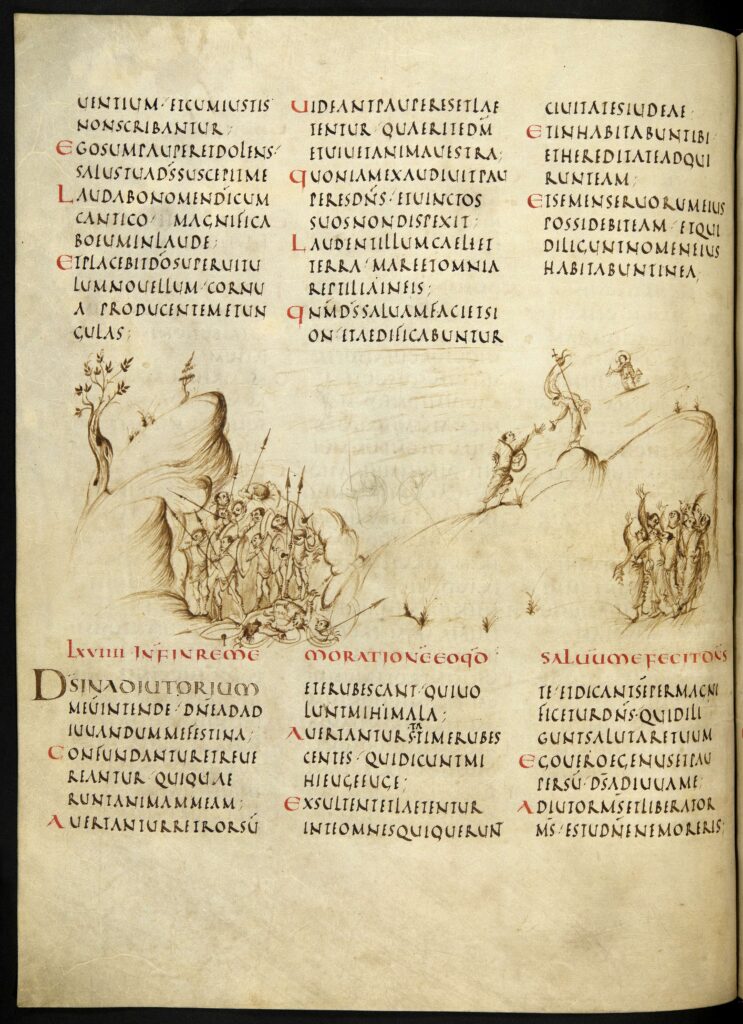
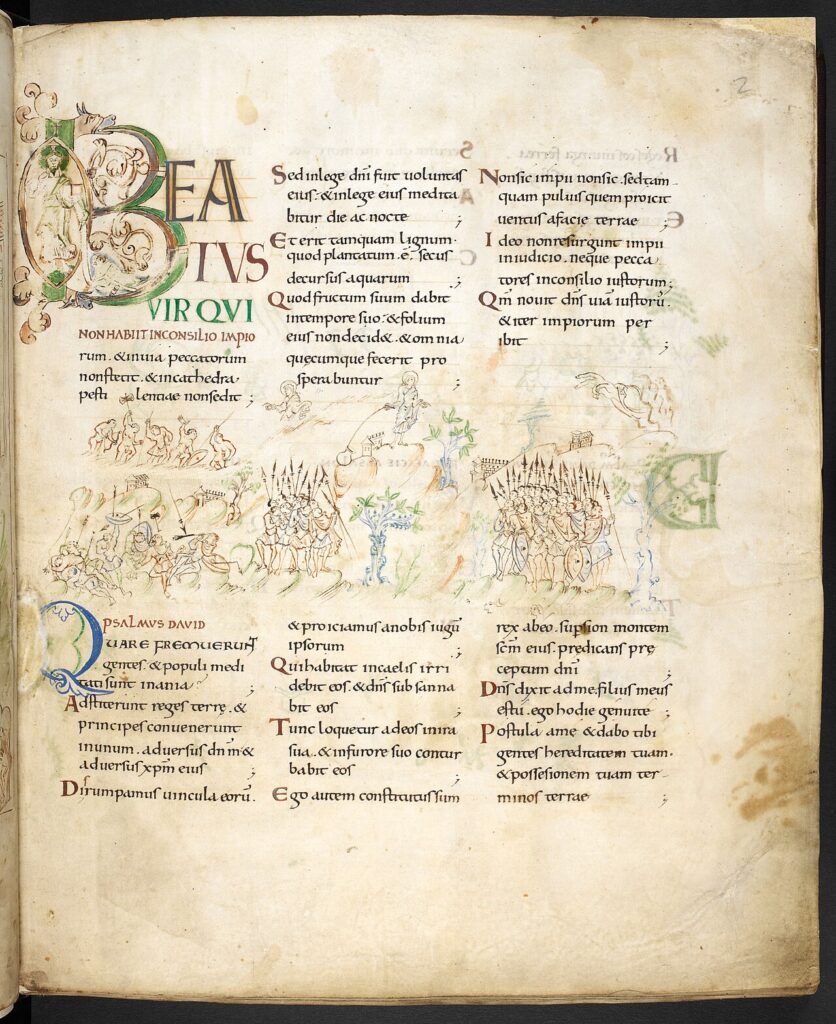
The Harley Psalter. London, British Library, Harley MS 603, folio 39v. Edited by William Noel. The Harley Psalter. Cambridge: Cambridge University Press, 1995.
Illustration for Psalm 74 (The Crushing of the Heads of Leviathan).
Artist: Unknown Anglo-Saxon artists (Christ Church, Canterbury).
Current Location: The British Library, London (Harley MS 603, folio 39v).
Provenance: Produced in phases beginning around the year 1000 at Christ Church, Canterbury, this manuscript is the earliest English copy of the Utrecht Psalter. Unlike the original, which used monochrome ink, the Harley artists utilized various colored inks (red, blue, green) and updated the iconography to reflect Anglo-Saxon visual tastes.