This tragedy and others performed in front of the demos fulfilled the crucial social and political role of facilitating a catharsis in the audience. Spectating the performance together somehow facilitated the whole or the unity of the polity.
One of the greatest poets ever — this is one of the most profound tragedies ever, that also reveals the important structure of tragic plot which Aristotle takes up in the Poetics.
Antigone is one of the Theban play and the other two are Oedipus Rex and Oedipus at Colonus.
Sophocles. The Theban Plays: Antigone, King Oidipous and Oidipous at Colonus. United States: Hackett Publishing Company, Incorporated, (n.d.).
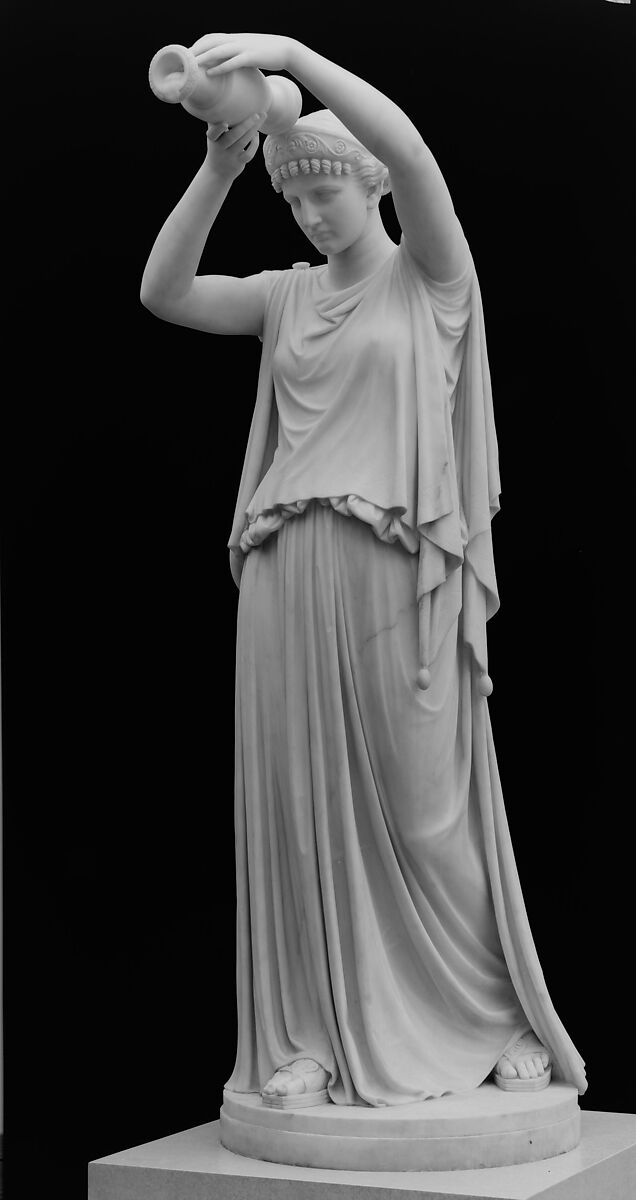
The featured image is Antigone Pouring a Libation over the Corpse of Her Brother Polynices
Rinehart, William Henry. Antigone Pouring a Libation over the Corpse of Her Brother Polynices. 1867–70; carved 1870. Marble, 70 1/4 x 24 x 39 1/2 in. New York: The Metropolitan Museum of Art.
Location: The Metropolitan Museum of Art, New York City (The American Wing, Gallery 700).
Museum Link: Metropolitan Museum of Art – Antigone
John H. Hall: Owned the piece until his death in 1891.
Family of John H. Hall: Donated the sculpture to The Metropolitan Museum of Art in 1891 in his memory.
Gardner, Albert TenEyck. American Sculpture: A Catalogue of the Collection of The Metropolitan Museum of Art. New York: The Metropolitan Museum of Art, 1965. Available via MetPublications.
Tolles, Thayer, ed. American Sculpture in The Metropolitan Museum of Art. Vol. 1, A Catalogue of Works by Artists Born before 1865. New York: The Metropolitan Museum of Art, 1999.
Perspectives on American Sculpture Before 1925. United Kingdom: Metropolitan Museum of Art, 2003. Ed. Tolles, Thayer.
On the image below:
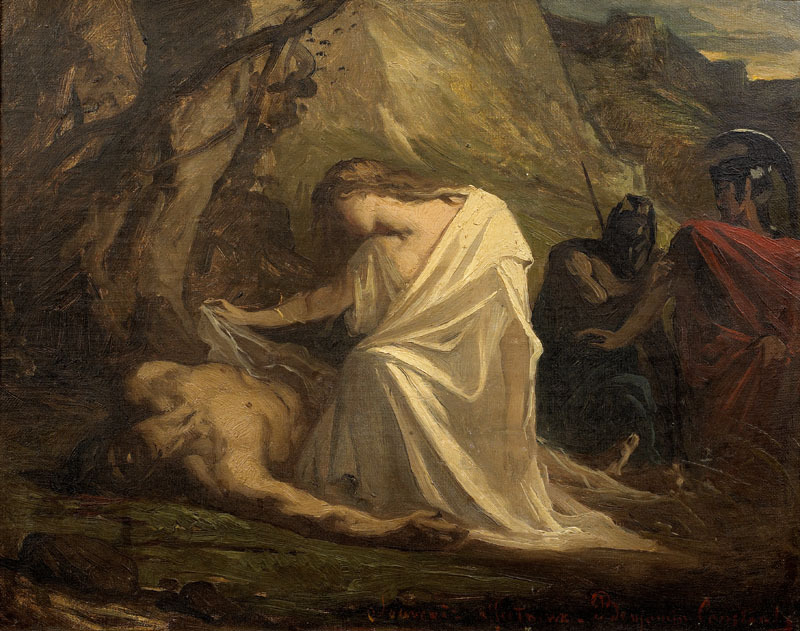
Benjamin-Constant, Jean-Joseph. Antigone au chevet de Polynice. 1868. Oil on canvas, 33 x 41 cm. Musée des Augustins, Toulouse.
The painting is currently held in the Musée des Augustins (Musée des Beaux-Arts de Toulouse) in Toulouse, France.
Official Museum Link: Musée des Augustins – Online Collection (Note: The work can also be found via the French Ministry of Culture’s Joconde database: Notice 05620010178).
The history of ownership for this specific piece (Inventory No. 2007 6 1) is as follows:
1868: Created by the artist as a preparatory sketch/entry for the Prix de Rome.
Circa 1868 – 2007: Held in the private collection of M. Delors, Paris. The painting remained within the Delors family for generations.
2007: Purchased by the Musée des Augustins from Mme Emmanuelle Bochet (a descendant of the Delors family) with assistance from the FRAM (Fonds régional d’acquisition pour les musées).
Rykner, Didier. “Des acquisitions et une nouvelle attribution pour le Musée des Augustins.” La Tribune de l’Art, March 15, 2008.
Focus: Detailed report on the 2007 acquisition and the painting’s significance as a Prix de Rome sketch. Available via La Tribune de l’Art.
Haxthall, Nathalie, and Axel Hémery (Eds.). Benjamin-Constant: Merveilles et mirages de l’orientalisme. Paris: Éditions Hazan; Toulouse: Musée des Augustins, 2014.
Focus: This is the definitive exhibition catalogue (published for the Montreal Museum of Fine Arts and Musée des Augustins exhibition) that tracks the artist’s transition from academic history painting to Orientalism. Available through major university libraries and museum stores.
Hémery, Axel. “Quoi de neuf au musée? 25 ans d’acquisitions (1985-2009).” Exhibition Catalogue, Musée des Augustins, 2009.
Focus: Features Antigone as a highlighted recent acquisition, discussing its place in the museum’s 19th-century collection.
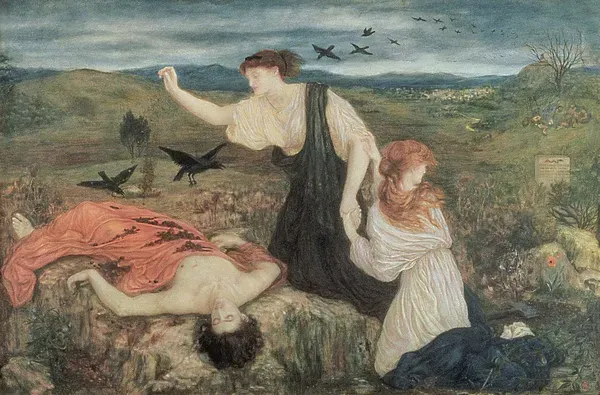
On the image below:
Sarafianos, Aris. “The Diaspora of Greek Painting in the Nineteenth Century: Christou’s Model and the Case of Marie Spartali-Stillman.” Historein 6 (2006): 150-169.
Where to find: Available via Historein Open Access or Google Scholar. This article examines her Greek heritage and how it influenced her choice of classical subjects like Antigone.
Frederick, Margaretta S., and Jan Marsh. Poetry in Beauty: The Pre-Raphaelite Art of Marie Spartali Stillman. Yale University Press, 2015.
Where to find: This is the definitive exhibition catalogue/monograph. It contains the most detailed provenance and technical analysis of this specific painting.
Stetz, Margaret D. “The Lives and Works of Marie Spartali Stillman.” The Journal of Pre-Raphaelite Studies 16 (2007): 92-94.
Where to find: Available through institutional access on JSTOR or the JPRS archives. This provides a review of her professional standing and specific mentions of her larger compositions.
On the image below:
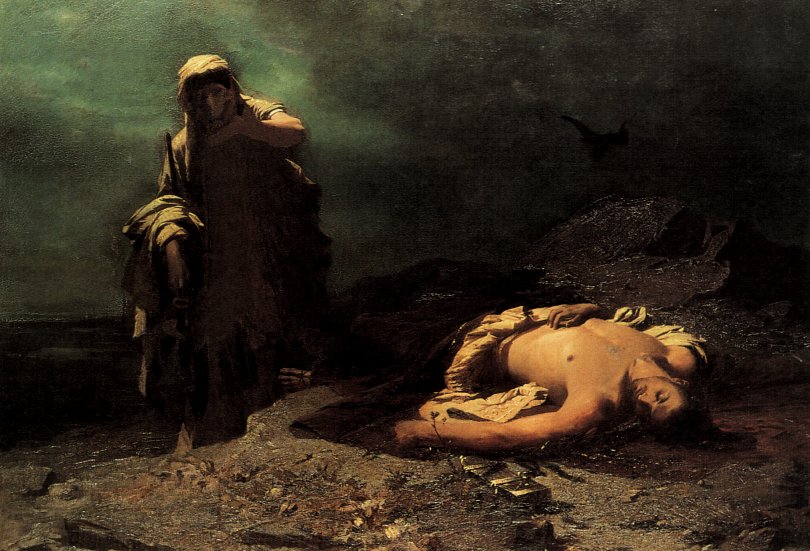
Lytras, Nikiforos. Antigone in front of the dead Polynices. 1865. Oil on canvas, 109 x 157 cm. National Gallery – Alexandros Soutsos Museum, Athens.
Artist: Nikiforos Lytras (Greek, 1832–1904)
Title: Antigone in front of the dead Polynices (also known as Antigone and Polynices)
Date: 1865
Medium: Oil on canvas
Dimensions: $109 \times 157$ cm
Current Location: National Gallery – Alexandros Soutsos Museum, Athens, Greece
Accession Number: Π.3758
The painting is currently on view in the Main Building of the National Gallery in Athens.
Official Museum Page: Antigone and Polynices, 1865 – National Gallery
Artist Biography (Museum): Lytras Nikephoros – National Gallery
Provenance
The work was created in 1865, toward the end of Lytras’s studies in Munich under Karl von Piloty. It was likely brought to Athens when the artist returned to Greece in 1865 to take up a professorship at the Athens School of Fine Arts. It has been a part of the National Gallery’s collection since its early development as a cornerstone of modern Greek academic painting.
Kouroutaki, Alexandra. “The Myth of Antigone in Modern Greek Painting.” Antigone Journal, 2023. (Discusses the transition of the myth into the 19th-century Greek academic context). Link to Journal
Lydakis, Stelios. The Greek Painters: 19th Century. Athens: Melissa Publishing House, 1976. (The definitive English-language survey of the period, covering Lytras’s mythological works).
Vakalopoulos, Apostolos. History of Modern Greece. Rutgers University Press, 1976. (Provides historical context for the cultural revival during which this was painted).
On the image below
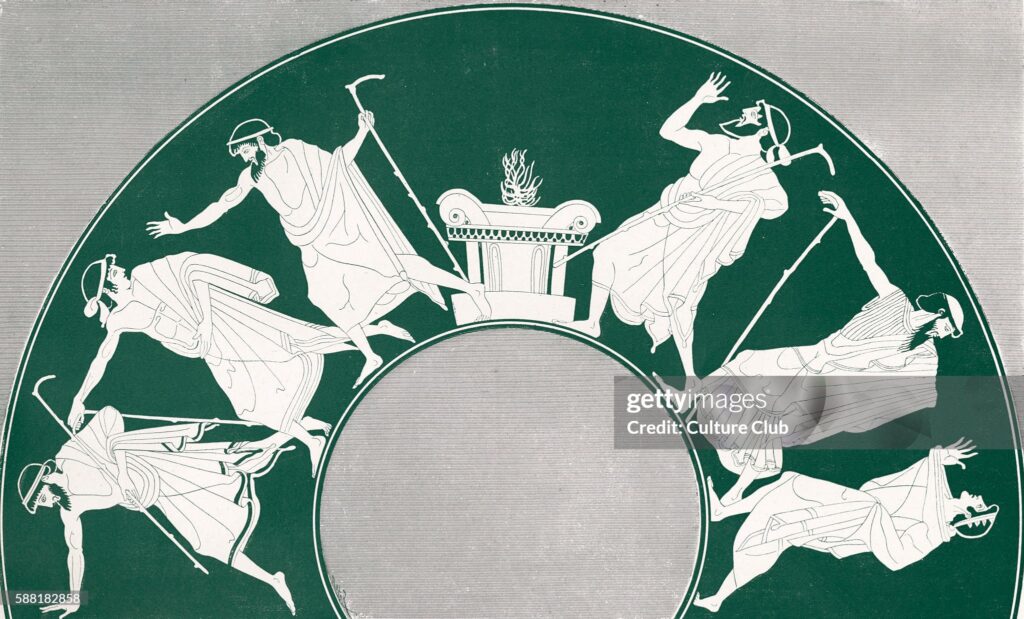
The Chorus of the Old Men (Antigone). In Le Théâtre, no. 24 (December 1899). After an Attic red-figure vase, ca. 5th century BCE.
The image is a modern reproduction—specifically a lithograph or engraving—of a scene found on an ancient Greek red-figure vase. It depicts the Chorus of Elders from Sophocles’ tragedy Antigone. The figures are shown in a stylized “dance” or rhythmic movement around a central altar (thymele), holding staves that signify their status as aged citizens of Thebes.
This specific rendering was published in the French magazine Le Théâtre in December 1899 to illustrate a contemporary production or to provide historical context for the play’s staging.
Museum and Current Location
The original vase from which this illustration is derived is part of the collection at the British Museum in London.
Museum: British Museum
Object Type: Attic Red-figure Stamnos (attributed)
Museum Link: The British Museum Collection Online
(Note: The British Museum holds several “theatrical” vases, including the “Basel Pronomos Vase” and others depicting tragic choruses; researchers often use this specific illustration to discuss the 1899 Comédie-Française production.)
Provenance
The original ceramic vessel was excavated in Vulci, Italy, a major site for Attic pottery exports. It was part of the Canino Collection (belonging to Lucien Bonaparte, Prince of Canino) before being acquired by the British Museum in the mid-19th century.
Scholarly Articles
For further academic study on the depiction of tragic choruses in vase painting, the following articles are primary resources:
Green, J. R. “Theatrical Motifs in Attic Vase Painting.” The Journal of Hellenic Studies 102 (1982): 201-214.
Taplin, Oliver. Pots & Plays: Interactions between Tragedy and Greek Vase-painting in the Fourth Century B.C. Los Angeles: J. Paul Getty Museum, 2007.
Csapo, Eric. “The Imagery of the Chorus.” In The Cambridge Companion to Greek Tragedy, edited by P. E. Easterling, 127-151. Cambridge: Cambridge University Press, 1997.
Trendall, A. D., and T. B. L. Webster. Illustrations of Greek Drama. London: Phaidon, 1971.
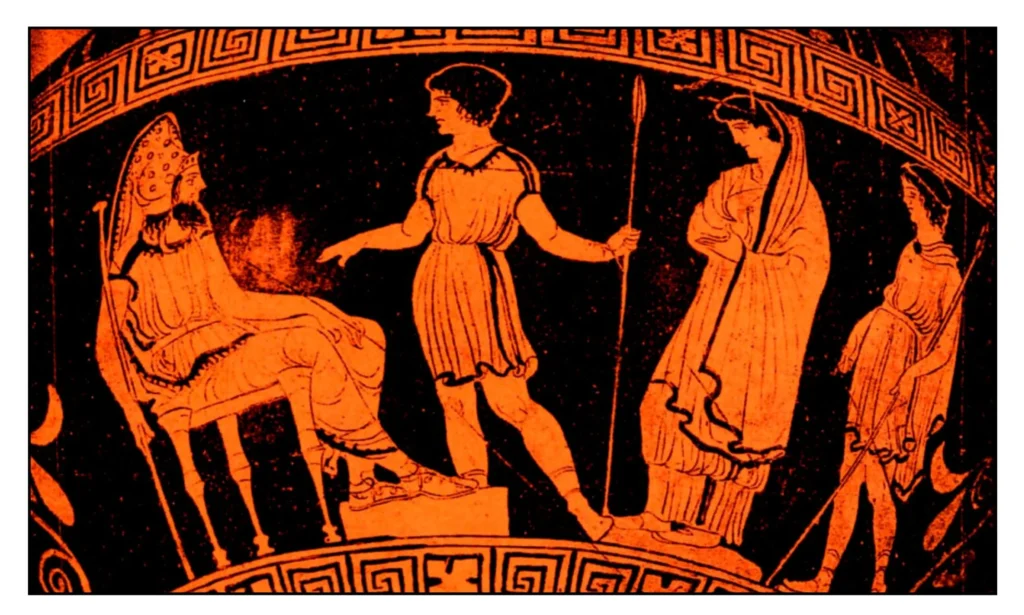
On the image below
Dolon Painter. Antigone Brought Before Creon. Lucanian Red-figure Hydria. c. 380–370 BCE. Ceramic. British Museum, London. https://www.britishmuseum.org/collection/object/G_1824-0501-44.
This image depicts a scene from a Lucanian red-figure hydria attributed to the Dolon Painter, dating to approximately 380–370 BCE. It illustrates a pivotal moment from the myth of Antigone, often identified as Antigone being brought before Creon after her defiance of his edict regarding the burial of her brother, Polynices.
Museum and Provenance
Current Museum: British Museum, London
Museum Number: 1824,0501.44 (also cataloged as Vase F175)
Provenance: This vessel was discovered in Pisticci, Italy (specifically in the Basilicata region, formerly Lucania). It was part of the collection of Richard Payne Knight, which was bequeathed to the British Museum in 1824.
- Scholarly Citations
- The following works are foundational to the study of this specific vase and its relationship to Greek tragedy:
- Trendall, Arthur Dale. The Red-figured Vases of Lucania, Campania and Sicily. Oxford: Clarendon Press, 1967. (Specifically p. 102, no. 532).
- Trendall, Arthur Dale, and Thomas B. L. Webster. Illustrations of Greek Drama. London: Phaidon, 1971. (See Section III.2, 5).
- Taplin, Oliver. Pots & Plays: Interactions between Tragedy and Greek Vase-painting in the Fourth Century B.C. Los Angeles: J. Paul Getty Museum, 2007. (Specifically p. 195–197).
- Robinson, David M. “The Antigone of Sophocles and Contemporary Art.” The Journal of Hellenic Studies 41 (1921): 180–190.
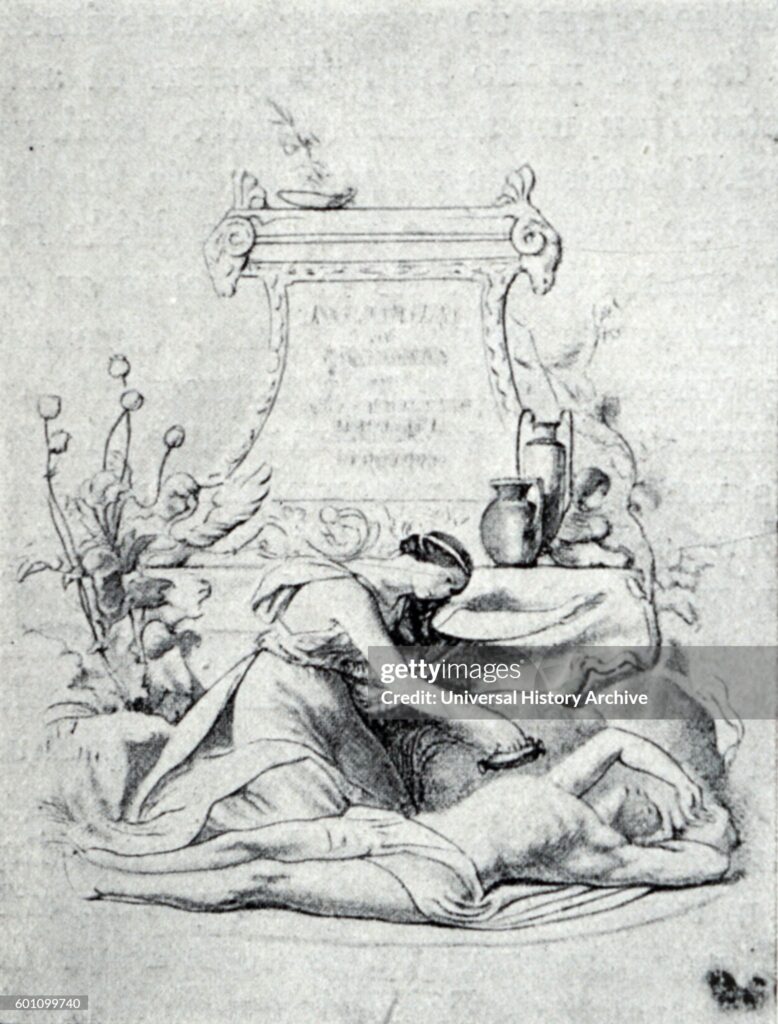
Lenepveu, Jules-Eugène. Antigone Gives Token Burial to the Body of Her Brother Polynices. 1835–98. Watercolor, pen and black ink over black chalk, on gray-green paper. Metropolitan Museum of Art, New York.
Artwork Details
Artist: Jules-Eugène Lenepveu (French, 1819–1898)
Date Created: 1835–1898
Art Type: Drawing (Watercolor, pen and black ink over black chalk, on gray-green paper)
Current Location: Metropolitan Museum of Art (The Met), New York
Accession Number: 1991.267
Provenance
The work was previously part of the Ian Woodner Family Collection. It was acquired by the Metropolitan Museum of Art in 1991 through the Ian Woodner Family Collection Fund.
Main Art History Scholarly Articles
While many scholars focus on Lenepveu’s larger public commissions (such as his work in the Panthéon or the Opéra de Paris), this specific drawing is often cited in discussions of 19th-century Neoclassicism and the reception of Sophoclean tragedy in French art.
Zanker, Graham. “Polyneices’ Body and His Monument: Class, Social Status, and Funerary Commemoration in Sophocles’ ‘Antigone’.” ResearchGate, 2016. (Explores the iconographic history of the burial ritual in Classical and post-Classical art).
Milošević, Bratislav. “Antigone – A Clashing of the Stereotypical and the Archetypal.” Athens Journal of Mediterranean Studies 8, no. 3 (July 2022): 183-196. Link to Article.
Loi, Joseph. “Clas 430 Milestone #4 Curator’s Remark: Antigone.” University of Washington, 2025. (Specifically references Lenepveu’s depiction of Antigone’s agency and determination in the Met’s drawing).
The text of Antigone the artist may have been reading was
Sophocles. Antigone, tragédie de Sophocle, mise à la scène française par Paul Meurice et Auguste Vacquerie. Paris: Furne et Cie, 1844.
Sophocles. Sophocle: Traduction nouvelle. Translated by Charles-Marie-René Leconte de Lisle. Paris: Alphonse Lemerre, 1877
On the image below
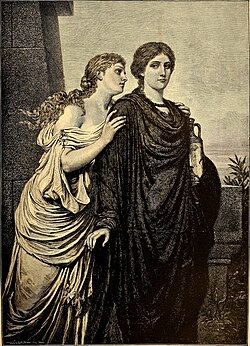
Teschendorff, Emil. Antigone and Ismene. c. 1892. Wood engraving by M. Weber. New York Public Library, New York. https://digitalcollections.nypl.org/items/510d47e4-37d1-a3d9-e040-e00a18064a99
Artwork Information
Artist: Emil Teschendorff (German, 1833–1894)
Title: Antigone and Ismene
Date: c. 1870–1892 (Original oil painting dates to the 1870s; widely circulated as an engraving by 1892).
Medium: Original: Oil on canvas. Reproductions: Wood engraving (as seen in your image) or lithograph.
Museum/Collection: The original oil painting has appeared in various private collections and auction houses (e.g., Bradford’s Auction Gallery). However, the New York Public Library (NYPL) holds a significant wood engraving of this work within their Digital Collections (The Miriam and Ira D. Wallach Division of Art, Prints and Photographs).
Museum Link: Antigone and Ismene – NYPL Digital Collections
Provenance and History
The artwork depicts a scene from Sophocles’ Greek tragedy Antigone. While the original oil painting was created by Teschendorff during his career in Berlin, it achieved widespread recognition through mass-produced wood engravings in late 19th-century literature, such as Ebenezer Cobham Brewer’s Character Sketches of Romance, Fiction, and the Drama (1892). The engraving in your image was executed by M. Weber.
Art History Scholarly Citations
Gaskin, Claire. Ismene’s Survivable Resistance. Melbourne: Puncher & Wattmann, 2021. (This text explores the artistic and literary shift toward centering Ismene, referencing the visual tradition Teschendorff contributed to).
Lubbock, Jules. The Tyranny of Taste: The Politics of Architecture and Design in Britain, 1550–1960. New Haven: Yale University Press, 1995. (Contextualizes the Academicism and neoclassical influence found in German and British depictions of Greek tragedy during the 19th century).
Goldhill, Simon. Victorian Culture and Classical Antiquity: Art, Opera, Fiction, and the Proclamation of Modernity. Princeton: Princeton University Press, 2011. (Analyzes how 19th-century artists like Teschendorff used Sophoclean themes to reflect contemporary European social values).
The text Teschendorff would have been reading is the Sophocles Edition by Johann Jakob Christian Donner.
Donner, Johann Jakob Christian, trans. Sophokles Tragödien. 10th ed. Leipzig: C. F. Winter’sche Verlagshandlung, 1889.
Publication Context: Donner’s translations of Sophocles (Sophokles Tragödien) were first published between 1837 and 1839. They became the “standard” German version for decades, prized for their attempt to preserve the original Greek meters (rhythms) in German verse.
The “Berlin Sophocles”: Teschendorff, who lived and worked in Berlin, would have used this edition as it was the official text used by the Prussian court and the university circles in which he moved.
The Performance: Mendelssohn & Tieck’s Antigone
The most significant cultural event regarding this play in Teschendorff’s lifetime was the 1841 production of Antigone at the New Palace in Potsdam and the Berlin State Opera.
Director: Ludwig Tieck.
Music: Felix Mendelssohn (Incidental Music to Antigone, Op. 55).
Impact on the Artist: This production was a landmark of “Prussian Hellenism.” It featured authentic archaeological costumes and a stage designed to mimic a Greek theater. Even though Teschendorff was a child when it premiered, the production was revived and remained the definitive visual and auditory reference for Antigone in Berlin throughout the late 19th century.
Scholarly Citations
Fischer-Lichte, Erika. History of European Drama and Theatre. London: Routledge, 2002. (Discusses the 1841 Berlin production of Antigone and its influence on German visual culture and national identity).
Steinberg, Michael P. “The Incidental Politics to Mendelssohn’s Antigone.” In Mendelssohn and His World, edited by R. Larry Todd, 137–157. Princeton: Princeton University Press, 2012. (Analyzes how the Donner translation and Mendelssohn’s music shaped the 19th-century German understanding of Sophocles).
Flashar, Hellmut. Inszenierung der Antike: Das griechische Drama auf der Bühne der Neuzeit 1585–1990. Munich: C.H. Beck, 1991. (The definitive German source on how Sophocles was translated and staged in Berlin during Teschendorff’s era).