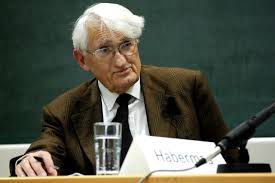
Jurgen Habermas Theory of Communicative Action
The concept of communicative action is developed in the first set (Chapter III) of "Intermedicate Reflections" [Zwischenbetrachtung], which provides access to three intertwined topic complexes: first, a concept of communication rationality that is sufficiently skeptical in its development but is nevertheless resistant to cognitive-instrumental abridgments of reason; second, a two-level concept of society that connects the "lifeworld" and "system" paradigms in more than a rhetorical fashion; and finally, a theory of modernity that explains the type of social pathologies that are today becoming increasingly visible, by way of the assumption that communicatively structured domains of life are being subordinated to the imperatives of autonomous, formally organized systems of action. Thus the theory of communicative action is intended to make possible a conceptualization of the social-life context that is tailored to the paradoxes of modernity.