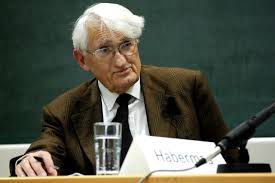
Read more about the article Jurgen Habermas Between Facts and Norms
habermas

Jurgen Habermas Between Facts and Norms

Moreover, a moral-practical self-understanding of modernity as a whole is articulated in the controversies we have carried on since the seventeenth century about the best constitution of the political community. This self-understanding is attested to both by a universalistic moral consciousness and by the liberal design of the constitutional state. Discourse theory attempts to reconstruct this normative self-understanding in a way that resists both scientistic reductions and aesthetic assimilations.


Continue ReadingJurgen Habermas Between Facts and Norms
Read more about the article Jurgen Habermas Theory of Communicative Action
forhabermastheoryofcommaction

Jurgen Habermas Theory of Communicative Action

The concept of communicative action is developed in the first set (Chapter III) of "Intermedicate Reflections" [Zwischenbetrachtung], which provides access to three intertwined topic complexes: first, a concept of communication rationality that is sufficiently skeptical in its development but is nevertheless resistant to cognitive-instrumental abridgments of reason; second, a two-level concept of society that connects the "lifeworld" and "system" paradigms in more than a rhetorical fashion; and finally, a theory of modernity that explains the type of social pathologies that are today becoming increasingly visible, by way of the assumption that communicatively structured domains of life are being subordinated to the imperatives of autonomous, formally organized systems of action. Thus the theory of communicative action is intended to make possible a conceptualization of the social-life context that is tailored to the paradoxes of modernity.

Continue ReadingJurgen Habermas Theory of Communicative Action
Read more about the article Habermas Jurgen, Legitimation Crisis
beuysjosephendof20thcent

Habermas Jurgen, Legitimation Crisis

"Under 'democracy,' the conditions under which all legitimate interests can be fulfilled by way of realizing the fundamental interest in self-determination and participation are no longer understood. It is now only a key for the distribution of rewards conforming to the system, that is, a regulator for the satisfaction of private interests. This democracy makes possible prosperity without freedom."

Continue ReadingHabermas Jurgen, Legitimation Crisis