How do we approach this text?
Why is it an excursus on a political thought syllabus?
It can’t be philosophy proper because it does not count as a logos, exactly.
We are including it because its about war, and the rise and fall of political communities. It features exemplary characters, and exemplary-ness comes to play a role in ethics.
We are trying to get to the beginning of what a political community is, and this seems to portray that. Moreover, it rises above chronicle or history to show us a format of epic.
Ethics, which has to do with interpersonal posture, is here both on display and in crisis. So the machinations of intense emotions into action, that make the outcome seem destined from the beginning, like each movement followed from the prior like a law of nature. The actions flow from the characters, ignite motives in others, which propel another action all like a river pouring into a sea.
So far, we know its a song, eventually written down. We know it was a well known tale.
Homer is not a singular figure and there is not one text behind these songs.
Homer is not even a proper name, but seems to have become one.
The story I heard goes something like, a man knew he was going to be the learned man of the community, but he was going blind, so he had to tell the story that was so long, epic, and remember all of it, and learning was an oral tradition back then anyway.
Later they were written down, and found, and compiled, and edited and translated.
So, who is the author becomes a series of questions about the composition of a text.
In order to pose, you cannot refer to author’s intention or interview him for more clarification. So, the sense of the text is not made in the unity of the author’s intention, because of the various intentions or foci at play.
So first we can investigate the history of when it was written down, by whom, and why and go from there on the debate about the unity of authorship or what that would mean in this case.
Alexander Pope’s translation begins with an introduction that defends the concept of the unity of authorship by an appeal to aesthetics, really.
Scott, John Adams. The Unity of Homer. United States: University of California Press, 1921.
Not the beginning of philosophy to philosophy departments, but since they do involve wars, could be a precursor to the beginning of political thought.
Later retellings show up how these stories were transmitted through the ages and informed mythologies about the beginning of Athens. In our search for the beginning of the study of the polity we are definitely going to want to know what mythologies about their own beginnings those concerned held.
With Virgil’s Aeneid they are reimagined weaving into the origin stories of Rome. Once again, we are trying to get back to the beginning of the history of political community and so we will definitely want to revisit the many foundings of Rome.
So one reason to take note of these songs is due to the immense cultural impact they have had on every single culture that has heard them. For more on this, see
Brill’s Companion to the Reception of Homer from the Byzantium to the Enlightenment
A lot of what will be included in the 17th and 18th century political thought were English, and if we look across the pond we can see that John Milton wrote a text using Homer’s songs as an exemplar to approximate to, whilst also being wholly original and for a different audience.
John Milton Paradise Lost
Milton, John., Newton, Thomas., Young, William., James, Joseph. Paradise Lost: A Poem in Twelve Books. By John Milton. From the Text of Dr. Newton. In Two Volumes. With the Life of the Author. [Six Lines from Dryden] Vol. I[-II].. United States: William Young and Joseph James, Chesnut-Street, 1787.
Then we get to the Irish bard and his go at remaking a masterpiece again with new ears and eyes.
James Joyce Ulysses
Joyce, James. Ulysses. United Kingdom: Oxford University Press, 1998.
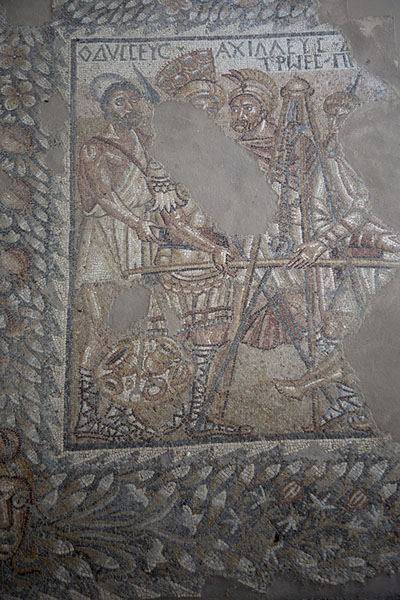
How do we know how popular these songs were in the time before philosophy? We know due to a variety and frequency of archeological finds which all depict scenes from these epics.
Archaeology Mosaic find
Here is a text about finding Homeric scenes on Hellenistic pottery.
Sparkes, Brian A.. The Red and the Black: Studies in Greek Pottery. United Kingdom: Routledge, 1996.
Finally, we recall that even today, auteurs are attracting to reviewing, revising, rewriting, some or all of the parts of these tales.
The film O Brother where art thou?
There are also contemporary allusions to Homeric epics in some Dylan songs.
References to Homeric themes in Bob Dylan songs.
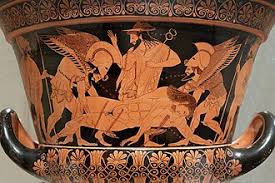
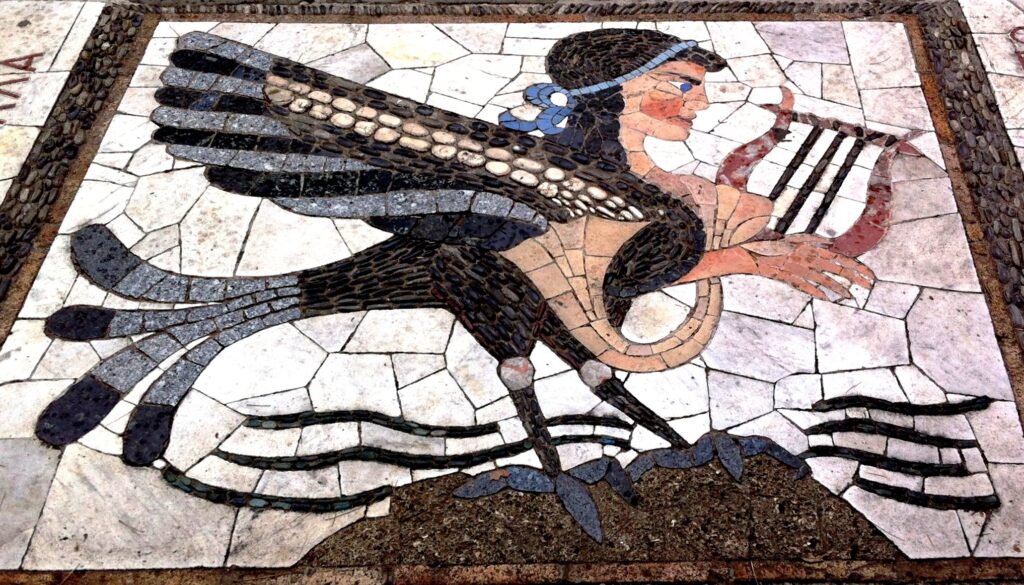
In the artworks below we witness how those who were building large homes or otherwise had the means to commission elaborate tile works, always wanted images from the songs as the themes of the tile work.
They went from song to image.
In this blog I’m exploring how to move from text to image.
Let’s go back to the featured image and the question of where are we beginning. This is our first hint that it might not be the beginning of philosophy, but should be up for consideration for near the beginning of political thought.
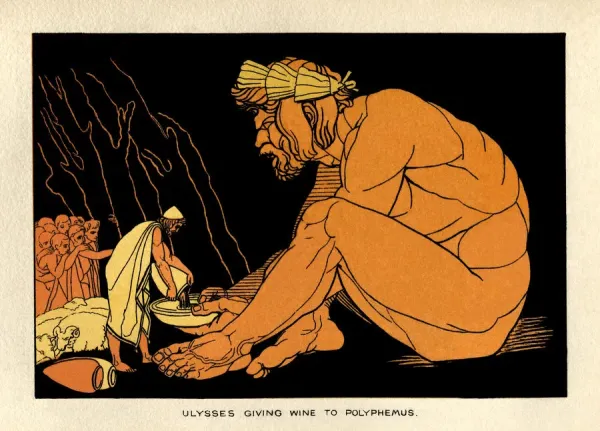
Here we find an image of ulysses giving wine to Polymephus. I just don’t think the beginning of philosophy, rational accounts of what is, how we know what is, and ethics, would start with a guy getting another guy drunk to trick and defeat him.
However, when I think of the beginning of politics, I think yes, politics definitely would include a scene like this.
This oral tradition of epic poetry inspired fine art long before it washed up onto our shores.
ProtoAttic ‘Eleusis neck-amphora’
Cook, John M. “Protoattic pottery.” The Annual of the British School at Athens 35 (1934): 165-219.
Moore, Mary B. “The Passas Painter: A Protoattic” Realist”?.” Metropolitan Museum Journal 38 (2003): 15-44.
Brann, Eva T. H.. Late Geometric and Protoattic Pottery, Mid 8th to Late 7th Century B.C.. United States: American School of Classical Studies at Athens, 1962.
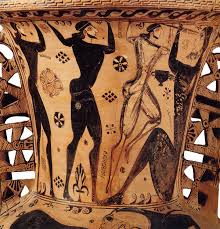
Etruscan Krater Signed by Aristonothos (c. 630 BCE):
Eichengreen, Amelia Warm. “Side B of the Aristonothos Vase: Ethnic Identity and Connectivity in Seventh-Century Caere” Etruscan Studies 24, no. 1-2 (2021): 71-87. https://doi.org/10.1515/etst-2020-0002
Bonfante, Larissa. “Chapter 6 Innovations Myth, Inscriptions, and Meaning” In Caere edited by Nancy Thompson de Grummond and Lisa Pieraccini, 61-72. New York, USA: University of Texas Press, 2016. https://doi.org/10.7560/308431-014
Bundrick, Sheramy D.. Athens, Etruria, and the Many Lives of Greek Figured Pottery. United States: University of Wisconsin Press, 2019.
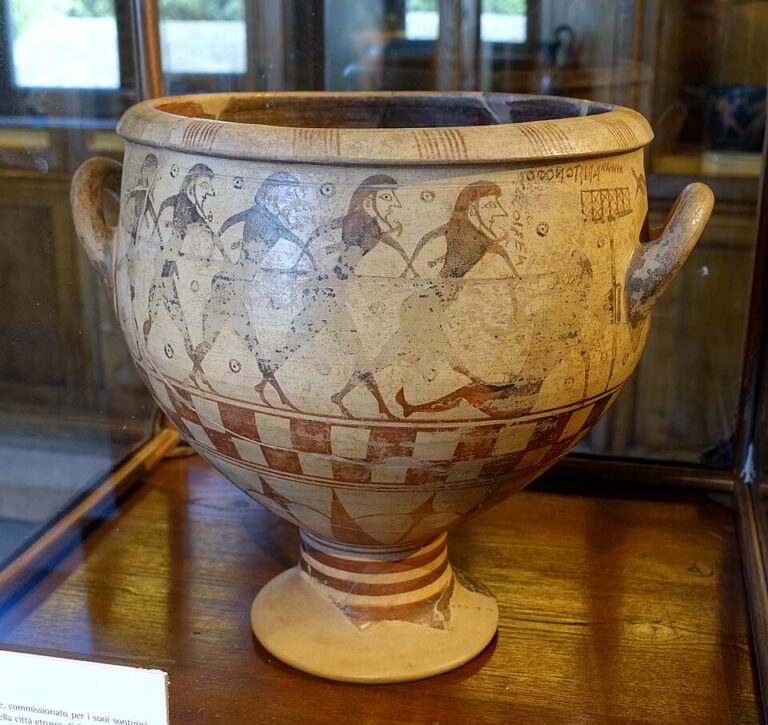
Euphronios Krater
Hawkins, Ashton. “The Euphronios Krater at the Metropolitan Museum: A Question of Provenance.” Hastings LJ 27 (1975): 1163.
Vermeule, Emily. “Fragments of a Symposion by Euphronios.” Antike Kunst 8, no. H. 1 (1965): 34-39.
The Euphronios Krater: Education, Stewardship, and Public Trust
.Venturo, Erica. “The Spectacle of Spectacle in Roman Art: Mosaics at Villa Romana del Casale.” Plebeian 6 (2020): 58-70.
@inproceedings{10.1145/3485444.3487646,
author = {Vennarucci, Rhodora and Fredrick, David and Tanasi, Davide and Reynolds, Nicholas and Kingsland, Kaitlyn and Jenkins, Brianna and Hassam, Stephan},
title = {In Ersilia’s Footsteps: Toward an Interactive WebGL Application for Exploring the Villa Romana del Casale at Piazza Armerina, Sicily},
year = {2021},
isbn = {9781450390958},
publisher = {Association for Computing Machinery},
address = {New York, NY, USA},
url = {https://doi.org/10.1145/3485444.3487646},
doi = {10.1145/3485444.3487646},
abstract = {A UNESCO World Heritage Site, the 4th-Century CE Villa Romana del Casale near Piazza Armerina, Sicily contains the largest collection of mosaics in the Roman world. However, due to accessibility issues (e.g., remote location, weak online presence), the Villa remains nearly unknown in comparison to popular sites like Pompeii, despite its cultural importance. VILLAE, a collaboration between archaeologists, classicists, and game designers at the University of South Florida and the University of Arkansas, aims to build academic and public engagement with the Villa through a serious game played directly online using WebGL. Addressing the issues of accuracy in 3D reconstruction versus digital embodiment and meaningful game play, this paper outlines the project’s pipeline for synthesizing the extensive 3D documentation of the site to create the digital prototype for an immersive narrative that unfolds the Villa’s history against the development of modern archaeology in Italy and focuses the human story and professional life of a pioneering female archaeologist, Ersilia Caetani-Lovatelli.},
booktitle = {Proceedings of the 26th International Conference on 3D Web Technology},
articleno = {12},
numpages = {7},
keywords = {WebGL, Video Games, Serious Play, Cultural Heritage},
location = {Pisa, Italy},
series = {Web3D ’21}
}
Prestileo, F. et al. (2022). Resilience of Cultural Heritage in Extreme Weather Conditions: The Case of the UNESCO Villa Romana del Casale Archaeological Site’s Response to the Apollo Medicane in October 2021. In: Gervasi, O., Murgante, B., Misra, S., Rocha, A.M.A.C., Garau, C. (eds) Computational Science and Its Applications – ICCSA 2022 Workshops. ICCSA 2022. Lecture Notes in Computer Science, vol 13380. Springer, Cham. https://doi.org/10.1007/978-3-031-10542-5_35
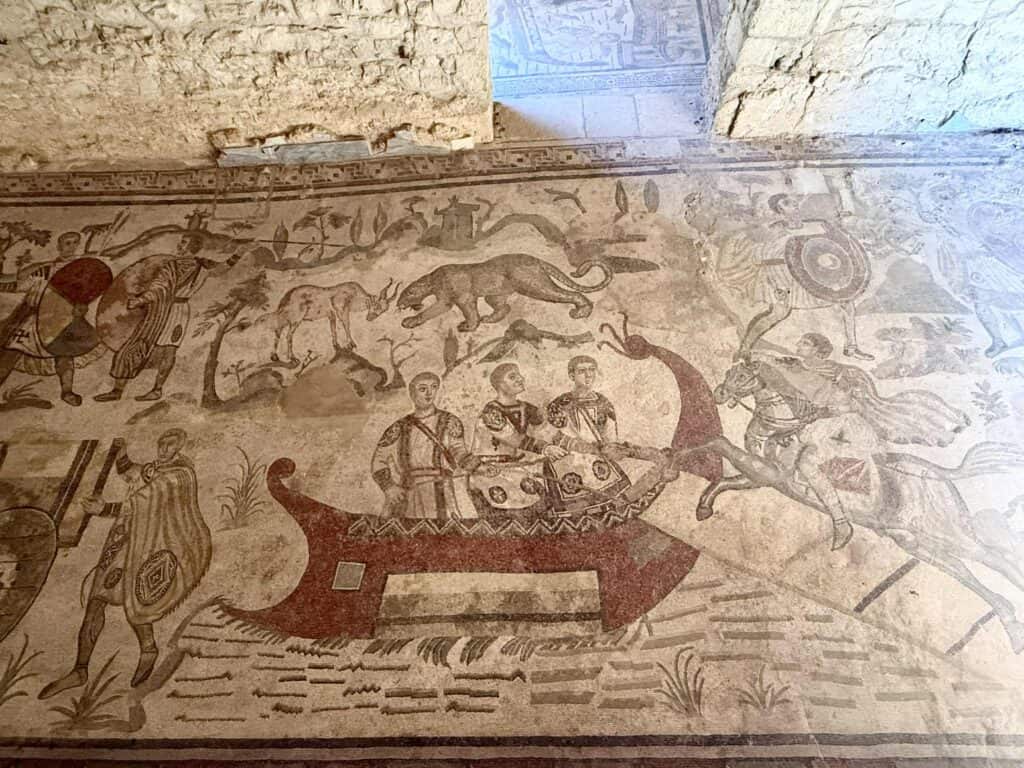
Crisà, A. (2017). [Review of the book Caddeddi on the Tellaro: A Late Roman Villa in Sicily and its Mosaics, by R. J. A. Wilson]. Classical World 111(1), 141-143. https://dx.doi.org/10.1353/clw.2017.0090.
Tanasi, Davide. “The Caddeddi Villa in Sicily and the Sources of Its Mosaics – R. J. A. WILSON, CADDEDDI ON THE TELLARO. A LATE ROMAN VILLA IN SICILY AND ITS MOSAICS (BABesch Supplement 28; Peeters, Leuven2016). Pp. Viii + 200, Figs. 197, Most in Colour. ISSN 0165-9367; ISBN 978-90-429-3388-0.” Journal of Roman Archaeology 31 (2018): 783–85. https://doi.org/10.1017/S1047759418001964.
Colline du Chateau in Nice, France Mosaic Tiles
Sagor, Shahidul Islam. “Roman Architecture in Provence.”
The featured image of this post is from Ulysses giving wine to the Cyclops, Polyphemus. From “Stories From Homer” by the Rev. Alfred J. Church, M.A.; illustrations from designs by John Flaxman. Published by Seeley, Jackson & Halliday, London, 1878.
Manola, Μ. “The significance of wine and the vine in the odyssey, suggestions for new technologies and experiential teaching approaches.” International Journal of Science and Research Archive 11, no. 2 (2024): 816-823.
The Negative Banquet of Odysseus and the Cyclops
In: Odysseys of Plates and Palates: Food, Society and Sociality