The Meno was written by Plato circa 385 BCE. As with all Platonic dialogues, no original autograph manuscript survives. The text we read today is reconstructed from the following primary manuscript traditions:
The Clarke Plato (MS E. D. Clarke 39): This is the oldest surviving manuscript of Plato’s Tetralogies (which includes the Meno). It was copied in 895 CE by Johannes the Calligrapher for Arethas of Patrae in Constantinople.
Provenance: Historically held at the Monastery of St. John the Theologian on the Island of Patmos. It was purchased by E. D. Clarke in 1801.
Current Location: The Bodleian Library, University of Oxford.
Codex Venetus Appendix Classis 4, 1 (Codex T): A 10th-century manuscript significant for establishing the Greek text.
Current Location: Biblioteca Nazionale Marciana, Venice.
Editio Princeps (First Printed Edition): Printed in Venice in 1513 by Aldus Manutius. This edition was instrumental in the Renaissance revival of Greek philosophy.
Provenance: Various copies exist; a notable copy was recently acquired by the Rare Book and Manuscript Library at the University of Illinois.
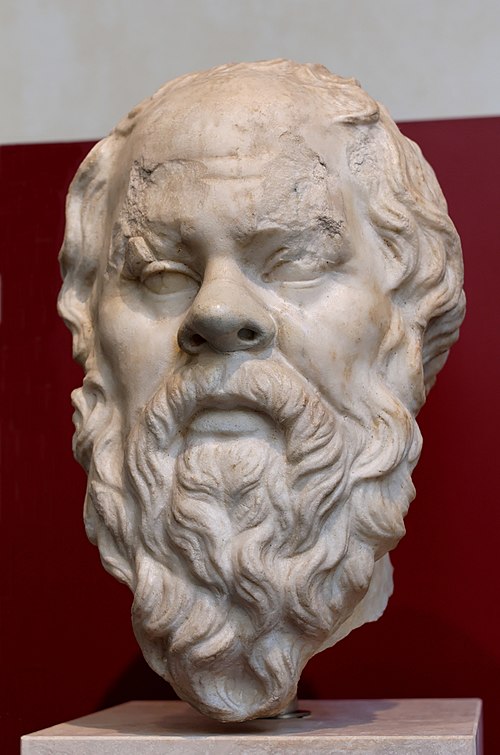
Museum Link: National Roman Museum – The Portrait Gallery
this link doesn’t work
Note: This specific bust is cataloged under Inventory Number 1236 and is located on the ground floor.
Provenance: This marble portrait was discovered in 1892 during excavations at Piazza Venezia in Rome for the construction of the Vittoriano monument. It is a high-quality Roman copy of a lost bronze original, which ancient sources attribute to the sculptor Lysippos. The original was commissioned by the Athenians and placed in the Pompeion, likely as a part of a civic effort to rehabilitate Socrates’ reputation after his execution.
Art History Scholarly Citations:
Zanker, Paul. The Mask of Socrates: The Image of the Intellectual in Antiquity. Translated by Alan Shapiro. Berkeley: University of California Press, 1995.
Richter, Gisela M. A. The Portraits of the Greeks. Vol. 1. London: Phaidon, 1965.
Fittschen, Klaus, and Paul Zanker. Katalog der römischen Porträts in den Capitolinischen Museen und den anderen kommunalen Sammlungen der Stadt Rom. Mainz: Philipp von Zabern, 1983.
Primary Source Materials:
Diogenes Laertius, Lives of Eminent Philosophers, 2.5.43: Perseus Digital Library – Lysippos’ Statue (The primary textual evidence linking the bronze original to the sculptor Lysippos).