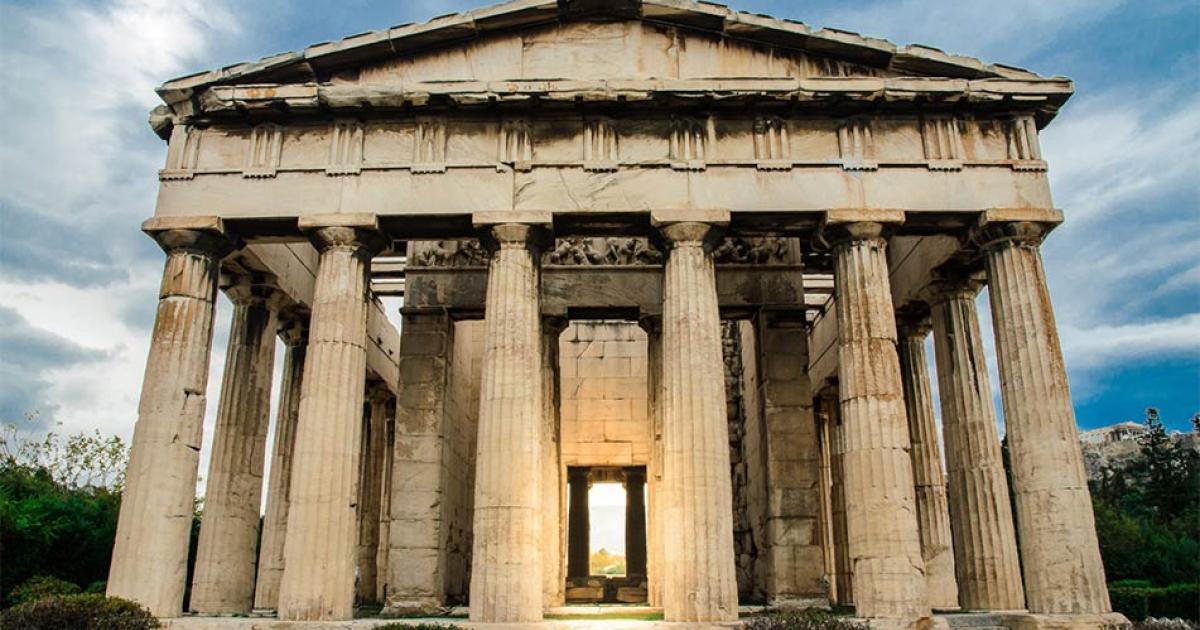
On the featured image
Brundle, Nick. Temple of Hephaestus, Athens, Greece. May 21, 2017. Photograph. Getty Images. https://www.gettyimages.com/detail/photo/temple-of-hephaestus-athens-greece-royalty-free-image/683278062.
Information regarding the archaeological site can be found through the official site managed by the Ministry of Culture or the excavation archives:
The Ancient Agora of Athens (Ministry of Culture)
The American School of Classical Studies at Athens (ASCSA) – Agora Excavations
Dinsmoor, William Bell. “Observations on the Hephaisteion.” Hesperia Supplements 5 (1941): 1–171. https://doi.org/10.2307/1353881
Thompson, Homer A. “The Sculptural Adornment of the Hephaisteion.” American Journal of Archaeology 66, no. 3 (1962): 339–47. https://doi.org/10.2307/501469
Translated by Zeyl, Donald J. Hackett Publishing, 1987.
The survival of the text through the Middle Ages is primarily due to the Byzantine manuscript tradition. Two of the most significant witnesses for the Gorgias are:
Codex Clarkianus (MS. Bodl. 39): Written in 895 CE, this is the oldest surviving manuscript for the first six tetralogies.
Codex Marcianus Graecus 184 (MS. T): A late 10th-century manuscript that provides essential alternative readings to the Clarkianus.
This dialogue brings up the thorniest questions in Philosophy and is a foundational text in epistemology– the theory of knowledge — the attempt to delineate belief versus knowledge, apparent truth and universal truth, rhetoric and philosophy.
The Editio Princeps (1513)
The first printed edition of the Greek text was published by the Aldine Press in Venice, edited by Marcus Musurus and Aldus Manutius.
Estienne, Henri, ed. Πλάτωνος ἅπαντα τὰ σωζόμενα: Platonis opera quae ad nos extant omnia. 3 vols. Geneva: Henricus Stephanus, 1578
Digital ArchivePlatonis Opera (1578) at Munich Digitization Center (MDZ)
Provenance Originally printed in Geneva; many extant copies are held in the Bibliothèque nationale de France and the British Library.
The Bodleian holds multiple copies of the 1578 edition, but its primary scholarly copy is often associated with the foundational collections of the library.
Shelfmark: A 1.13-15 Art. (This refers to the three-volume set in the “Art” collection).
Provenance: This copy is part of the original Bodleian deposit system. Notably, Henri Estienne (Stephanus) dedicated Volume I to Queen Elizabeth I, which made the edition a high-priority acquisition for English institutional libraries in the late 16th and early 17th centuries.
Digital Access: The Bodleian has digitized portions of its Platonic holdings, though the most famous “Bodleian Plato” is the 9th-century manuscript Codex Clarkianus (MS. Bodl. 39), which Estienne himself may have consulted indirectly through secondar
Bodleian Catalog: Search Oxford Libraries Online (SOLO)y sources.
The Library of Congress holds the 1578 edition within its Rare Book and Special Collections Division.
Shelfmark: PA4279 .A2 1578 (Located in the Jefferson Rare Book Room).
Library of Congress Catalog: LOC Rare Book Division
Provenance: This copy is significant for its association with the American founding. It was part of the Thomas Jefferson Collection. Jefferson’s personal library formed the core of the Library of Congress after the original collection was burned in 1814. Jefferson was a meticulous reader of the classics; his copy contains his characteristic ownership marks (initialing near the signature marks of the pages).
Physical Description: The set consists of three folio volumes, featuring the parallel Greek text and Jean de Serres’ Latin translation.
Plato. Gorgias. Translated by Walter R. M. Lamb. Loeb Classical Library 166. Cambridge, MA: Harvard University Press, 1925
Grafton, Anthony. “The Importance of Being Henri: Henri Estienne and the Reformation of Ancient Greece.” The Journal of the Warburg and Courtauld Institutes 66 (2003): 1–25
Key Article: Long, A. A. “Socrates in Hellenistic Philosophy.” The Classical Quarterly 38, no. 1 (1988): 150–171.
Irwin, Terence H. “Socrates the Epicurean?” Illinois Classical Studies 11 (1986): 85–112.
Woolf, Raphael. “Callicles and Psychic (dis)Harmony in the Gorgias.” Oxford Studies in Ancient Philosophy 18 (2000): 1–40.
Kamtekar, Rachana. “The Profession of Friendship: Callicles, Democratic Politics and Rhetorical Education.” Ancient Philosophy 25 (2005): 319–339.
Moss, Jessica. “The Gorgias’ Psychic Power: Rhetoric and the Soul.” Oxford Studies in Ancient Philosophy 32 (2007): 1–25.
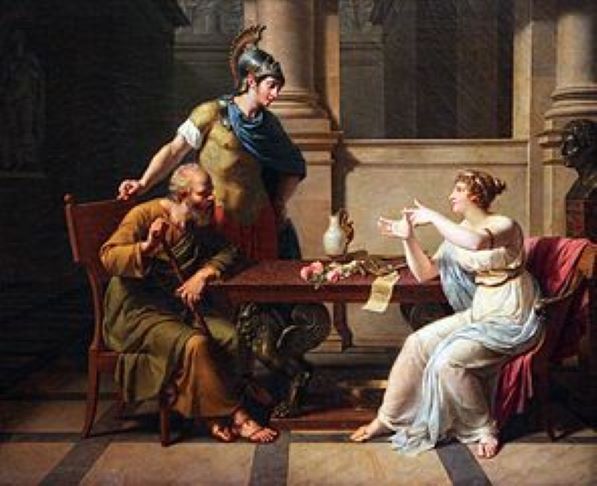
Socrates conversing with Aspasia who is teaching him rhetoric. This goes with the dialogue Menexenus, however it is fitting here because it shows Socrates’ interest in rhetoric.
The Debate of Socrates with Aspasia (Nicolas-André Monsiau 1801) is an example of Neoclassical and is at the Pushkin Museum of Fine arts in Moscow.
For academic commentary on this see
Geraths, C., & Kennerly, M. (2016). Painted Lady: Aspasia in Nineteenth-Century European Art. Rhetoric Review, 35(3), 197–211. https://doi.org/10.1080/07350198.2016.1178688
This article by Gregory Nagy explores various eras interest in Aspasia.
Monsiau, Nicolas-André. Socrates and Alcibiades at Aspasia’s. 1801. Oil on canvas. Pushkin Museum of Fine Arts, Moscow.
Museum Location
The painting is currently held in the collection of the Pushkin State Museum of Fine Arts in Moscow, Russia.
Museum Link: Pushkin Museum – Collection Entry
Inventory Number: Zh-1248
Original Exhibition: Salons of 1801, Paris (No. 240).
Acquisition: Part of the collection of Prince Nikolai Yusupov (1750–1831), a prolific Russian collector of French Neoclassical art.
Transfer: Following the Russian Revolution, the work was moved from the Arkhangelskoye Palace (the Yusupov estate) to the State Hermitage Museum (1924), and finally transferred to the Pushkin Museum of Fine Arts in 1927.
The edition of Plato’s oeuvre that would have been known to Monsiau is
Dacier, André, trans. Les Œuvres de Platon. 2 vols. Paris: L’Anisson, 1699.
Articles on the painting
Bordier, Gérard. L’Antiquité retrouvée: L’enseignement des peintres à la fin du XVIIIe siècle. Paris: Éditions du Regard, 2005.
Kalinina, E. V. French Painting of the 18th and 19th Centuries in the Pushkin Museum. Moscow: Fine Arts Publishing, 1982.
Ledbury, Mark. “Monsiau, Nicolas-André.” Grove Art Online. Oxford University Press, 2003
Articles on Dacier
Schmitt, Arbogast. “André Dacier and the French Reception of Plato in the 17th and 18th Centuries.” International Journal of the Classical Tradition 12, no. 3 (2006): 384–410.
Quantin, Jean-Louis. “Dacier, André (1651–1722).” In The Dictionary of Seventeenth-Century French Philosophers, edited by Luc Foisneau. London: Thoemmes Continuum, 2008.
Lajer-Burcharth, Ewa. “The Painted Room: What the Painter Saw.” Oxford Art Journal 31, no. 2 (2008): 185–204.
Volpilhac-Auger, Catherine. “Platon à la lettre: Les traductions de Dacier et le goût du XVIIIe siècle.” Revue d’Histoire littéraire de la France 94, no. 1 (1994): 12–28.
This painting actually is more related to the dialogues of the Menexenus where he refers to Aspasia his rhetoric mentor.
The military figure is Alcibiades, an Greek soldier with leadership ambitions, featured in dialogues Alcibiades I and II.