Plato: ‘The Republic’. United Kingdom: Cambridge University Press, 2000.
The Republic (Greek: Politeia) was composed by Plato around 375 BCE. It was preserved through the Byzantine manuscript tradition, most notably in the Codex Parisinus Graecus 1807 (9th century)
Machiavelli and Hobbes would have both read the translation to latin by Marsilio Ficino, but different editions.
Citation (Chicago Bibliography): Plato. Opera. Translated by Marsilio Ficino. Florence: Lorenzo di Alopa, 1484.
Citation (Chicago Footnote):
Plato, Opera, trans. Marsilio Ficino (Florence: Lorenzo di Alopa, 1484).
the Jean de Serres (Serranus) edition of 1578, which included the Greek text alongside a Latin translation, was the scholarly standard of Hobbes’s era.
Citation (Chicago Bibliography): Plato. Platonis opera quae ad nos extant omnia. Edited by Jean de Serres. Translated by Marsilio Ficino. Geneva: Henricus Stephanus, 1578.
Citation (Chicago Footnote):
Plato, Platonis opera quae ad nos extant omnia, ed. Jean de Serres, trans. Marsilio Ficino (Geneva: Henricus Stephanus, 1578).
Museum/Archive Link: The Digital Stephanus (1578 Edition) – Thesaurus Linguae Graecae
Scholarly Article: Hankins, James. “Cosimo de’ Medici and the ‘Platonic Academy’.” Journal of the Warburg and Courtauld Institutes 53 (1990): 144–62. DOI: 10.2307/751344.
Socrates and his interlocutors take up the question of justice, and of the ideal state. Themes of education and child raising, roles in the ideal polity.
There is an attempt at a parallelism between the organization of the soul and the polity.
There is a classification of regimes.
It is in this text we have the famous parable of the cave.
We can find new angles on the tension between the philosophical and political life.
The idea of a philosopher King is floated and examined.
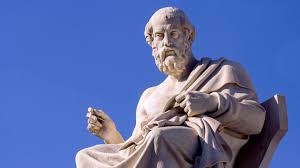
On the featured image
Chicago Style Citation
Bibliography: Drosis, Leonidas. Plato. 1885. Marble. Academy of Athens, Athens.
Footnote:
Leonidas Drosis, Plato, 1885, marble, Academy of Athens, Athens.
Artist: Leonidas Drosis (Greek, 1834–1882). Note: While Drosis designed the statue, it was executed in marble by the Italian sculptor Piccarelli.
Date: Completed in 1885.
Location: Flanking the entrance of the Academy of Athens, Panepistimiou Street, Athens, Greece.
Provenance: Commissioned as part of a sculptural ensemble for the Academy building (designed by Theophil Hansen). The project was funded by the benefactor Simon Sinas. The statue has remained in its original outdoor location at the Academy since its completion.
The Academy of Athens – Official History
Fideler, David. “A Short History of Plato’s Academy.” Plato’s Academy Centre, 2021. Link.
Wick, David Philip. “Plato’s Academy and the ‘Roman Market’: A Case Study in ‘Humanities Education’ During Times of Crisis or Recession.” Athens Journal of History 9, no. 3 (July 2023): 249-260. DOI: 10.30958/ajhis.9-3-2.