Aeschylus. The Persians. Translated by Seth Benardete. In Aeschylus II: The Suppliant Maidens, The Persians, Seven against Thebes, Prometheus Bound, edited by David Grene and Richmond Lattimore. Chicago: University of Chicago Press, 1991. Wiley Online Library.
Manuscript Tradition: The primary textual “provenance” for the play survives through the Mediceus manuscript (Laurentianus 32.9), held in the Biblioteca Medicea Laurenziana in Florence, Italy.
The Loeb Classic Library publishes a different translation.
Aeschylus. Persians. Seven against Thebes. Suppliant Maidens. Prometheus Bound. Edited and translated by Alan H. Sommerstein. Loeb Classical Library 145. Cambridge, MA: Harvard University Press, 2009.
Harrison, Thomas. The Emptiness of Asia: Aeschylus’ Persians and the History of the Fifth Century. London: Duckworth, 2000.
Miller, Margaret C. Athens and Persia in the Fifth Century BC: A Study in Cultural Receptivity. Cambridge: Cambridge University Press, 1997.
Sommerstein, Alan H. “The Theatre of Aeschylus.” In The Encyclopedia of Greek Tragedy, edited by Hanna M. Roisman. Wiley-Blackwell, 2013.
On the Featured Image
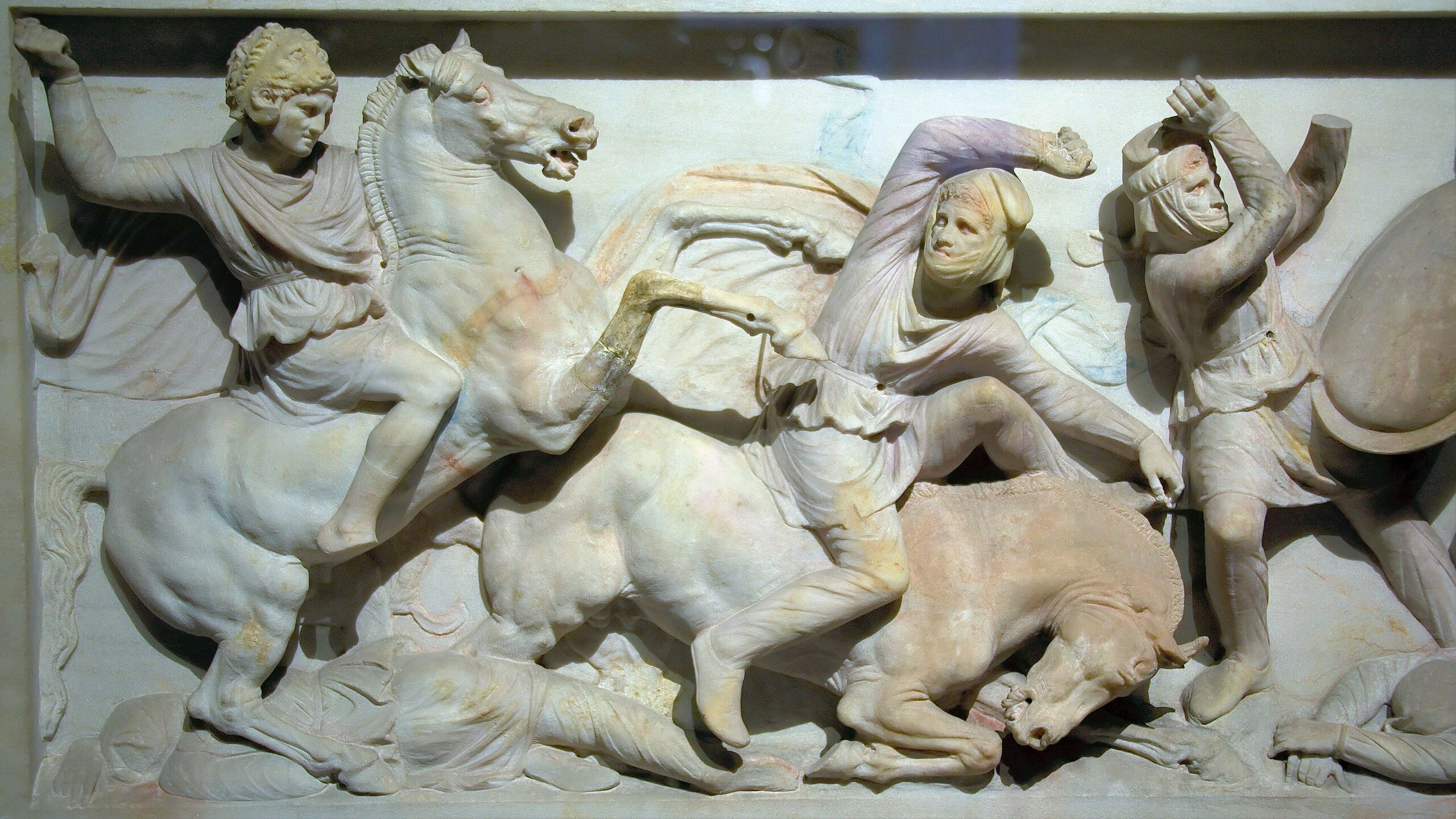
The Alexander Sarcophagus. c. 312 BCE. Pentelic marble with polychromy, 195 × 318 × 167 cm. Istanbul Archaeology Museum, Istanbul.
Palagia provides a rigorous art-historical re-evaluation of the monument’s iconography, focusing on the stylistic nuances of the battle and hunt scenes and the identities of the figures depicted.
von Graeve, Volkmar. Der Alexandersarkophag und seine Werkstatt. Berlin: Gebr. Mann, 1970.
A foundational art-historical study of the workshop practices, marble construction, and the original polychromy (paint) that decorated the sarcophagus.
Stewart, Andrew. Faces of Power: Alexander’s Image and Hellenistic Politics. Berkeley: University of California Press, 1993.
Stewart, a leading scholar on Greek sculpture, analyzes the sarcophagus as a pivotal work of art history that transitioned classical styles into the more emotive and complex Hellenistic tradition.
Heckel, Waldemar. “The Alexander Sarcophagus: Some Notes on the Identity of the Figures.” The University of Ottawa Quarterly 47 (1977): 401–412.
This article focuses on the identification of the Persian and Macedonian figures through an analysis of their costume and weaponry as represented in the marble reliefs.