The Politics, and the Constitution of Athens. United Kingdom: Cambridge University Press, 1996.
This specific volume, edited by Stephen Everson, utilizes two classic translations that were revised for modern clarity:
The Politics: Uses the translation by Benjamin Jowett. Everson utilized the “Revised Oxford Translation” version of Jowett’s text (originally edited by Jonathan Barnes) to ensure technical terms remained consistent with modern Aristotelian scholarship.
The Constitution of Athens (Athenaion Politeia): Uses the translation by Frederic G. Kenyon. Kenyon was the scholar who originally transcribed and translated the text after its sensational discovery in the late 19th century.
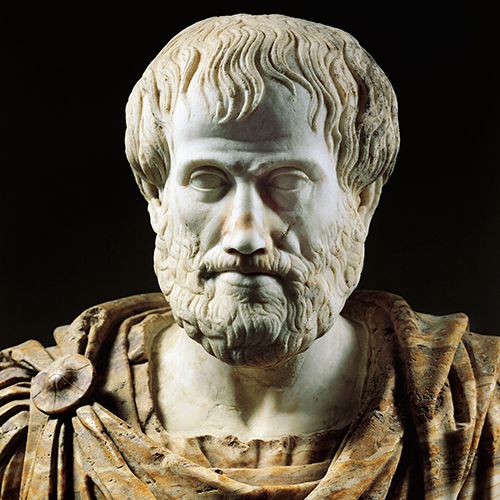
Lysippos (after). Portrait of Aristotle. 1st–2nd century AD. Marble. 32 cm. National Roman Museum, Palazzo Altemps, Rome.
While this image is frequently associated with the J. Paul Getty Museum in educational contexts (and has been featured in Getty research publications), the specific marble bust in the photograph—noted for its distinct yellowish-brown marble mantle—is actually a Roman copy housed in the National Roman Museum (Museo Nazionale Romano) at the Palazzo Altemps in Rome.
Museum Link: National Roman Museum – Palazzo Altemps
Getty Reference: Portrait of Aristotle – Getty Collection (Note: The Getty’s primary Aristotle portrait is a head without the draped mantle seen here).
This piece is a Roman-era marble copy (1st or 2nd century AD) of a lost Greek bronze original.
Original Commission: The original bronze was created by the Greek sculptor Lysippos around 330 BC, likely commissioned by Alexander the Great to honor his tutor.
Acquisition: The marble bust was part of the historical Ludovisi Collection before being acquired by the Italian state for the National Roman Museum.
Modern Additions: The alabaster/colored marble mantle (the draped clothing) is a 17th-century addition, a common practice during the Baroque period to “complete” ancient fragments for display in private galleries.
The following works by art historians focus on the sculptural history, the attribution to Lysippos, and the Roman practice of copying Greek originals:
Richter, Gisela M. A. The Portraits of the Greeks. Vol. 2. London: Phaidon, 1965.
Focus: This is the seminal work on identifying the “Aristotle type” and cataloging the various Roman copies.
Dillon, Sheila. Ancient Greek Portrait Sculpture: Contexts, Subjects, and Styles. Cambridge: Cambridge University Press, 2006.
Focus: Examines the social and political contexts of philosopher portraits and how they were adapted by Roman collectors.
Smith, R. R. R. Hellenistic Sculpture: A Handbook. London: Thames & Hudson, 1991.
Focus: Discusses the transition of portraiture from the Classical to the Hellenistic period, specifically referencing Lysippos’s influence on the “intellectual” portrait style.
The specific accession number and catalog details for the Portrait of Aristotle in the Palazzo Altemps (National Roman Museum) are as follows:
Accession Number: Inv. 8575
Collection: Museo Nazionale Romano (Ex-Ludovisi Collection)
Location within Museum: Ground floor, Galata Room (or nearby portrait galleries)
Documentation & Additional Scholarly References
The following sources provide deep dives into the provenance of the Ludovisi marbles and the specific reconstruction of this bust:
Palma, Beatrice. Museo Nazionale Romano: Le Sculture. I, 4. I Marmi Ludovisi: Storia della Collezione. Rome: De Luca, 1983.
Focus: This is the definitive catalog for the Ludovisi collection, detailing how the 17th-century alabaster mantle was integrated with the ancient marble head.
Bol, Peter C. Forschungen zur Villa Albani. Katalog der antiken Bildwerke. Berlin: Gebr. Mann, 1989.
Focus: While focusing on the Villa Albani, Bol provides extensive cross-references to the Aristotle “Type A” portraits found in the Palazzo Altemps.
Gabriel, Mabel M. Masters of Campanian Painting. New York: Bittner, 1952.
Focus: Though broader in scope, Gabriel discusses the “philosopher type” in Roman domestic settings and the specific aesthetic of the Altemps copy.
The Italian Ministry of Culture manages the digital archives for the National Roman Museum. You can find the specific record via the Catalogo Generale dei Beni Culturali:
Direct Catalog Entry: Ritratto di Aristotele – Ministero della Cultura
Museum Page: Palazzo Altemps Collection Highlights
Would you like me to find the specific publication year for the most recent conservation report on this piece?
The history of the Politics
Aristotle. Aristotelis Politicorum Libri Octo. Translated by William of Moerbeke. Edited by Franz Susemihl. Leipzig: Teubner, 1872. (Original translation c. 1260).
Online Access: The Latin Library
Aristotle. Aristotelis Politicorum Libri Octo. Translated by Leonardo Bruni. Florence: 1438.
Online Access: Münchener DigitalisierungsZentrum
Aristotle. Aristotelis Opera Omnia Quae Extant Graece & Latine. Edited by Guillaume Du Val. 2 vols. Paris: Typis Regiis, 1619.
Online Access: Google Books (Volume 1)
Context: This was the definitive Greek-Latin parallel edition of the early 17th century. It includes the Latin translations by scholars like Julius Caesar Scaliger and the extensive commentaries that defined the “Aristotelity” Hobbes encountered at Oxford.
Aristotle. Politics. Translated by H. Rackham. Loeb Classical Library 264. Cambridge, MA: Harvard University Press, 1932.
Online Access: Perseus Digital Library
Aristotle. Aristotelis Politica. Edited by Immanuel Bekker. Berlin: Georgium Reimerum, 1831.
Online Access: Archive.org
Context: The source of the “Bekker numbers” (e.g., 1252a) which are the universal standard for citing any passage in Aristotle.
Aristotle. The Politics. Translated by Carnes Lord. 2nd ed. Chicago: University of Chicago Press, 2013.
Online Access: University of Chicago Press
Context: Generally considered the most “technical” and literal modern English translation, preferred by political theorists for its precision.
Passages of Focus
Book I, 1-2;
Book II, 1-2;
Book III, 6-13;
Book IV, 11-13
Political science will have to begin and the beginning by asking what is politics.
What is a polis and how it is similar or different from other types of social organization.
On the Constitution of Athens
The Papyrus Discovery (1890–1891)
The text was unknown until 1890, when Sir Frederic G. Kenyon, an assistant in the British Museum, identified it on the verso of four papyrus rolls found in Egypt (Papyrus 131).
The First Edition: Kenyon published the editio princeps (first printed edition) and the first English translation in 1891.
Initial Impact: This discovery revolutionized the study of Athenian democracy, as it provided a historical narrative of the Athenian “constitution” that contradicted or filled gaps in Thucydides and Herodotus.
The Early 20th-Century Standardizations
Following Kenyon’s discovery, several scholars sought to refine the translation of technical legal and political terms (such as ostrakismos or heliaia).
Postgate & Others: Various British and German scholars published competing translations and commentaries between 1892 and 1910, often debating the authenticity of the text (whether it was written by Aristotle himself or a student in his school).
The Loeb Edition (1935): Translated by H. Rackham. This edition provided the first widely accessible “facing-page” version, allowing scholars to compare the Greek papyrus text with English.
Modern Scholarly Translations
In the latter half of the 20th century, translations shifted toward providing “historical-critical” contexts rather than just literal linguistic equivalents.
P. J. Rhodes (1984): Published by Penguin Classics (and later a massive scholarly commentary by Oxford). Rhodes is considered the definitive modern authority on the Athenaion Politeia. His translation is prized for its immense historical accuracy regarding Athenian law.
The Everson/Cambridge Edition (1996): As noted above, this edition returned to a revised Kenyon translation, chosen for its elegance and its foundational status in the history of the text’s English reception.