2 And after six days Jesus took with him Peter and James and John, and led them up a high mountain by themselves. And he was transfigured before them, 3 and his clothes became radiant, intensely white, as no one[a] on earth could bleach them.
Why would we be reviewing the Book of Mark in a blog about the history of political philosophy.
Because god-likeness is a central theme of accounts of sovereignty in the Leviathan and elsewhere.
When we think of godlikeness and the polity and try to go to the earliest accounts we come to Rome, the deification of the returning consul after conquering more territory receives a welcome akin to deification. This is called the triumph. Romulus goes upward into the sky enveloped in a bright light.
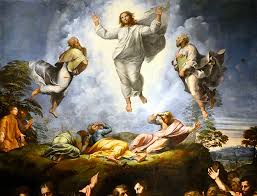
So, of course we are interested in an account of a deification of a very specific kind in the account of Jesus’ transfiguration the earliest account of which is in the book of Mark. In order to give an account of how the transfiguration differs from the triumphator, then you have to read scholarly books on Mark, and preferably have access to the passage in various languages and translations.
This exploration of how Jesus’ entry into Jerusalem as King of the Jews infuriated Jews, and would have sent Roman heads spinning has to be further explored in Luke.
Just as there are other accounts of transfiguration.
The study of the transfiguration is also important for political science insofar as revolution is a foci of inquiry. Try to isolate the moment one order collapses and another one begins.
So then we think, on the individual level of the idea of conversion. Because we know in articulating that movement we can try to abstract out to what is profound change in the interior about? How can we map that motion?
Next we have the idea in Aristotle’s Poetics that plot involves recognition and reversal. The story is going along motion in certain direction. Then the protagonist, the chorus, or a main character recognizes some fact about themselves or the situation they had hitherto not realized, and this realization creates a reversal in the direction of the plot.
Now Hobbes uses this plot structure in a certain way, and at the apotheosis of the sovereign, the prevailing feeling is fear, and the recognition and reversal ensues with the covenant.
The plot of Hamlet, as well, which is portrayed as the archetype of the early modern man’s dilemma, features a recognition and reversal.
So, being a person who values drawing distinctions where possible, I think that there could be some distinctions made between types of recognitions and reversals.
What are the recognitions and reversals in the story of Jesus.
Well, the transfiguration is one.
The conversion stories feature them.
So, we can see in trying to find the godlikeness of the sovereign we have Greek references to Aristotle’s Poetics and Sophocles Oedipus as a textbook example for him.
So we have a Greek plot structure, we have a Roman political tradition, and an early modern text that says that the people need to get saved from their own desires which of course makes one think of the King of Jerusalem.
We can also see that we have three traditions already at play while the fourth emerges.
Finally, there is the question of life.
Life comes up in questions of sovereignty because its raison d’etre is to save your life, secure your life, make you live, something about life.
We know from the Jewish tradition, in Deuteronomy, we are looking to choose life.
Well, what do we learn about life in the Gospels?
I want to use this word because in questioning what it means to save one’s life, there’s life, the living, and then there is what does saving one’s life mean and theologians came up with this word soteriology to talk about it.
Studying the history of political thought have to approach sotieriology what it means to be saved since the need to be saved from social disorder is the fear that freezes the future citizen in the subject position.
Have to address the issue of saviour-dom even if we categorize the stories in the text as myth, because the myth is operative in the imaginations of so many. Myth and re reading the Bible are avoided at the university philosophy department because it does not rise to the level of philosophy if its just a compelling story. This uneasy not really fitting together — philosophical inquiry and replay of myth is why soteriology has been left out.
Can it be wrested out of the deep recess of the imagination far enough to turn around and examine? What is the right descriptor for stories of salvation that takes it beyond myth. Is it universal psychology? Is it sociology or anthropology?
Approaching a gospel to recognize its influence in the history of political thought, and how is that different than listening to the Word of God from a pew.
On the Featured Image
Raphael. The Transfiguration. 1516–1520. Oil on wood, 410 x 279 cm. Pinacoteca Vaticana, Vatican Museums, Vatican City.
Artist: Raphael (Raffaello Sanzio, 1483–1520)
Title: The Transfiguration (La Trasfigurazione)
Date: 1516–1520
Medium: Tempera and oil on wood panel
Dimensions: 410 cm × 279 cm (161 in × 110 in)
Museum Inventory Number: Inv. 40333 (MV.40333)
Repository Location: Pinacoteca Vaticana (Room VIII), Vatican Museums, Vatican City
Official Museum Link: Vatican Museums — The Transfiguration by Raphael
Provenance
1516: Commissioned by Cardinal Giulio de’ Medici (later Pope Clement VII) as an altarpiece for the Cathedral of Saint-Just in Narbonne, France.
1520: Completed in Rome shortly before Raphael’s death in April 1520; displayed at the head of Raphael’s catafalque during his funeral lying-in-state.
1523–1797: Retained by Cardinal Giulio de’ Medici in Rome and installed on the high altar of the Church of San Pietro in Montorio, Rome.
1797–1815: Seized by Napoleon Bonaparte’s troops following the Treaty of Tolentino (1797) and transferred to Paris, where it was exhibited in the Musée Napoléon (Louvre).
1815–Present: Restored to the Papal States following the Congress of Vienna (1815) under the direction of Antonio Canova; subsequently allocated to the permanent collection of the Pinacoteca Vaticana in the Vatican Museums.
Hall, Marcia B. Raphael’s Transfiguration: Process and Meaning. Philadelphia: Temple University Press, 1982.
Jones, Roger, and Nicholas Penny. Raphael. New Haven: Yale University Press, 1983.
Oberhuber, Konrad. Raphael: The Complete Work. Milan: Electa, 1999.