Potter, Robert, trans. 1781. The Tragedies of Euripides. London: J. Dodsley.
Coleridge, E. P., trans. 1891. The Plays of Euripides. London: George Bell and Sons.
Wyckoff, Elizabeth, trans. 1959. “The Phoenician Women.” In Euripides IV: The Complete Greek Tragedies, edited by David Grene and Richmond Lattimore, 441–528. Chicago: University of Chicago Press.
Craik, Elizabeth, ed. and trans. 1988. Euripides: Phoenician Women. Warminster: Aris & Phillips.
Kovacs, David, ed. and trans. 2002. Euripides: Helen, Phoenician Women, Orestes. Cambridge, MA: Harvard University Press.
On the featured image:
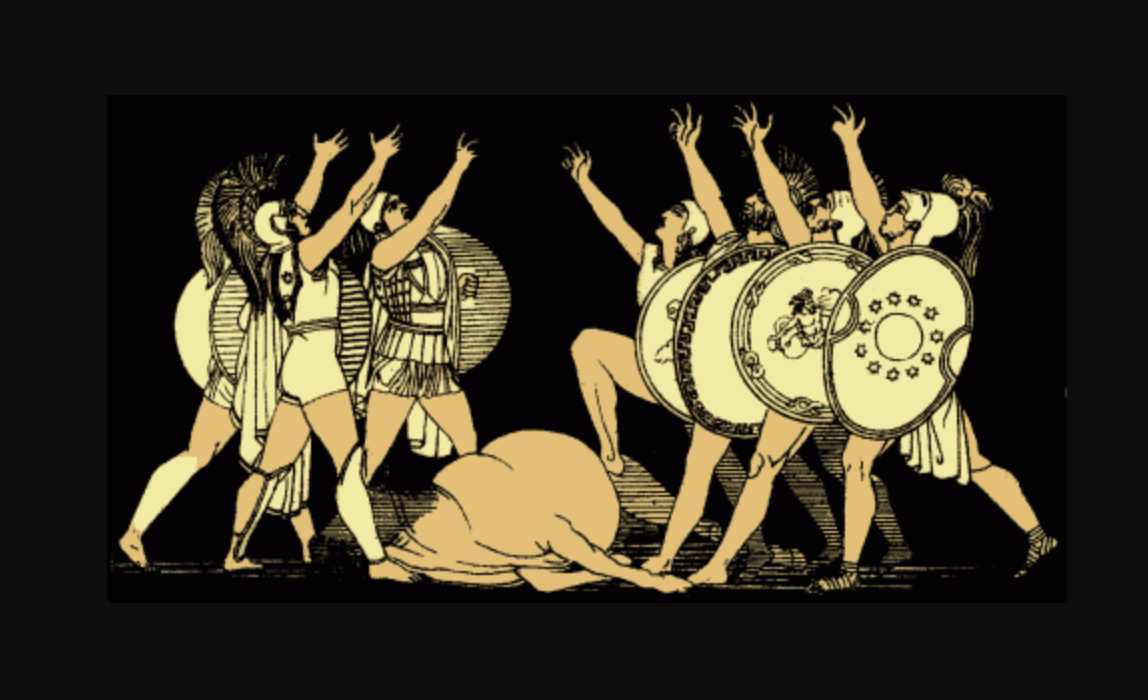
Flaxman, John. 1795. The Seven Before Thebes. Engraving by Tommaso Piroli. From Compositions from the Tragedies of Aeschylus. London: J. Matthews.
Museum/Collection: Original sets of these engravings and the preparatory drawings are held at the Royal Academy of Arts, London and the British Museum.
Provenance: Flaxman’s designs were commissioned while he was in Rome (c. 1792–1795). They were intended to provide a visual companion to the classical texts that were being widely re-translated during the Enlightenment.
Potter, Robert, trans. 1781. The Tragedies of Euripides. London: J. Dodsley.
The image provided is a line drawing reproduction of a famous neoclassical illustration by John Flaxman (1755–1826). It depicts a central scene from Euripides’ Phoenician Women: the Oath of the Seven Against Thebes.
Chicago Style Citation:
Flaxman, John. 1795. The Seven Before Thebes. Engraving by Tommaso Piroli. From Compositions from the Tragedies of Aeschylus. London: J. Matthews.
John Flaxman was a leading figure in British Neoclassicism. This specific illustration is part of his celebrated series of line engravings that sought to emulate the “purity” of Greek red-figure and black-figure vase painting.
Linear Minimalism: Flaxman stripped away shading and perspective to focus on the expressive power of the outline, a style that influenced European art from Ingres to Picasso.
The Scene: The image depicts the seven commanders (Polynices, Tydeus, Capaneus, Parthenopaeus, Mecisteus, Hippomedon, and Adrastus) as they swear a blood oath over a shield. In the Phoenician Women, this martial fervor is contrasted sharply with the domestic grief of Jocasta and Antigone.
Museum/Collection: Original sets of these engravings and the preparatory drawings are held at the Royal Academy of Arts, London and the British Museum.
Provenance: Flaxman’s designs were commissioned while he was in Rome (c. 1792–1795). They were intended to provide a visual companion to the classical texts that were being widely re-translated during the Enlightenment.
While this specific composition is often titled in reference to Aeschylus’ Seven Against Thebes, it became the definitive visual representation for the opening movements of Euripides’ Phoenician Women in the 18th and 19th centuries. The “shield-swearing” ritual is described by the Messenger in Euripides’ text (lines 1104–1140), detailing the distinct emblems on each commander’s shield—elements Flaxman meticulously attempted to recreate.
Scholarly Art History Citations
Symmons, Sarah. 1984. Flaxman and the Neoclassical Illustration. Cambridge: Cambridge University Press. (The primary scholarly work on Flaxman’s stylistic choices and his influence on the visual reception of Greek tragedy).
Trendall, A. D., and T. B. L. Webster. 1971. Illustrations of Greek Drama. London: Phaidon. (Essential for comparing Flaxman’s 18th-century “re-imagining” with the original 4th-century BCE vase paintings that inspired him).
Small, Jocelyn Penny. 1981. The Antigone-Polynices-Eteocles Cycle in Greek and Roman Art. Princeton: Princeton University Press. (Provides the art history context for the evolution of the “Seven” iconography from antiquity to the neoclassical era).
Bentley, G. E. 1964. The Early Engravings of Flaxman’s Classical Designs. New York: New York Public Library. (A technical provenance study of the publication history of these specific illustrations).