We want to learn Italian so we can read Machiavelli. Also, we are tracing how Plato and Aristotle made it into modernity and in so doing what is it’s relation to Christianity and so we need to read Dante.
Dante’s Christianity has been questioned from the perspective of Biblical hermeneutics, i.e., there really is no hell or, its other people.
And if we didn’t read Dante, we wouldn’t catch Bob Dylan’s reference to Canto XIV of Paradiso in Dante Alighieri’s Divine Comedy to in Tangled Up in Blue.
Not since the holy writ has a text required so much exegesis to get a grip on. A trilogy you could read again and again and not be sure you sucked all the marrow out of it.
On the featured poem
“O luce etterna che sola in te sidi,
sola t’intendi, e da te intelletta
e intendente te ami e arridi! …
A l’alta fantasia qui mancò possa;
ma già volgeva il mio disio e ‘l velle,
sì come rota ch’igualmente è mossa,
l’amor che move il sole e l’altre stelle.”
the closing lines of Dante Alighieri’s Divina Commedia (Divine Comedy), specifically Paradiso, Canto XXXIII, lines 124–126 and 142–145.
Giorgio Petrocchi (La Commedia secondo l’antica vulgata, 1966–1967)
“O Light eternal, fixed in Thyself alone, who alone understandest Thyself, and who, understood by Thyself and understanding, lovest and smilest on Thyself!”
“Here force failed my high fantasy; but already my desire and will were turned, like a wheel moving equally, by the Love that moves the sun and the other stars.”
Alighieri, Dante. Paradiso. Translated by Robert Hollander and Jean Hollander. New York: Anchor Books, 2007.
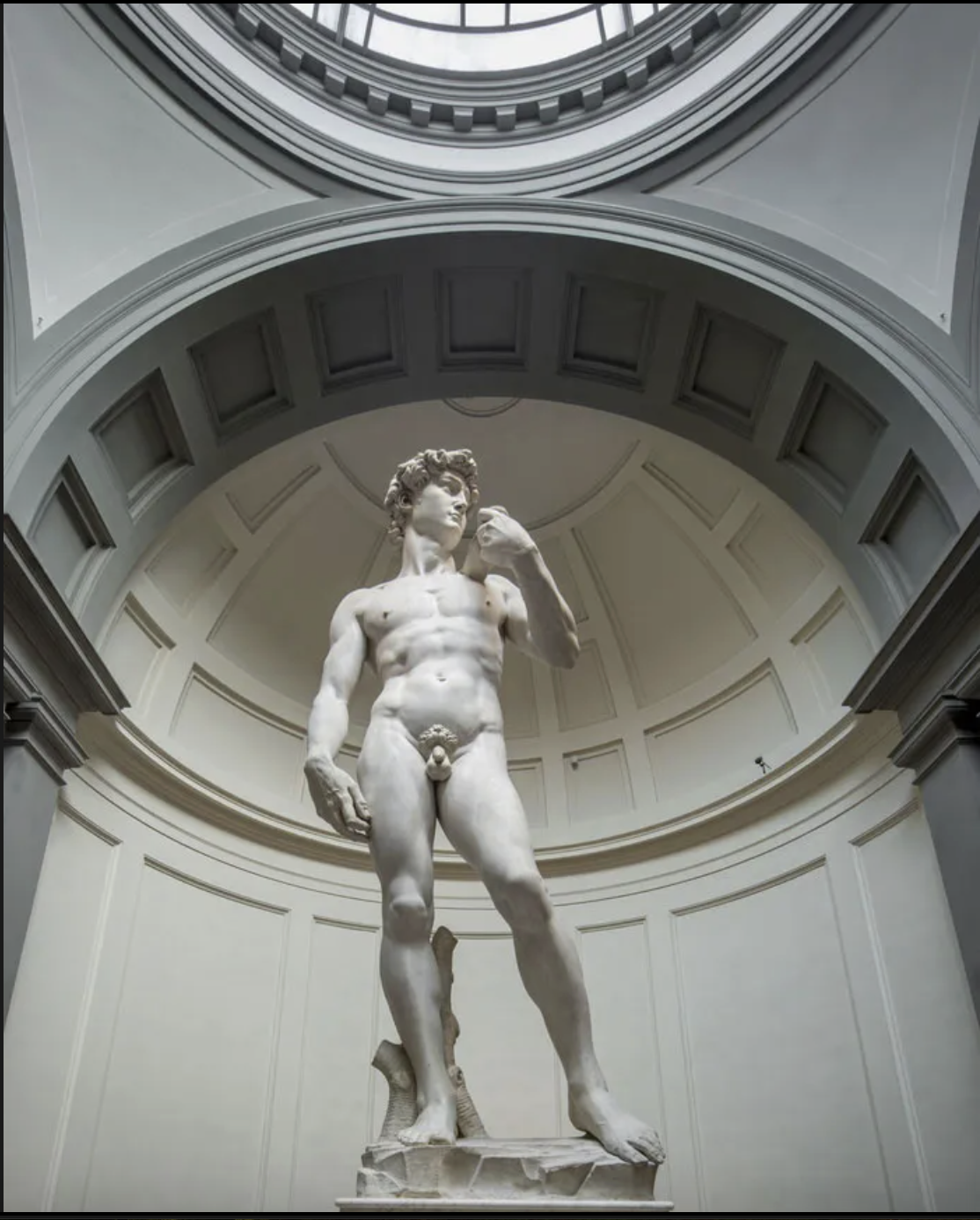
On the featured image
1501: Commissioned by the Operai (Board of Directors) of the Opera del Duomo and the Arte della Lana (Wool Merchants Guild) to carve a colossal figure from a massive block of Carrara marble that had been structurally compromised and abandoned by earlier sculptors (Agostino di Duccio in 1464 and Antonio Rossellino in 1475).
1504: Upon completion, a committee of civic leaders and artists (including Leonardo da Vinci and Sandro Botticelli) determined that the sculpture should be placed at ground level in front of the town hall (Palazzo Vecchio) in the Piazza della Signoria, transforming its meaning into a militant civic emblem of the Florentine Republic.
1873: To safeguard the marble from environmental degradation and weathering, the original colossus was moved via a specially engineered transport system to the Galleria dell’Accademia, where it rests under a purpose-built skylight tribune designed by Emilio de Fabris.