Machiavelli, Niccolò. The Prince: Second Edition. United Kingdom: University of Chicago Press, 1998.
532: Two authorized versions were published in Rome (by Antonio Blado) and Florence (by Bernardo Giunta).
Machiavelli, Niccolò. Il principe. Florence: Bernardo Giunta, 1532.
Newberry Library (Chicago): Catalog Record (Held in the Vault).
British Library: Digital Scan (General resource link for Machiavelli holdings).
Machiavelli, Niccolò. Il principe. Rome: Antonio Blado, 1532.
Morgan Library & Museum (New York): Catalog Entry.
Bayerische Staatsbibliothek (Munich): Digital Version (Complete). This is one of the most accessible high-resolution scans of the first edition.
1559: The Catholic Church placed all of Machiavelli’s works on the Index Librorum Prohibitorum (List of Prohibited Books), which ironically fueled its “underground” popularity across Europe.
Vatican Library (Biblioteca Apostolica Vaticana): Digital Archive. Note: Search for “Barb. lat. 5093” for the related Machiavelli manuscript or the 1559 printed Index.
Beacon for Freedom of Expression: Historical Database Record (A specialized project tracking the history of the Index).
Catholic Church. Index librorum prohibitorum. Rome: Antonio Blado, 1559.
Machiavelli, Niccolò. Nicolo Machiavelli Florentini princeps: ex Sylvestri Telii Fulginatis traductione diligenter emendata. Translated by Silvestro Tegli. Basel: Petrus Perna, 1560.
Yale University (Beinecke Library): Catalog Record.
Stanford University: Catalog Record.
Google Books (Digitized by Ghent University): Full Latin Text.
1640: The first English translation, by Edward Dacres, was published in London, making the text more accessible to British thinkers.
Machiavelli, Niccolò. Nicholas Machiavel’s Prince: Also, The Life of Castruccio Castracani of Lucca, and The Meanes Arming the Duke Valentine to Murder Vitellozzo Vitelli, Oliverotto da Fermo, Paul, and the Duke of Gravina. Translated by Edward Dacres. London: R. Bishop, 1640.
Folger Shakespeare Library: Digital Image Collection.
University of California, Berkeley (Bancroft Library): Catalog Record. This copy is part of the Irving Stone collection.
National Library of Australia: Digital Catalog Record.
If you want to know what early modern political thought is all about and you only have time for one text, this is it.
Did you ever wonder what it means when someone is called Machiavellian?
The political scheming Machiavelli witnessed in Florence was insane, and he was reading Livy, trying to scour the annals of Roman history to find guidance.
Read this to meditate on the relationship between the style and substance of a text.
On the featured image
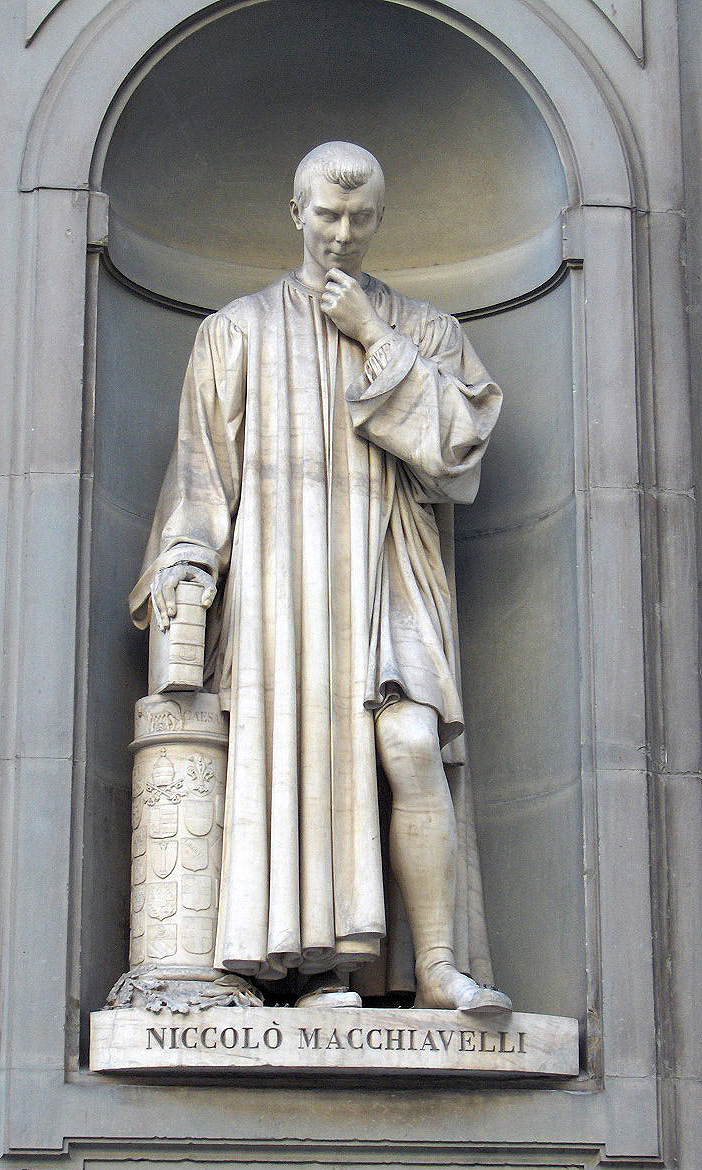
Bartolini, Lorenzo. Niccolò Machiavelli. 1843. Marble. Piazzale degli Uffizi, Florence.
Gallerie degli Uffizi. “The 28 Statues in the Courtyard.” Accessed March 26, 2026. https://www.uffizi.it/en/artworks/the-28-statues-in-the-courtyard.
The marble statue of Niccolò Machiavelli was sculpted by Lorenzo Bartolini (1777–1850), one of the most prominent Italian Neoclassical and Romantic sculptors of the 19th century.
Location: It occupies one of the 28 exterior niches in the Piazzale degli Uffizi (the Uffizi Gallery courtyard) in Florence.
Commission & Provenance: While Giorgio Vasari originally designed these niches in the 16th century for “Illustrious Tuscans,” they remained empty for nearly 300 years. In 1834, the Florentine printer Vincenzo Batelli revived the project through a public subscription. The statue of Machiavelli was completed and installed in 1843.
Iconography: Machiavelli is depicted in a thoughtful, contemplative pose, holding a book—traditionally identified as his most famous work, The Prince—resting on a pedestal decorated with various coats of arms representing the Florentine Republic.
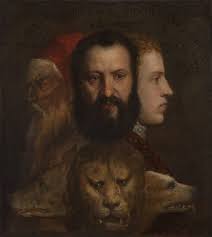
Titian. An Allegory of Prudence. ca. 1550–1565. Oil on canvas. 76.2 cm × 68.6 cm. National Gallery, London.
Museum and Gallery Location
National Gallery. “An Allegory of Prudence.” Accessed March 26, 2026. https://www.nationalgallery.org.uk/paintings/titian-an-allegory-of-prudence.
Scholarly Analysis
Panofsky, Erwin. “Titian’s ‘Allegory of Prudence’: A Postscript.” In Meaning in the Visual Arts, 146–68. Chicago: University of Chicago Press, 1982.
About the Painting
This work is a complex allegorical portrait by the Venetian master Titian (Tiziano Vecellio), likely assisted by members of his workshop. It is celebrated for its dense symbolism regarding time and human experience.
Composition: The painting features three human heads facing different directions, each paired with an animal head below it.
Left (Old Man/Wolf): Represents the Past and the wisdom of memory. The figure is often identified as a self-portrait of the aged Titian.
Center (Mature Man/Lion): Represents the Present and the fortitude required for current action. This figure is frequently identified as Titian’s son, Orazio.
Right (Young Man/Dog): Represents the Future and the hope or caution of what is to come. This figure is often identified as Titian’s nephew and assistant, Marco Vecellio.
The Inscription: Across the top of the canvas is a Latin inscription: EX PRAETERITO / PRAESENS PRUDENTER AGIT / NE FUTURA ACTIONE DETURPET (“From the past, the present acts prudently, lest it spoil future action”).
Provenance: The painting was likely intended as a private family emblem or a “testamentary” statement. It passed through several private collections, including those of the Earl of Aberdeen and later the art historian Erwin Panofsky, before being acquired by the National Gallery, LondoArt historians, most notably Erwin Panofsky, have analyzed the work as a visual representation of the three parts of Prudence (Prudentia): Memoria (Memory), Intelligentia (Understanding), and Providentia (Foresight). The animal imagery—the wolf, lion, and dog—draws from the ancient Egyptian symbol of Serapis as described by Macrobius and Petrarch.n, in 1966.
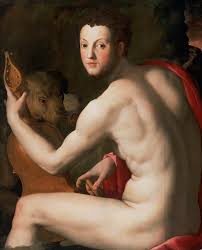
Bronzino, Agnolo. Portrait of Cosimo I de’ Medici as Orpheus. ca. 1537–1539. Oil on panel. 93.7 cm × 76.4 cm. Philadelphia Museum of Art.
Museum and Gallery Location
Philadelphia Museum of Art. “Portrait of Cosimo I de’ Medici as Orpheus.” Accessed March 26, 2026. https://www.philamuseum.org/objects/52029.
Scholarly Analysis
Zappella, Christine. “The Implicating Gaze in Bronzino’s Cosimo I de’ Medici as Orpheus and the Intellectual Culture of the Accademia Fiorentina.” Studies in Iconography 42 (2021): 161–86.
About the Painting
This remarkable Mannerist portrait by Agnolo Bronzino depicts the young Duke Cosimo I de’ Medici in the guise of the mythological musician Orpheus. It is a unique work in both Bronzino’s oeuvre and the iconography of the Medici family.
Subject and Symbolism: The nude Duke is shown holding a lira da braccio (a Renaissance bowed string instrument) after having charmed Cerberus, the three-headed hound of Hades seen in the shadows behind him.
Political Context: Scholars suggest the painting may have been commissioned to celebrate Cosimo’s marriage to Eleonora di Toledo in 1539, or perhaps to commemorate his military victory at the Battle of Montemurlo (1537), casting him as a “pacifier” who brings order to Florence just as Orpheus calmed the underworld.
Artistic Influence: The pose of the figure is a direct reference to the Belvedere Torso, an ancient Roman marble fragment, signaling Bronzino’s engagement with classical sculpture and the high style of the Renaissance.
Location and Provenance
The painting is currently held at the Philadelphia Museum of Art (Accession Number: 1950-86-1). It was a gift to the museum from Mrs. John Wintersteen in 1950. Unlike many of Bronzino’s official portraits of the Duke in armor, this is the only known version of this specific composition, indicating it may have been intended for a private, highly intellectual audience rather than as a mass-produced diplomatic gift.
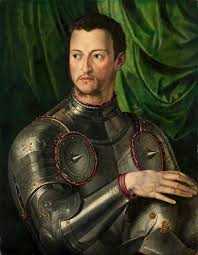
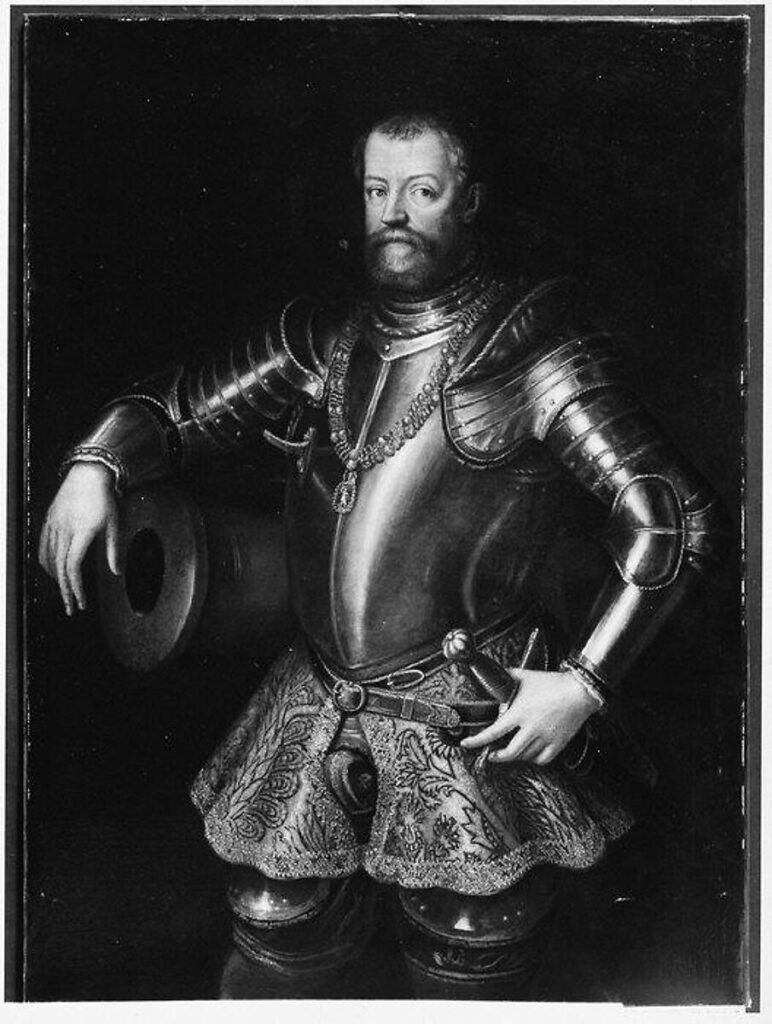
Bronzino, Agnolo. Portrait of Cosimo I de’ Medici in Armour. 1545. Oil on wood. 74 cm × 58 cm. Gallerie degli Uffizi, Florence.
Gallerie degli Uffizi. “Portrait of Cosimo I de’ Medici in Armour.” Accessed March 26, 2026. https://www.uffizi.it/en/artworks/portrait-of-cosimo-i-de-medici-in-armour.
Scholarly Analysis
Simon, Robert B. “Bronzino’s Portrait of Cosimo I in Armour.” The Burlington Magazine 125, no. 966 (1983): 527–39.
This iconic image by Agnolo Bronzino is the official state portrait of Cosimo I de’ Medici, the Duke of Florence (and later the first Grand Duke of Tuscany). It is considered a masterpiece of Mannerist portraiture and served as a crucial tool for Medicean political propaganda.
Historical Context: Painted around 1545, the portrait celebrates Cosimo’s successful consolidation of power and his diplomatic victory in removing Spanish garrisons from Florence.
The Armour: The Duke is depicted in a suit of “white” (polished steel) armor. The meticulously rendered reflections on the metal demonstrate Bronzino’s technical virtuosity. The armor symbolizes Cosimo as a “ruler-commander,” emphasizing strength and invincibility.
Compositional Choice: Unlike the more intimate Cosimo as Orpheus (which you recently viewed), this portrait presents the Duke as a stern, distant, and authoritative leader. His hand rests on a helmet, a traditional pose for a military commander.
Versions and Variants
Because this image was intended for political dissemination, Bronzino and his workshop produced at least 25 versions to be sent as diplomatic gifts to other European courts.
The Prime Version: The version in the Uffizi (Florence) is widely accepted as the primary half-length prototype.
Gallerie degli Uffizi (Florence): Portrait of Cosimo I de’ Medici in Armour
The Three-Quarter Length Prime: A recent technical analysis (2023) confirmed that the version held by the Art Gallery of New South Wales (Sydney) is the “prime autograph version” of the three-quarter-length composition.
Art Gallery of New South Wales (Sydney): Cosimo I de’ Medici in Armour
Metropolitan Museum of Art (New York): Cosimo I de’ Medici (1519–1574) in Armor
Metropolitan Museum of Art (New York),
the Toledo Museum of Art (Ohio),
Toledo Museum of Art (Ohio): Cosimo I de’ Medici in Armor
The Toledo version of Cosimo I de’ Medici in Armor is a significant three-quarter-length representation. Its history reflects the movement of Medici state portraiture into American public collections in the early 20th century.
Circa 1545 or after: Executed by Agnolo Bronzino or his workshop in Florence as part of the official series of diplomatic and state portraits.
Early History: Like many workshop versions, it likely remained in a private collection in Europe (possibly within the extended Medici or associated Florentine noble circles) for several centuries.
Early 20th Century: The painting was acquired by Edward Drummond Libbey (1854–1925), the founder of the Toledo Museum of Art and a pioneer in the American glass industry.
1913: Edward Drummond Libbey gifted the painting to the Toledo Museum of Art. It was one of the museum’s earliest and most important Renaissance acquisitions, assigned accession number 1913.232.
Current Status: It remains a cornerstone of the Toledo Museum of Art’s Italian Renaissance collection and is frequently cited in technical studies regarding Bronzino’s workshop practices.
Key Iconographic Details of the Toledo Version
Unlike the “prime” Uffizi version, which is a half-length portrait with a plain background, the Toledo version is three-quarter length and includes specific symbolic elements:
The Broncone: The helmet rests on a “broncone” (a laurel tree stump with a new sprout), a specific Medici emblem signifying the renewal and stability of the dynasty.
The Olive Branch: An olive branch is included, emphasizing the peace and prosperity brought to Florence under Cosimo’s rule.
Order of the Golden Fleece: The Duke wears the collar and pendant of the Order of the Golden Fleece, which he was inducted into by Emperor Charles V in 1545. This helps date the painting (or at least the specific state of the portrait) to after that year.
Museo Nacional Thyssen-Bornemisza (Madrid): Portrait of Cosimo I de’ Medici in Armour
and the Museo Thyssen-Bornemisza (Madrid).