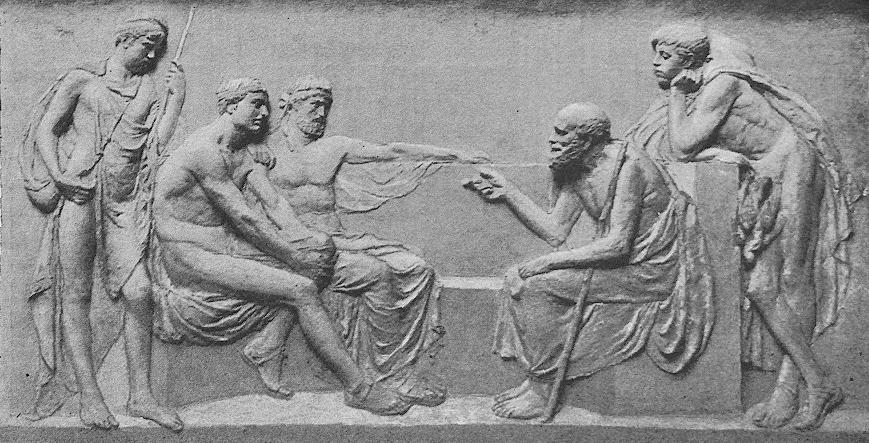
On the featured image
Harry Bates, Socrates Teaching the People in the Agora, 1886, white marble relief, University of Manchester, Manchester, UK.
This relief was a pivotal work in Bates’s career. In 1883, he entered the Royal Academy Schools and won the Gold Medal and Traveling Scholarship for this specific panel. The award allowed him to travel to Paris, where he studied under the mentorship of Jules Dalou and Auguste Rodin.
Provenance and Museum
The marble version of this relief was presented to Owens College (now part of the University of Manchester) by the architect Alfred Waterhouse, R.A., around 1886.
Current Location: The University of Manchester / Whitworth Art Gallery (Note: It is often held within the University’s institutional collections due to its historical connection to Owens College).
Provenance: The marble relief was carved in 1886, based on Bates’s 1883 Gold Medal-winning plaster model. It was acquired by the architect Alfred Waterhouse and subsequently gifted to Owens College (the predecessor to the University of Manchester). It is currently situated within the University’s collection, historically associated with the Council Chamber.
Royal Academy Exhibition Records (1883–1884)
The initial appearance of this work was a watershed moment for the “New Sculpture” movement. While it was modeled in 1883 to win the Gold Medal, its formal exhibition records are as follows:
Exhibition Year: 1884
Exhibition: Royal Academy of Arts, 116th Summer Exhibition
Catalogue Number: 1712
Original Material: Plaster (The marble version you see in Manchester was commissioned later following the success of this plaster debut).
Beattie, Susan. The New Sculpture. New Haven: Yale University Press, 1983.
Getsy, David. “Privileging the Object of Sculpture: Actuality and Harry Bates’s Pandora of 1890.” Art History 28, no. 1 (2005): 74–95.
Read, Benedict. Victorian Sculpture. New Haven: Yale University Press, 1982.
Wyke, Terry, and Harry Cocks. Public Sculpture of Greater Manchester. Liverpool: Liverpool University Press, 2004.
On the text
Original Composition (c. 399–390 BCE): The work was written in Athens, likely within the decade following Socrates’ execution. It was not “published” in the modern sense but was circulated as a manuscript among the intellectual circles of Athens and students of the Academy.
Early Circulation: During the 4th century BCE, various “Socratic discourses” (Sokratikoi logoi) were written by different followers (such as Xenophon). Plato’s version became the definitive philosophical portrait.
Hellenistic and Roman Eras: The text was preserved and copied in libraries like the Library of Alexandria. It was later organized into the “First Tetralogy” of Plato’s works by the scholar Thrasyllus in the 1st century CE.
Medieval Transmission: The text survived through the Byzantine Empire. The oldest surviving complete manuscripts date to the 9th century.
Burnet, John. “The Socrates of Byzantium.” The Journal of Hellenic Studies 31 (1911): 1–12. (Discusses the transmission history through the lens of Byzantine scribal culture).
| Version / Manuscript | Approximate Date | Current Location |
| Oxyrhynchus Papyri | 2nd–3rd Century CE | Various (e.g., Sackler Library, Oxford) |
| Codex Oxoniensis Clarkianus 39 | 895 CE | Bodleian Library, Oxford, UK |
| Codex Venetus Marcianus App. gr. IV, 1 | 12th Century | Biblioteca Marciana, Venice, Italy |
| Aldine Edition (First Printed) | 1513 | Major Rare Book Libraries (e.g., British Library) |
| Stephanus Edition (Standard Reference) | 1578 | Bibliothèque Nationale de France, Paris |
Renaissance and Modernity: The first printed edition (editio princeps) was published in Venice in 1513 by Aldus Manutius.
The “Bread” Extraction (1801): During his travels through the Ottoman Empire, the English mineralogist and collector Edward Daniel Clarke visited the Patmos monastery in October 1801. He discovered the manuscript in a heap of parchment on the library floor. To avoid the notice of the Turkish government and local spies, Clarke negotiated a secret purchase. The manuscript was reportedly smuggled off the island hidden inside crates of bread delivered to Clarke’s ship.
Arrival in Oxford (1809): After Clarke returned to England, the manuscript was inspected by the famous classicist Richard Porson. In 1809, the Bodleian Library at the University of Oxford purchased Clarke’s entire collection of manuscripts for £1,000, where it has been housed ever since under the shelfmark MS. E. D. Clarke 39.
Codex Oxoniensis Clarkianus 39. MS. E. D. Clarke 39. Oxford: Bodleian Library, 895 CE.
Allen, Thomas W. Notes on Abbreviations in Greek Manuscripts. Oxford: Clarendon Press, 1889. (Focuses on the paleography of the Clarke Plato).
Wilson, Nigel G. Scholars of Byzantium. London: Duckworth, 1983. (Details Arethas of Caesarea’s role in preserving the text).
Digital Access: Digital Bodleian: MS. E. D. Clarke 39 (High-resolution scans of the entire codex).
Library Entry: Bodleian Library Archives – Clarke Collection.
Plato. Opera Omnia. Translated by Marsilio Ficino. Florence: Laurentius de Alopa, 1484.
Link: Ficino’s 1484 Latin Plato – Digitized at the Bavarian State Library
Friedrich Schleiermacher (1768–1834): His German translation (1804–1828) changed everything. He was the first to argue that the order of the dialogues was a deliberate “philosophical program.”
Citation: Plato. Platons Werke. Translated by Friedrich Schleiermacher. Berlin: Realschulbuchhandlung, 1804.
Ulrich von Wilamowitz-Moellendorff (1848–1931): The “Giant” of German Hellenism. His work Platon (1919) remains a foundational text for understanding the historical Socrates versus the Platonic Socrates.
Citation: Wilamowitz-Moellendorff, Ulrich von. Platon: Sein Leben und seine Werke. Berlin: Weidmann, 19
French scholarship is centered on the Association Guillaume Budé, which sought to create definitive French “critical editions” (Greek text on one side, French on the other).
Maurice Croiset (1846–1935): He produced the definitive Apology for the Collection des Universités de France (the “Budé” series).
Citation: Platon. Œuvres complètes, Tome I: Introduction, Hippias mineur, Alcibiade, Apologie de Socrate, Criton, Euthyphron. Edited and translated by Maurice Croiset. Paris: Les Belles Lettres, 1920.
Link: Les Belles Lettres – Budé Series
Standard Scholarly Editions (Present Day)
The Loeb Classical Library (HUP)
The Loeb series is the global standard for students and scholars needing a portable, reliable Greek-English facing text.
Citation: Plato. Euthyphro. Apology. Crito. Phaedo. Phaedrus. Translated by Harold North Fowler. Revised by Chris Emlyn-Jones and William Preddy. Loeb Classical Library 36. Cambridge, MA: Harvard University Press, 2017.
Link: Loeb Classical Library: Apology (LCL 36)
Oxford Classical Texts (OCT)
This is the “purest” Greek text used by philologists, focusing on the manuscript tradition (stemma) rather than translation.
Citation: Plato. Platonis Opera, Tomus I. Edited by E. A. Duke et al. Oxford Classical Texts. Oxford: Oxford University Press, 1995.
Link: Oxford University Press – Plato OCT
Plato. The Dialogues of Plato. Translated by Benjamin Jowett. 3rd ed. 5 vols. New York: Oxford University Press, 1892
The apology is Socrates’ defense of himself, his way of life. This is the original utterance of “an unimagined life is not worth living” and also its better to be at odds with the whole world than at odds with yourself. Clue that ethics has something to do with the unity of the self.
This text is also the tragic end, which is always death. The Apology is sometimes entitled The Life and Death of Socrates.
So this text addresses the questions of what is a philosophical way of life and why is it provoking this reaction from the authorities.
A thread in the history of Western Thought begins here which is —- Is there some sort of an inherent conflict between a philosophical and a political ways of life?