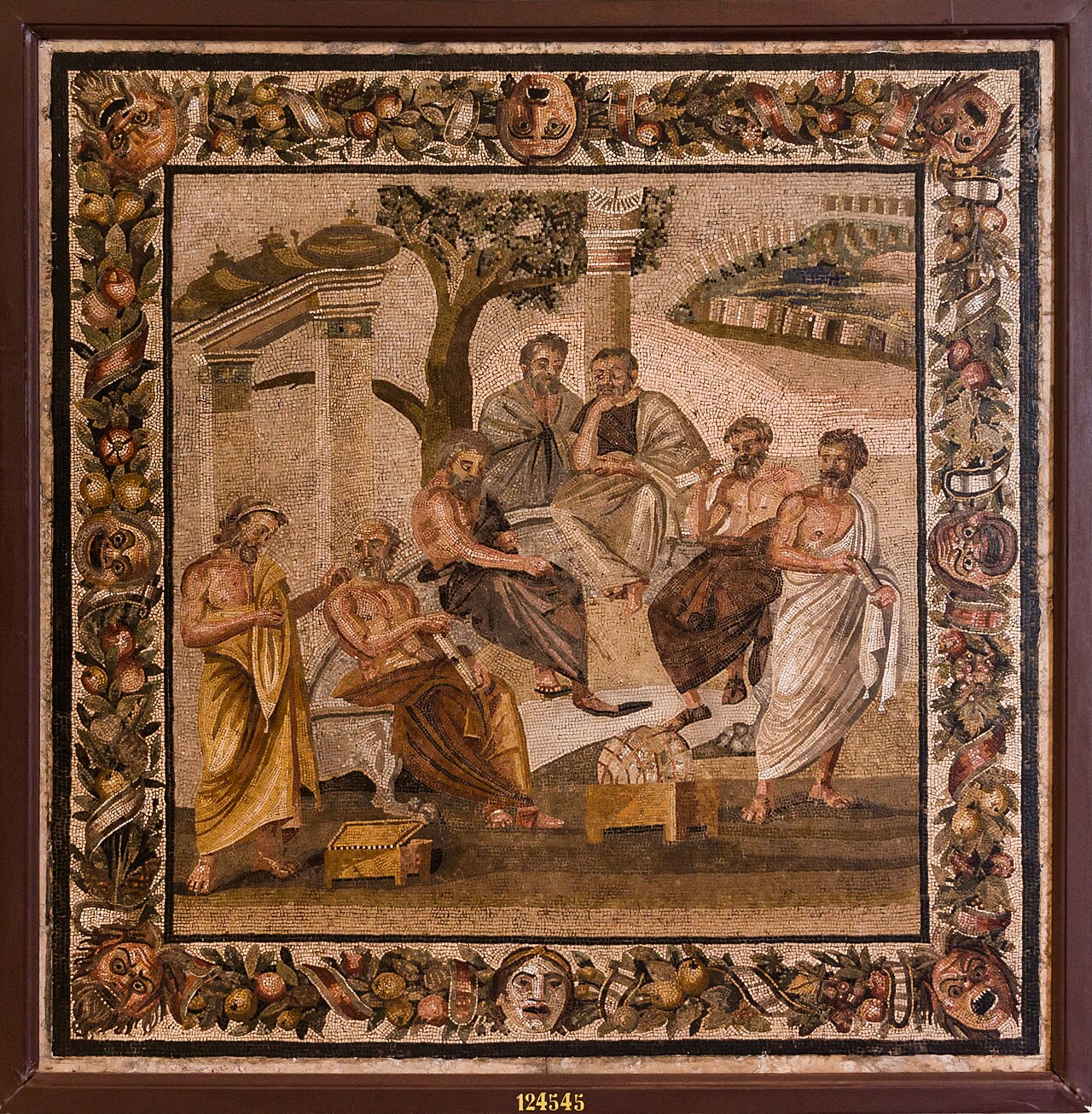
On the featured image
Plato’s Academy Mosaic. 1st century BCE–1st century CE. Mosaic, 86 x 85 cm. National Archaeological Museum of Naples (MANN), inv. 124545. From the Villa of T. Siminius Stephanus, Pompeii.
This mosaic, commonly referred to as the Plato’s Academy Mosaic or the Mosaic of the Seven Sages, is an emblema (a centerpiece panel) recovered from the environs of Pompeii. It is a premier example of Roman mosaic art from the late Republican or early Imperial period.
Archaeological & Art Historical Details
Inventory Number: MANN 124545
Current Location: National Archaeological Museum of Naples (Museo Archeologico Nazionale di Napoli), Hall LIX.
Museum Link: MANN – Official Site
Provenance: Discovered on July 14, 1897, in Room F of the Villa of T. Siminius Stephanus (also known as the Villa of the Mosaic of the Philosophers). The villa was located in Contrada Cività, Fondo Masucci d’Aquino, just outside the Vesuvian Gate of Pompeii. It was found at a depth of two meters within a layer of volcanic ash.
Dimensions: Approximately 86 cm x 85 cm (roughly 34 x 33 inches).
Date: 1st century BCE – 1st century CE.
Medium: Stone and glass tesserae (mosaic).
Style/Context: This is a free-standing emblema set into a travertine slab, likely a Roman copy of a lost Hellenistic original (potentially a 3rd-century BCE painting). A similar version of this mosaic was found in Sarsina and is currently held in the Villa Albani, Rome.
Scholarly Article Citations
The following sources provide extensive archaeological and iconographic analysis of the work:
Massa-Pairault, Françoise-Hélène. “De l’Académie au Musée: regards sur la mosaïque «des Philosophes» (MANN 124545).” Revue archéologique 69, no. 1 (2020): 29–83. DOI: 10.3917/arch.201.0029.
Griffiths, Alan. “Navel-Gazing in Naples?: The Painting Behind the ‘Pompeii Philosophers’.” Syllecta Classica 27 (2016): 151–166.
Gaiser, Konrad. Das Philosophenmosaik in Neapel: Eine Darstellung der platonischen Akademie. Abhandlungen der Heidelberger Akademie der Wissenschaften. Heidelberg: Winter, 1980.
Mattusch, Carol C., ed. Pompeii and the Roman Villa: Art and Culture Around the Bay of Naples. Washington: National Gallery of Art, 2008.
I read a lot of the classic texts out of this compilation
Readings in Ancient Greek Philosophy: From Thales to Aristotle. United Kingdom: Hackett Publishing Company, Incorporated, 2016.
Except mine was the 1995 edition.
The Loeb Classical Library (Harvard University Press).
Why it is used: Essential for scholars who need the original Greek text alongside the English translation. While some older Loeb translations (like those by W.R.M. Lamb) are dated, they remain the baseline for many formal citations of the Greek text.
Citation (Chicago Style):
Plato. Euthyphro. Apology. Crito. Phaedo. Phaedrus. Translated by Harold North Fowler. Loeb Classical Library 36. Cambridge, MA: Harvard University Press,1914.
Regardless of the translation used, all academic work must cite Plato using Stephanus numbers (e.g., Crito 43a). This system, based on the 1578 edition by Henricus Stephanus, allows scholars to find the exact passage in any translation or original Greek text.
Bibliography: Plato. Platonis opera quae extant omnia. Edited and translated by Jean de Serres. Printed by Henricus Stephanus. 3 vols. Geneva: Henricus Stephanus, 1578.
Footnote:
Plato, Platonis opera quae extant omnia, ed. Jean de Serres, trans. Jean de Serres, printed by Henricus Stephanus (Geneva: Henricus Stephanus, 1578).
Sutcliffe, Tom. “The History of the Stephanus Edition of Plato.” The Library 12, no. 1 (1990): 55–68.
Meinwald, Constance. “Plato’s Works and the Stephanus Pagination.” In The Oxford Handbook of Plato, edited by Gail Fine. Oxford: Oxford University Press, 2008.
Grafton, Anthony. The Footnote: A Curious History. Cambridge, MA: Harvard University Press, 1997. (Provides context on the evolution of scholarly citation and Renaissance printing).
Articles on the Crito
Kraut, Richard. “Plato’s Apology and Crito: Two Recent Studies.” Ethics 91, no. 4 (1981): 651–664
Weiss, Roslyn. Socrates Dissatisfied: An Analysis of Plato’s Crito. Oxford: Oxford University Press, 1998.
The Crito is the precursor to the Apology since Socrates is already in his jail cell.
Crito comes to see if Socrates would rather flee to another town.
Complicates the role of the polis in the examined life. Its not a simple other or irrelevant to the practice of philosophy.
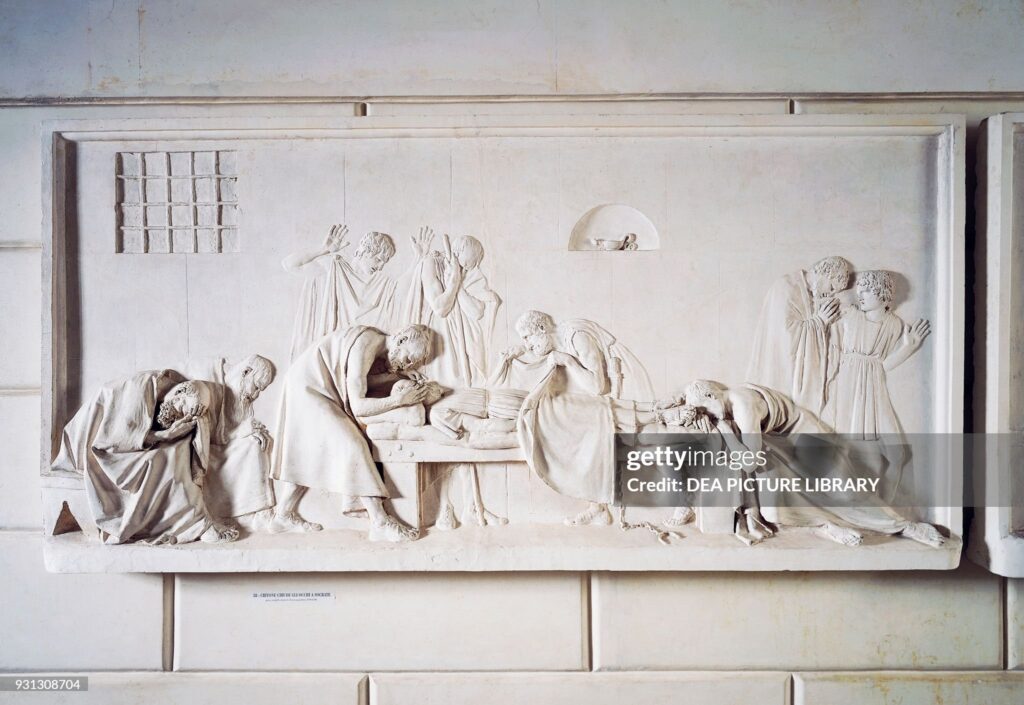
This artwork is a neoclassical plaster bas-relief titled Crito Closing the Eyes of Socrates (also known as Critone chiude gli occhi a Socrate), created by the Italian sculptor Antonio Canova between 1790 and 1792. It is part of a series of four (later five) reliefs depicting the final days of Socrates, inspired by Plato’s Phaedo.
Bibliography: Canova, Antonio. Crito Closing the Eyes of Socrates. 1790–1792. Plaster bas-relief, 125.5 x 262.5 cm. Fondazione Cariplo, Milan.
Footnote:
Antonio Canova, Crito Closing the Eyes of Socrates, 1790–1792, plaster bas-relief, Fondazione Cariplo, Milan.
Location and Museum
The original plaster relief is held in the collection of the Fondazione Cariplo in Milan, Italy. It is frequently exhibited at the Gallerie d’Italia – Piazza Scala (Milan).
Official Museum Link: Gallerie d’Italia – Crito Closing the Eyes of Socrates
Alternative Collection Link: Artgate Fondazione Cariplo
Provenance
Creation (1790–1792): Sculpted in Rome during Canova’s intensive study of Platonic themes.
Rezzonico Commission: The series was originally intended for the Rezzonico family (specifically Prince Abbondio Rezzonico) for his villa in Bassano del Grappa.
Canova kept the plaster models in his studio for various periods.
Fondazione Cariplo Acquisition: The work entered the collection of the Cariplo Foundation in 1991, having been part of the historic heritage of the Cassa di Risparmio delle Provincie Lombarde.
Gipsoteca Canoviana: A secondary plaster cast exists in the Museo Gypsotheca Antonio Canova in Possagno, the artist’s birthplace.
Scholarly Articles and Literature
The following publications analyze the relief within the context of Neoclassicism and Canova’s narrative technique:
Antonio Canova, Crito Closing the Eyes of Socrates, 1790–1792, plaster relief, Gallerie d’Italia (Fondazione Cariplo), Milan.
Monoson, S. Sara. “Socrates in Combat: Trauma and Resilience in Plato’s Political Theory.” Socrates in the Nineteenth and Twentieth Centuries, edited by M.B. Trapp, Ashgate, 2007. (This article discusses the psychological complexity of Canova’s Socrates series).
Pavanello, Giuseppe. L’opera completa del Canova. Milan: Rizzoli, 1976. (The definitive catalogue raisonné for Canova’s works).
Johns, Christopher M. S. Antonio Canova and the Politics of Perfection. Princeton: Princeton University Press, 1998. (Discusses the ethical and political motivations behind Canova’s choice of Socratic subjects).
Honour, Hugh. “Canova’s Studio Practice-I: The World of the Statue.” The Burlington Magazine 114, no. 828 (1972): 146–59. (Details the practice of reading Cesarotti’s translations aloud to Canova).
Mazzocca, Fernando. Canova: L’ideale classico tra scultura e pittura. Venice: Marsilio, 2011. (Contextualizes the Cariplo reliefs within the Cesarotti-Canova friendship).
Pestilli, Livio. Antonio Canova: The Reevaluation of a Legacy. London: Lund Humphries, 2025.
Focus: A recent study using unpublished letters to recontextualize Canova’s Socratic reliefs within the political sphere of the late 18th century.
What edition of the dialogue was Canova reading? or rather being read to him…
Bibliography: Cesarotti, Melchiorre, trans. Il Fedone di Platone. In Opere dell’abate Melchiorre Cesarotti, vol. 18. Padua: Tipografia del Seminario, 1800–1813.