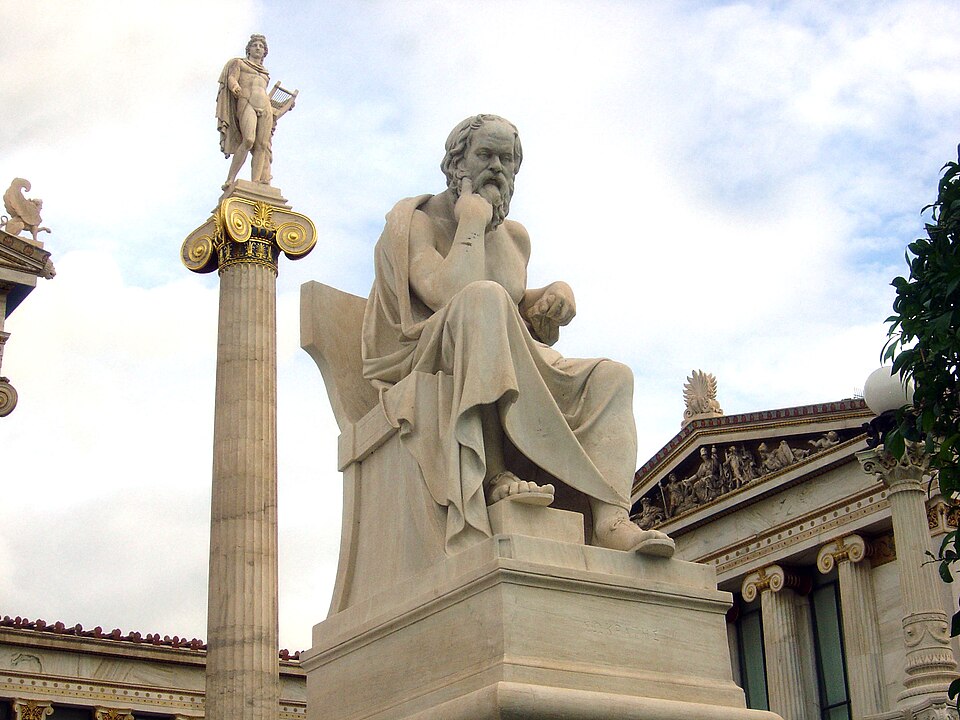
On the featured image
Bibliography: Drosis, Leonidas. Socrates. 1885. Marble. Academy of Athens, Athens.
Footnote:
Leonidas Drosis, Socrates, 1885, marble, Academy of Athens, Athens.
The image depicts the seated marble statue of the philosopher Socrates, which stands opposite the statue of Plato at the Academy of Athens.
Artist: Leonidas Drosis (Greek, 1834–1882); carved in marble by the Italian sculptor Piccarelli.
Date: Completed in 1885.
Location: Flanking the entrance of the Academy of Athens, Panepistimiou Street, Athens, Greece.
Provenance: This statue was part of the neoclassical sculptural program for the Academy of Athens, funded by Simon Sinas. It has remained in its original location since the late 19th century.
Scholarly Resources & Citations
Museum/Institutional Link
Scholarly Articles
Kaltsas, Nikolaos. Sculpture in the National Archaeological Museum, Athens. Los Angeles: J. Paul Getty Museum, 2002.
Piazzesi, Chiara. “Socrates and the Neoclassical Aesthetic: The Portrayal of the Philosopher in Modern Athens.” Journal of Modern Greek Studies 28, no. 1 (2010): 45-68.
This text is usually found in an edition with other dialogues, Euthyphro, Crito, Apology.
Watch the Socratic method in action as Socrates and his interlocutors try to arrive at a definition of just and make distinctions around the concept of the just.
The earliest fragments of the Euthyphro exist in the Oxyrhynchus Papyri, but the primary survival of the text occurred through Byzantine clerical copying.
Codex Oxoniensis Clarkianus 39 (MS. Clarke 39): Written in 895 AD, this is the most significant manuscript for the first six tetralogies of Plato, including the Euthyphro. It remains the foundational source for modern Greek editions.
Plato was largely unavailable in the West in Greek until the 15th century. The definitive “publication” that brought Euthyphro into the hands of thinkers like Machiavelli was:
Marsilio Ficino (1484): The Platonis Opera Omnia, published in Florence. Ficino provided the first complete Latin translation, making Plato accessible to the Latin-reading elite of Europe.
The Greek Editio Princeps
Aldine Press (1513): Edited by Marcus Musurus and published by Aldus Manutius in Venice. This was the first time the Greek text of Euthyphro was printed in its original language.
The Stephanus Edition (1578)
Henricus Stephanus (Henri Estienne): Published in Geneva, this three-volume set of the complete works featured a new Latin translation and the Greek text.
Plato. Euthyphro. In Platonis Opera, edited by John Burnet. Oxford: Clarendon Press, 1903
Museum and Repository Links
The Bodleian Library (MS. Clarke 39): View Codex Clarkianus 39
The British Library (Aldine Plato): 1513 Editio Princeps
Schleiermacher, Friedrich. Platons Werke. Berlin: Realschulbuchhandlung, 1804–1828.
Plato. Platonis Opera Omnia: Recensuit et Commentariis Instruxit. Edited by Gottfried Stallbaum. Gotha: Hennings, 1821–1860.
Plato. Five Dialogues: Euthyphro, Apology, Crito, Meno, Phaedo. Translated by G. M. A. Grube. Revised by John M. Cooper. 2nd ed. Indianapolis: Hackett Publishing Company, 2002.
Plato. Complete Works. Edited by John M. Cooper and D. S. Hutchinson. Indianapolis: Hackett Publishing Company, 1997.
The Standard Greek Text (New OCT)
Plato. Platonis Opera: Tomus I. Edited by E. A. Duke, W. F. Hicken, W. S. M. Nicoll, D. B. Robinson, and J. C. G. Strachan. Oxford: Oxford University Press, 1995.
Plato. Platonis Dialogi: Secundum Thrasylli Tetralogias Dispositi. Edited by Karl Friedrich Hermann. Leipzig: Teubner, 1851–1853.
The Legacy Greek Text (Burnet OCT)
Plato. Platonis Opera: Tomus I. Edited by John Burnet. Oxford: Oxford University Press, 1900.
The Bryn Mawr Greek Commentary
Hare, John E., ed. Plato’s Euthyphro. Bryn Mawr Greek Commentaries. Bryn Mawr, PA: Bryn Mawr College, 1985.
Hankins, James. Plato in the Italian Renaissance. Leiden: Brill, 1990. (Detailed analysis of the editions available to Machiavelli)