The Timaeus starts off as though it were a sequel to the Republic.
Then it dives deep into cosmology and gives an account of the creation of the world, the relation of heaven and earth, and the origin of animals.
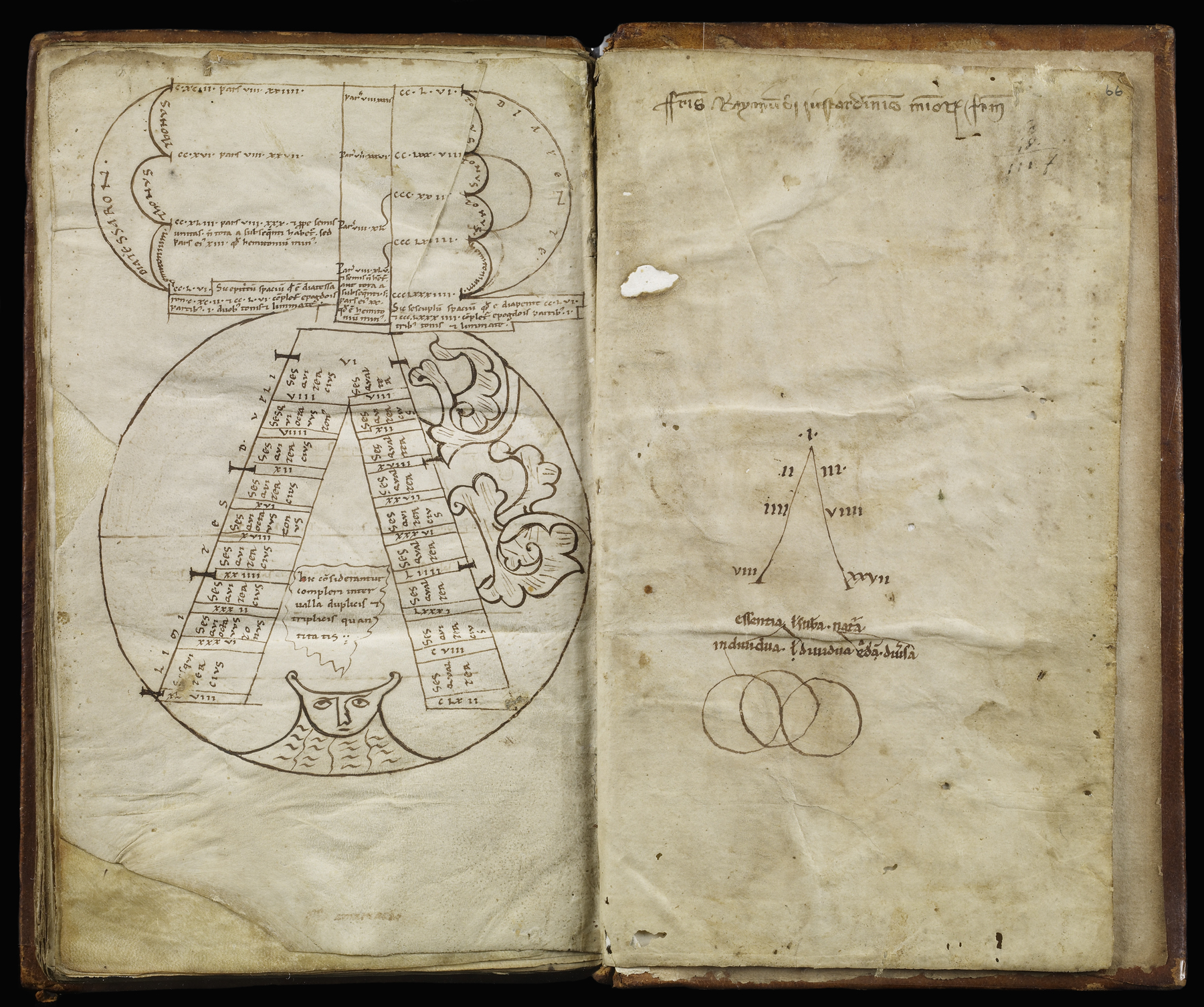
Plato. Timaeus. Translated by Calcidius (Latin version). Manuscript. 10th Century. Bibliothèque nationale de France, MS Latin 6280.
Bibliothèque nationale de France (BnF), Paris – MS Latin 6280 (A primary 10th-century witness of the Calcidius translation).
Provenance: Often originated in monastic scriptoria like Fleury or Corbie; many 12th-century copies are associated with the library of the Cathedral of Chartres.
Scholarly Article: Somfai, Anna. “The Eleventh-Century Glossed Manuscripts of Plato’s Timaeus.” In The Journal of the Warburg and Courtauld Institutes, vol. 65, 2002, pp. 1-41.
1. The Calcidius Fragment (The Medieval Era)
For the medieval scholar, “Plato” was synonymous with the Timaeus. However, they only knew the first 53 chapters. Because they lacked the sections on biology and the “Receptacle” (the $khora$), the medieval Timaeus was viewed primarily as a work of astronomy and music theory. This led to the visual tradition of the Lambda diagrams mentioned previously.
2. The Byzantine Preservation
While the West had only half the text in Latin, the full Greek text was preserved in Byzantium. After the Fall of Constantinople (1453), Greek scholars fled to Italy, bringing complete manuscripts of the Timaeus with them. This provided the linguistic catalyst for the Renaissance.
Before the Latin translation was printed, the physical Greek manuscripts were the treasures of the Renaissance. The manuscript used by Marsilio Ficino was provided by Cosimo de’ Medici in 1462.
Institutional Link: Biblioteca Medicea Laurenziana, Florence – Pluteo 85.9 (One of the primary 15th-century Greek manuscripts of the Timaeus in the Medici collection).
Provenance: Brought from Constantinople (likely by Giovanni Aurispa or via Bessarion’s circle) to Florence. Owned by Cosimo de’ Medici and housed in the Laurenziana since its founding.
Scholarly Article: Hankins, James. “The Study of the Timaeus in Early Renaissance Italy.” In Natural Particulars: Nature and the Disciplines in Renaissance Europe, 77–119. Cambridge: MIT Press, 1999.
Chicago Style Citation: Plato. Timaeus. 15th Century. Greek Manuscript on paper. Biblioteca Medicea Laurenziana, Florence, MS Plut. 85.9.
3. The Ficino “Rebirth”
Marsilio Ficino’s translation in the late 15th century allowed artists and philosophers to see the entire work for the first time. This transition is what shifted the Timaeus from a technical astronomical manual (Medieval) into a grand philosophical epic (Renaissance), directly influencing the Neoplatonism found in the works of Botticelli and Michelangelo.
Marsilio Ficino’s translation was the first time the West could read the full Timaeus in Latin. It was printed by the nuns of San Jacopo di Ripoli, the first press to employ women as compositors.
Digital Repository Link: Bayerische Staatsbibliothek – Digitized 1484 Ficino Edition
- https://exhibits.library.illinois.edu/s/rbml/item/4199
Provenance: Funded by Filippo Valori and Francesco Berlinghieri. The press was located at the monastery of San Jacopo di Ripoli in Florence.
Location: Significant copies are held at the Bayerische Staatsbibliothek (Munich), the British Library, and the University of Illinois Rare Book & Manuscript Library.
Scholarly Article: Hankins, James. Platonism in the Italian Renaissance. Leiden: Brill, 1991.
Chicago Style Citation: Plato. Opera. Translated by Marsilio Ficino. Florence: San Jacopo di Ripoli, 1484.
On the featured image
Walters Art Museum. Leaf from Commentarii in Somnium Scipionis: Lambda Diagram of the World-Soul from Plato’s Timaeus. ca. 1175–1200. Manuscript leaf (W.22.66R). Northeastern France.
Illuminated Manuscript / Cosmological Diagram
MuseumThe Walters Art Museum, Baltimore
ProvenanceProduced in Northeastern France (late 12th c.); Acquired by Henry Walters in 1903.
This is a visual representation of Timaeus 35b–36b, where Plato describes the “World Soul” divided into harmonic proportions. It resembles the Greek letter Lambda and features the geometric progressions of 1, 2, 4, 8 and 1, 3, 9, 27. These are considered the earliest “schematic artworks” of Platonic thought.
Reydams-Schils, Gretchen. “The Timaeus, Perspective, and Early Renaissance Concepts of Architectural Space.” In The Legacy of Plato’s Timaeus, edited by G. J. Reydams-Schils. Brill, 2012.
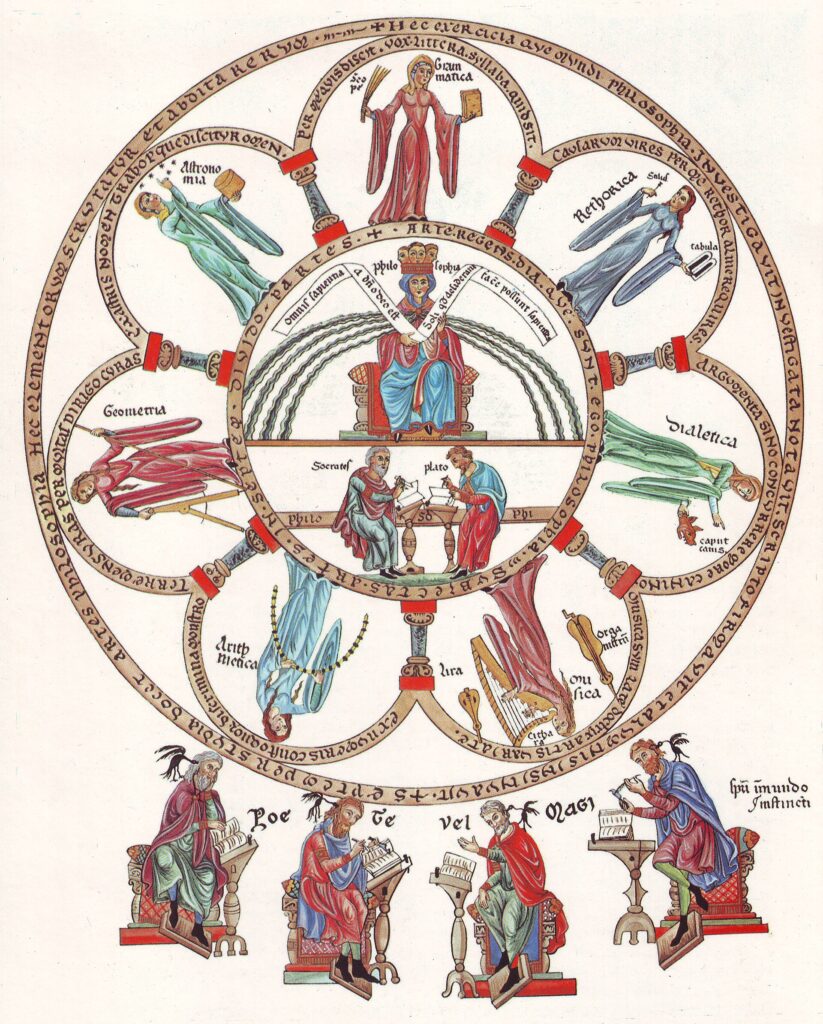
On the image below
Philosophia and the Seven Liberal Arts from the Hortus Deliciarum. ca. 1180. Ink and tempera on vellum (Facsimile). Original destroyed in 1870. Strasbourg Library.
Klibansky, Raymond. The Continuity of the Platonic Tradition During the Middle Ages. London: The Warburg Institute, 1939
.
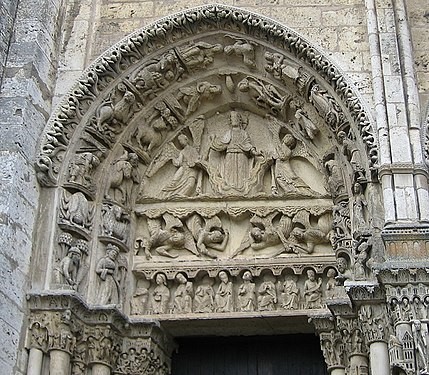
. The Royal Portal (Chartres)
Chicago Style Citation: Unknown Sculptor. The Seven Liberal Arts and the Personification of Music (Archivolts, Right Portal). ca. 1145. Limestone. Cathédrale Notre-Dame de Chartres, France. https://whc.unesco.org/en/list/81/
Location: West Facade, Right Portal (Portail de l’Incarnation), Chartres, France.
Provenance: Commissioned under the episcopate of Geoffrey de Lèves (c. 1144). It is one of the few sections of the cathedral that survived the catastrophic fire of 1194. It remains in situ.
Scholarly Article: Katzenellenbogen, Adolf. “The Representation of the Liberal Arts.” In The Sculptural Programs of Chartres Cathedral: Christ, Mary, Ecclesia, 15–26. Baltimore: Johns Hopkins Press, 1959.