Aristotle. On Virtues and Vices. Translated by H. Rackham. Loeb Classical Library 285. Cambridge, MA: Harvard University Press, 1937.
Magna Moralia (Great Ethics): Though its authenticity is often debated among scholars (some attributing it to a later Peripatetic student), it remains a core part of the Aristotelian ethical tradition. It serves as a concise synthesis of his ethical views.
Aristotle. Metaphysics, Books X–XIV; Oeconomica; and Magna Moralia. Translated by Hugh Tredennick and G. Cyril Armstrong. Loeb Classical Library 287. Cambridge, MA: Harvard University Press, 1935
G. Cyril Armstrong (Magna Moralia): This translation is part of the Loeb series and is often bundled with the Oeconomica. Armstrong’s work is essential for those studying the Peripatetic tradition, as the Magna Moralia (Great Ethics) acts as a bridge between the earlier Eudemian Ethics and the later Nicomachean developments.
Codex Marcianus 214.
The Codex Marcianus Graecus 214 (often abbreviated as Marc. gr. 214 or Gr. Z. 214) is a significant 14th-century parchment manuscript held at the Biblioteca Nazionale Marciana in Venice. It is a primary source for Aristotle’s ethical and physical works, including the Magna Moralia and the Physics.
Venice. Biblioteca Nazionale Marciana. MS Marcianus Graecus 214 (coll. 479).
Museum/Library Record: Biblioteca Nazionale Marciana – Manoscritti Greci
Note: This link leads to the “Internet Culturale” digital repository for Italian libraries, where the Marciana’s Greek codices are indexed under their signature “Gr. Z. 214 (=479)”.
Provenance: This codex was part of the original foundational collection donated by Cardinal Bessarion to the Republic of Venice in 1468. Bessarion, a Byzantine scholar, sought to preserve the “entire language” of the Greeks in a safe place following the fall of Constantinople.
Scholarly Translation (Loeb): Aristotle, Magna Moralia – Loeb Classical Library 287
Manuscript Location: Codex Marcianus Graecus 214 (14th century) held at the Biblioteca Nazionale Marciana, Venice.
On Virtues and Vices (De Virtutibus et Vitiis): The shortest ethical treatise in the corpus. It provides a taxonomic approach to ethics, defining specific virtues and their corresponding vices
Aristotle. Athenian Constitution; Eudemian Ethics; and On Virtues and Vices. Translated by H. Rackham. Loeb Classical Library 285. Cambridge, MA: Harvard University Press, 1937.
Scholarly Translation (Loeb): Aristotle, On Virtues and Vices – Loeb Classical Library 285
Digital Repository (Perseus): English Translation by H. Rackham
Manuscript Location: The primary manuscript tradition for this work includes Codex Laurentianus lxxxi.11 (10th century) in Florence and Codex Parisiensis 1854 (12th century) in Paris.
Archive Record: BnF Archives et Manuscrits – Grec 1854
Codex Laurentianus 81.11 (Florence):
Archive Record: Biblioteca Medicea Laurenziana – Pluteo 81.11
Aristotle. Art of Rhetoric. Translated by J. H. Freese. Loeb Classical Library 193. Cambridge, MA: Harvard University Press, 1926.
Scholarly Translation (Loeb): Aristotle, Art of Rhetoric – Loeb Classical Library 193
H. Rackham (On Virtues and Vices): Rackham’s translation remains the standard scholarly English reference for De Virtutibus et Vitiis. It provides a brief but rigorous taxonomy of moral qualities.
Art History Connection: Art historians frequently utilize Rackham’s definitions of “Magnificence” ($\mu\epsilon\gamma\alpha\lambda\alpha\pi\rho\epsilon\pi\epsilon\iota\alpha$) and “Liberality” when analyzing the patronage and monumental architecture of the late Classical and Hellenistic periods.
John Henry Freese (Art of Rhetoric): Although George Kennedy is often cited for modern political analysis, Freese’s Loeb translation is the definitive source for cross-referencing the Greek text in art historical studies regarding the “Pathos” of Hellenistic sculpture.
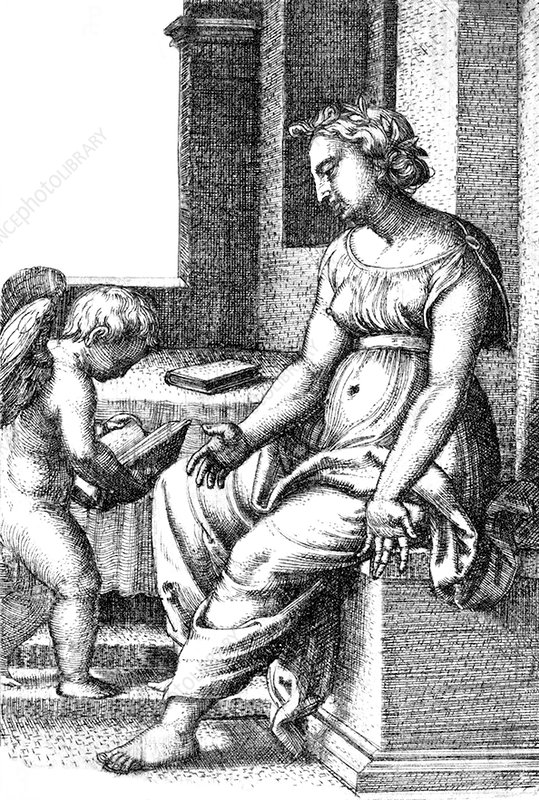
Marcantonio Raimondi: Philosophy
This engraving is a personification of Philosophy, executed by the Italian Renaissance printmaker Marcantonio Raimondi (ca. 1480–1534). The composition is based on a design by Raphael (Raffaello Sanzio), specifically related to his work in the Stanza della Segnatura in the Vatican, where a similar personification appears in the ceiling vault above the School of Athens.
Bibliography: Raimondi, Marcantonio. Philosophy. ca. 1510–15. After Raphael. Engraving, 17.8 x 14.6 cm. New York: The Metropolitan Museum of Art.
Footnote:
Marcantonio Raimondi, Philosophy, ca. 1510–15, after Raphael, engraving, 17.8 x 14.6 cm, The Metropolitan Museum of Art, New York.
Museum Record (Metropolitan Museum of Art): A Personification of Philosophy Sitting on Clouds
Museum Record (The British Museum): Philosophy; A Female Figure Seated Facing Left
Provenance: This specific impression (Accession Number 18.20.5) was acquired by the Metropolitan Museum of Art in 1918 via the Rogers Fund. Historically, Raimondi’s prints after Raphael were central to the “reproductive print” market in Rome, intended to disseminate Raphael’s high-classical style across Europe.
Art History Scholarly Citations
In accordance with your preference for works by art historians, the following texts analyze the technical and iconographic significance of this piece:
Scholarly Article/Catalog Selections:
Shoemaker, Innis H., and Elizabeth Broun. The Engravings of Marcantonio Raimondi. Lawrence: Spencer Museum of Art, University of Kansas, 1981.
Note: This is the definitive exhibition catalog for Raimondi’s oeuvre, detailing his transition from Bolognese goldsmithing to the Roman “Raphaelesque” style.
Pon, Lisa. Raphael, Dürer, and Marcantonio Raimondi: Copying and the Italian Renaissance Print. New Haven: Yale University Press, 2004.
Note: Pon provides a scholarly examination of the intellectual property and artistic collaboration between Raphael and Raimondi.
Wouk, Edward H., ed. Marcantonio Raimondi, Raphael and the Image Multiplied. Manchester: Manchester University Press, 2016.
Note: This work focuses on the “multiplied image” and how prints like ‘Philosophy’ functioned as scholarly tools for Renaissance humanists.