They were eventually recovered and brought to Rome, where Andronicus of Rhodes (c. 60 BCE) organized them into the structured treatises we recognize today. This editorial process essentially created the “system” of Aristotelian science, grouping disparate scrolls into cohesive units like the Physics and History of Animals.
Key Scientific Works and Citations
Aristotle. Physics. Translated by Robin Waterfield. Oxford: Oxford University Press, 2008.
Overview: This work serves as the foundational text for Aristotle’s natural philosophy. It establishes the “Four Causes” and the study of change ($kinesis$), moving away from abstract mathematics toward the study of the physical world.
Location: The Physics typically occupies the first section of the Corpus Aristotelicum.
Aristotle. History of Animals. Translated by D. M. Balme. Edited by Allan Gotthelf. Cambridge: Cambridge University Press, 2002.
Overview: Part of a massive biological trilogy (including Parts of Animals and Generation of Animals), this text is a masterpiece of empirical observation. Aristotle recorded data on over 500 species, much of which remained the scientific standard until the Renaissance.
Scholarly Context: Art historians often reference the History of Animals when analyzing the shift toward naturalism and anatomical accuracy in classical and Renaissance depictions of wildlife.
Aristotle. On the Heavens. Translated by W. K. C. Guthrie. Loeb Classical Library 338. Cambridge, MA: Harvard University Press, 1939.
Overview: This text outlines Aristotle’s cosmological model, including the theory of the five elements (earth, water, air, fire, and aether) and the geocentric structure of the universe.
Museum/Manuscript Note: Primary Greek manuscripts are held in the Vatican Library (notably Codex Vaticanus 261) and the Bibliothèque nationale de France.
Aristotle. Meteorology. Translated by H. D. P. Lee. Loeb Classical Library 397. Cambridge, MA: Harvard University Press, 1952.
Overview: Despite the name, this work covers more than weather; it includes geology, hydrology, and chemistry. It discusses the “exhalations” of the earth and the formation of minerals.
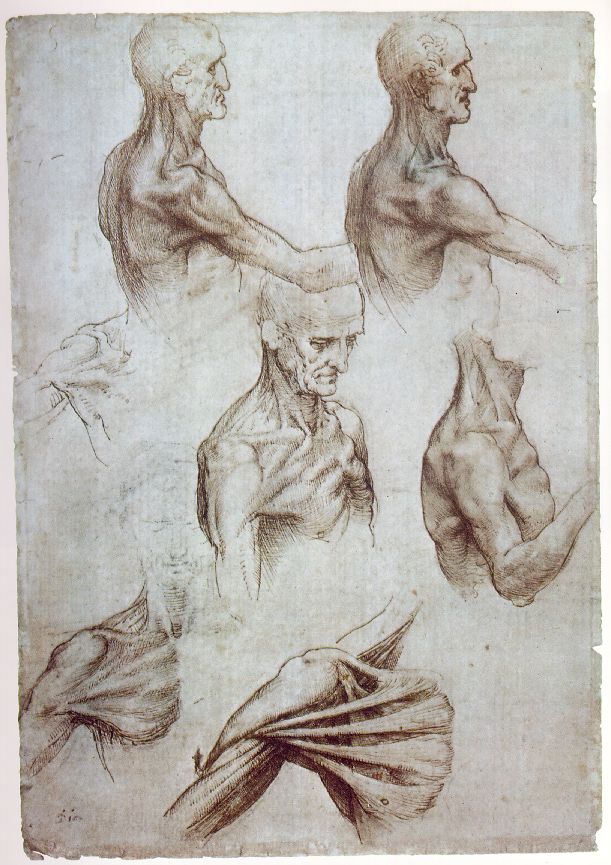
Leonardo da Vinci. Anatomical Studies of the Shoulder. ca. 1510–1511. Pen and ink with wash over black chalk on paper, 29.2 x 19.8 cm. Royal Collection Trust, Windsor Castle, UK.
This drawing is part of the world-renowned collection of Leonardo da Vinci’s anatomical papers held at Windsor Castle. It belongs to a series often referred to as “Anatomical Manuscript A,” where Leonardo transitioned from traditional medieval medical theory to groundbreaking empirical dissection.
Museum Record: Royal Collection Trust – RCIN 19003r
Collection Overview: Leonardo da Vinci at the Royal Collection
Provenance
1519: Bequeathed by Leonardo da Vinci to his pupil and assistant, Francesco Melzi.
ca. 1570: Acquired by the sculptor Pompeo Leoni from Melzi’s heirs.
1590s: Leoni bound the drawings into several large albums.
1630s: Likely acquired by Thomas Howard, 21st Earl of Arundel, during his travels in Europe.
1690: Recorded in the Royal Collection during the reign of William III, though the exact date of entry into the British Royal Library remains a subject of historical debate (likely via the Earl of Arundel’s collection or Charles II).
Articles about it
Clayton, Martin, and Ron Philo. Leonardo da Vinci: Anatomist. London: Royal Collection Trust, 2012.
Kemp, Martin. Leonardo da Vinci: The Marvellous Works of Nature and Man. Oxford: Oxford University Press, 2006.
Bambach, Carmen C. Leonardo da Vinci Rediscovered. Vol. 2, The Maturity of Design. New Haven: Yale University Press, 2019.
Zöllner, Frank, and Johannes Nathan. Leonardo da Vinci: The Complete Paintings and Drawings. Cologne: Taschen, 2019.