West, M. L. 1987. Euripides: Orestes. Warminster: Aris & Phillips.
M. L. West (1987): A scholarly landmark for art historians and philologists. This Aris & Phillips edition includes a facing-page Greek text and a commentary that is the gold standard for understanding the play’s technical and historical nuances.
The Westminster Boys (1567): One of the earliest recorded English engagements with the text was a Latin-to-English performance by the Westminster schoolboys. During this period, the play was often adapted rather than strictly translated (e.g., John Pickering’s Horestes in 1567).
Robert Potter (1781):
Potter, Robert, trans. 1781. The Tragedies of Euripides. London: J. Dodsley.
The first complete translation of Euripides’ extant plays into English verse. Potter’s work is quintessential 18th-century neoclassicism, emphasizing a formal, elevated style that smoothed over the play’s more jagged, “un-tragic” tonal shifts.
T.W.C. Edwards (1823): Produced a “literal” translation designed for students, often printed alongside the Greek text. It prioritized grammatical accuracy over poetic merit.
E. P. Coleridge (1891):
Coleridge, E. P., trans. 1891. The Plays of Euripides. London: George Bell and Sons.
Published in the Bohn’s Classical Library, Coleridge’s prose translation became a standard for decades. While accurate, it is often criticized for its “Victorian” stiffness, which struggled to capture the play’s manic energy.
William Arrowsmith (1958):
Arrowsmith, William, trans. 1958. “Orestes.” In Euripides IV: The Complete Greek Tragedies, edited by David Grene and Richmond Lattimore, 185–288. Chicago: University of Chicago Press.
Part of the Chicago Complete Greek Tragedies series. Arrowsmith’s version is perhaps the most influential of the 20th century. He treated the play as a study in psychological disintegration and “the theater of the absurd,” using gritty, contemporary language.
Philip Vellacott (1972):
Vellacott, Philip, trans. 1972. Euripides: Orestes and Other Plays. Harmondsworth: Penguin Classics.
Published by Penguin Classics, Vellacott’s translation is noted for its readability and his insightful (though sometimes controversial) introductions that frame Orestes as a critique of contemporary Athenian politics.
Museum/Location: The National Archaeological Museum, Athens. This collection houses the primary physical artifacts related to the Orestes myth in Attica.
Provenance and Iconography: Lexicon Iconographicum Mythologiae Classicae (LIMC). Use this database to track the archaeological provenance of specific depictions of Orestes in Greek and Roman art.
Anne Carson (2009): Included in An Oresteia, Carson’s translation is spare, poetic, and starkly modern. She emphasizes the “wrongness” and isolation of the characters, leaning into the play’s weirdness.
Ian Johnston (2010): A widely used contemporary verse translation known for its clarity and suitability for modern stage performance.
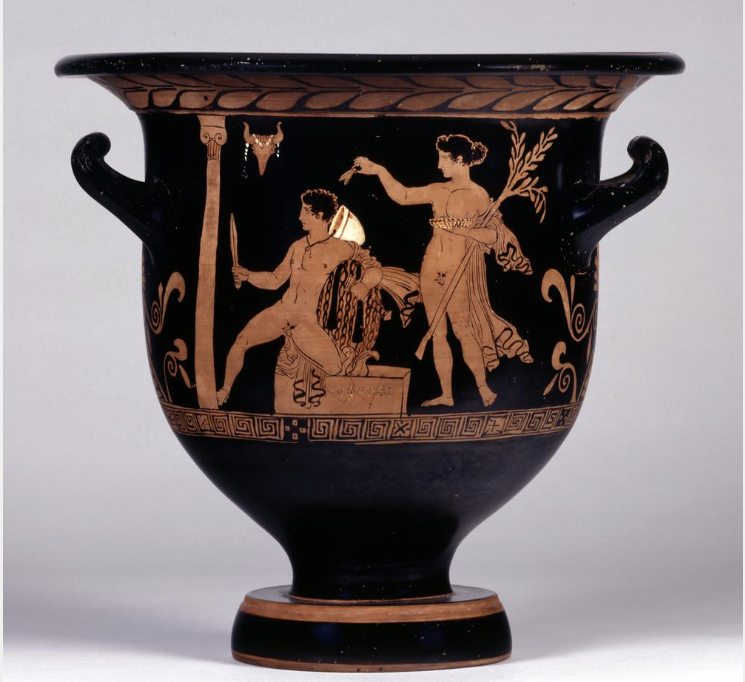
On the featured image:
The Eumenides Painter. ca. 380–370 BCE. Orestes at Delphi. Faliscan red-figure bell-krater. Rome: Museo Nazionale di Villa Giulia, Inv. 8259.
Museum: Museo Nazionale di Villa Giulia, Rome.
Provenance: Found in a tomb in Falerii Veteres (modern Civita Castellana), Italy. It belongs to the Faliscan school of red-figure pottery, which was heavily influenced by Attic (Athenian) imports and theatrical trends.