Aeschylus. The Libation Bearers. Translated and edited by Alan H. Sommerstein. Loeb Classical Library 146. Cambridge, MA: Harvard University Press, 2009.
Museum/Institution: The British Museum: The Oresteia in Art (Houses Attic vases showing Electra and Orestes at the tomb).
Archaeological Context: Mycenae: The Treasury of Atreus (The historical/mythological site often associated with the tomb of Agamemnon).
Herbert Weir Smyth (1926): For decades, the standard Loeb Classical Library edition. It utilized a formal, somewhat archaic English prose that captured the “grandeur” of Aeschylus but struggled with the play’s dense, muddy choral odes.
Aeschylus. Aeschylus: Agamemnon, Libation-Bearers, Eumenides, Fragments. Translated by Herbert Weir Smyth. Loeb Classical Library 146. Cambridge, MA: Harvard University Press, 1926.
Richmond Lattimore (1953): A landmark in the “Chicago Greek Tragedies” series. Lattimore attempted to recreate the meter and line-breaks of the original Greek, favoring a spare, literal style that influenced decades of academic study.
Aeschylus. The Oresteia: Agamemnon, The Libation Bearers, The Eumenides. Translated by Richmond Lattimore. Chicago: University of Chicago Press, 1953.
Robert Fagles (1975): Perhaps the most celebrated “literary” translation. Fagles focused on the “sensory theatre” and the driving momentum of the blood-feud, using more fluid, modern poetic structures.
Aeschylus. The Oresteia. Translated by Robert Fagles. New York: Penguin Classics, 1979.
Ted Hughes (1999): A visceral, highly poetic adaptation. Hughes emphasized the primitive, elemental violence of Orestes’s matricide, though it is often classified more as an adaptation than a strict translation.
Aeschylus. The Oresteia. Translated by Ted Hughes. New York: Farrar, Straus and Giroux, 1999.
Christopher Collard (2002): Published by Oxford World’s Classics, this translation is favored for its balance of readability and detailed explanatory notes regarding the play’s historical and religious context.
Aeschylus. Oresteia. Translated by Christopher Collard. Oxford World’s Classics. Oxford: Oxford University Press, 2002.
On the featured image
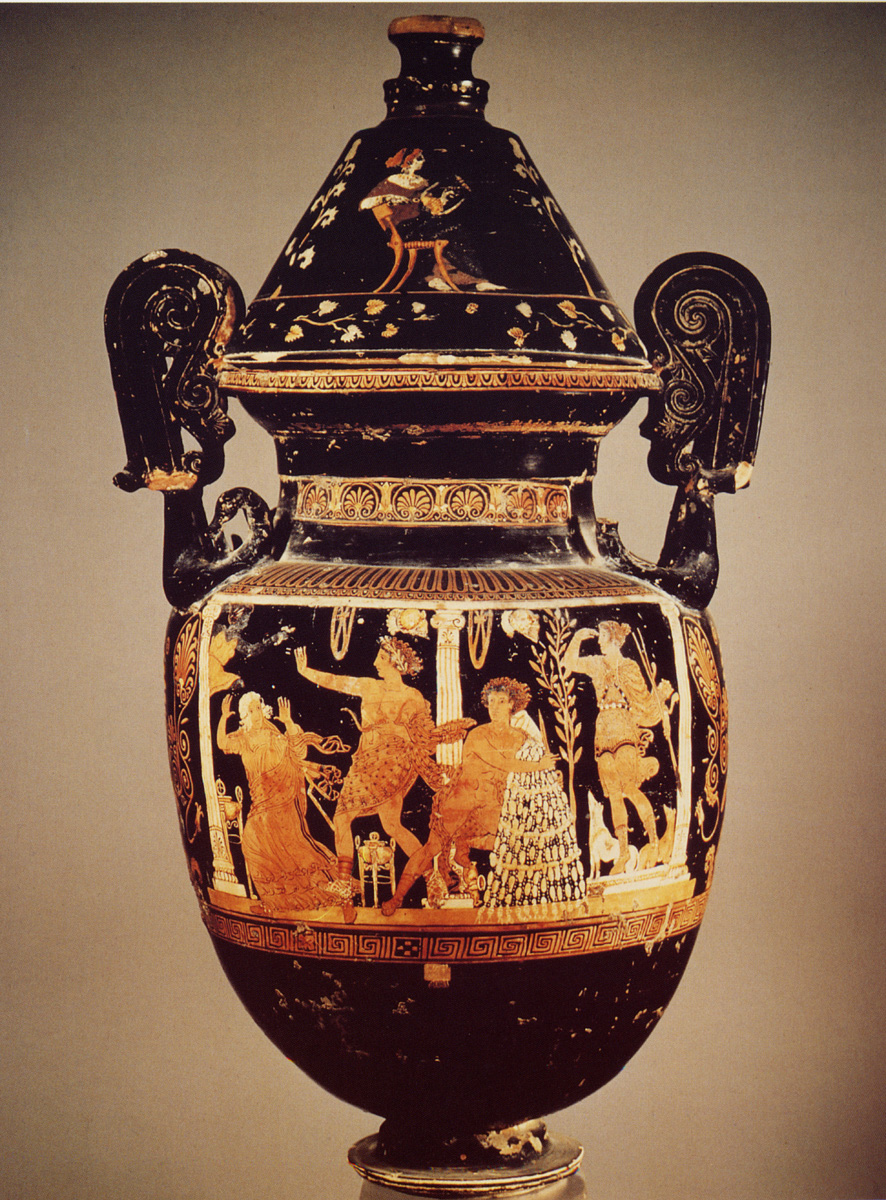
Darius Painter. Apulian Red-Figure Volute-Krater: Orestes at Delphi. c. 330 BCE. Terracotta, height: 95.5 cm. Museo Archeologico Nazionale, Naples.
Artwork Details
Museum/Location: Museo Archeologico Nazionale, Naples, Italy (Inv. 82113).
Provenance: Discovered in Canosa di Puglia, Italy. This is a monumental “volute-krater,” a vessel shape identified by the scroll-like handles, typical of the sophisticated “Ornate Style” of Apulian pottery.
Art History Context: Attributed to the Darius Painter, arguably the most influential and technically proficient vase painter in South Italy. This work is roughly 40–50 years later than the “Eumenides Painter” krater you provided earlier (orestesatdelphibetter.jpg). It demonstrates a significant leap in complexity, utilizing multiple ground lines and a larger cast of characters to represent the Eumenides.
Iconographic Analysis
This vase depicts the sanctuary of Apollo at Delphi with exceptional detail:
Orestes and the Omphalos: In the center, Orestes clings to the Omphalos (the wool-bound stone representing the center of the world). He holds a sword, still reflecting the violence of The Libation Bearers.
The Divine Protectors: Apollo stands to the left, holding a laurel branch and performing the ritual of purification. Above him, Artemis is often depicted in these larger compositions as a witness to the transition of justice.
The Furies (Erinyes): Unlike the single Fury in earlier works, the Darius Painter depicts multiple Furies. One is seen on the far left, wings spread and snakes in her hair, hovering over the scene to signify that Orestes is not yet free of his “pollution.”
The Pythia: The Delphic priestess is often shown fleeing in terror (far right) at the sight of the chthonic Furies entering her sacred temple.
Scholarly Article Citations (Art History)
Trendall, Arthur Dale. The Red-Figured Vases of Apulia: Volume II, Late Apulian. Oxford: Clarendon Press, 1982.
Significance: This is the definitive catalog for the Darius Painter. Trendall discusses this specific Naples krater as a masterpiece of “spatial depth,” noting how the painter uses architectural columns to create a sense of the interior temple space.
Aellen, Christian. À la recherche de l’ordre cosmique: forme et fonction des personnifications dans la céramique italiote. Zurich: Akanthus, 1994.
Significance: Provides an analysis of the personifications (like the Furies) on monumental Apulian kraters, arguing that their heightened theatricality mirrors the evolution of late 4th-century dramatic performances.
Taplin, Oliver. Pots and Plays: Interactions between Tragedy and Greek Vase-painting. Los Angeles: J. Paul Getty Museum, 2007.
Significance: Taplin uses this specific vase to contrast the “minimalist” staging of Aeschylus’s own time with the “maximalist” visual culture of the 4th century, where artists began to fill the “blank spaces” of the stage with divine and monstrous figures.
Relevant Links
Museum Record: MANN: Volute-Krater with Orestes (Inv. 82113)
Database: The Beazley Archive: Darius Painter