The Eudemian Ethics at the Loeb Classical Library
The Textual Transmission of the Aristotelian Corpus (Stanford Encyclopedia of Philosophy)
Primary Manuscript Witnesses:
Vaticanus Graecus 1342 (Pb): A 13th-century manuscript considered one of the most reliable witnesses for the “Eudemian” specific books.
Marcianus Graecus 213 (Mb): A 14th-century Venice manuscript that provides critical alternative readings used by modern editors like Christopher Rowe to correct the 19th-century Susemihl edition.
Provenance and Museum Records: The primary manuscripts for the Eudemian Ethics are held in the Vatican Library (Biblioteca Apostolica Vaticana) and the Biblioteca Nazionale Marciana in Venice. These institutions maintain the digitized records of the codices, which allow art historians and paleographers to study the marginalia and scribal hands that shaped the transmission of Aristotelian thought.
Vatican Library (Vat. gr. 1342): Digital Record
Marciana National Library (Gr. Z. 213): Digital Record
Aristotle. Aristotelis Opera. Edited by Jean-Baptiste Camot. Venice: Aldus Manutius, 1495–1498.
Aristotle. Aristotelis Stagiritae peripateticorum principis Organum. Edited by Erasmus of Rotterdam and Simon Grynaeus. Basel: Johann Bebel, 1531.
Sylburg, Friedrich, ed. Aristotelis Opera quae exstant. Vol. 3, Ethicorum ad Nicomachum libri X. Ethicorum ad Eudemum libri VII. Frankfurt: Wechel, 1584.
Aristotle. Aristotelis Opera. Edited by Immanuel Bekker. Berlin: Georgium Reimerum, 1831.
Aristotle. Aristotelis Ethica Eudemia. Edited by Franz Susemihl. Leipzig: Teubner, 1884.
Aristotle. The Works of Aristotle. Vol. 9, Ethica Nicomachea, Ethica Eudemia, Politica, and Athenaion Politeia. Translated by J. Solomon. Edited by W. D. Ross. Oxford: Clarendon Press, 1925.
Aristotle. Eudemian Ethics. Translated by H. Rackham. Loeb Classical Library 285. Cambridge, MA: Harvard University Press, 1935.
Harlfinger, Dieter. Die Überlieferungsgeschichte der Eudemischen Ethik. Berlin: De Gruyter, 1971.
Aristotle. Ethica Eudemia. Edited by R. R. Walzer and J. M. Mingay. Oxford Classical Texts. Oxford: Oxford University Press, 1991.
Di Basilio, Giulio, ed. Investigating the Relationship Between Aristotle’s Eudemian and Nicomachean Ethics. London: Routledge, 2022
Aristotle. Eudemian Ethics. Translated by Christopher Rowe. Leiden: Brill, 2025
Serranito, Fabio. “Philosophy as a Way of Life in Aristotle’s Eudemian Ethics I.” White Rose Research Online (2025). Accessed March 22, 2026. https://eprints.whiterose.ac.uk/.
Aristote. Éthique à Eudème. Traduit par Vianney Décarie. Bibliothèque des Textes Philosophiques 57. Paris: J. Vrin, 1978.
Aristote. Éthique à Eudème. Traduit par Catherine Dalimier. Bibliothèque des Textes Philosophiques 78. Paris: J. Vrin, 2011.
Aristote. Éthique à Eudème. Traduit par Catherine Dalimier. Bibliothèque des Textes Philosophiques 97. Paris: J. Vrin, 2023.
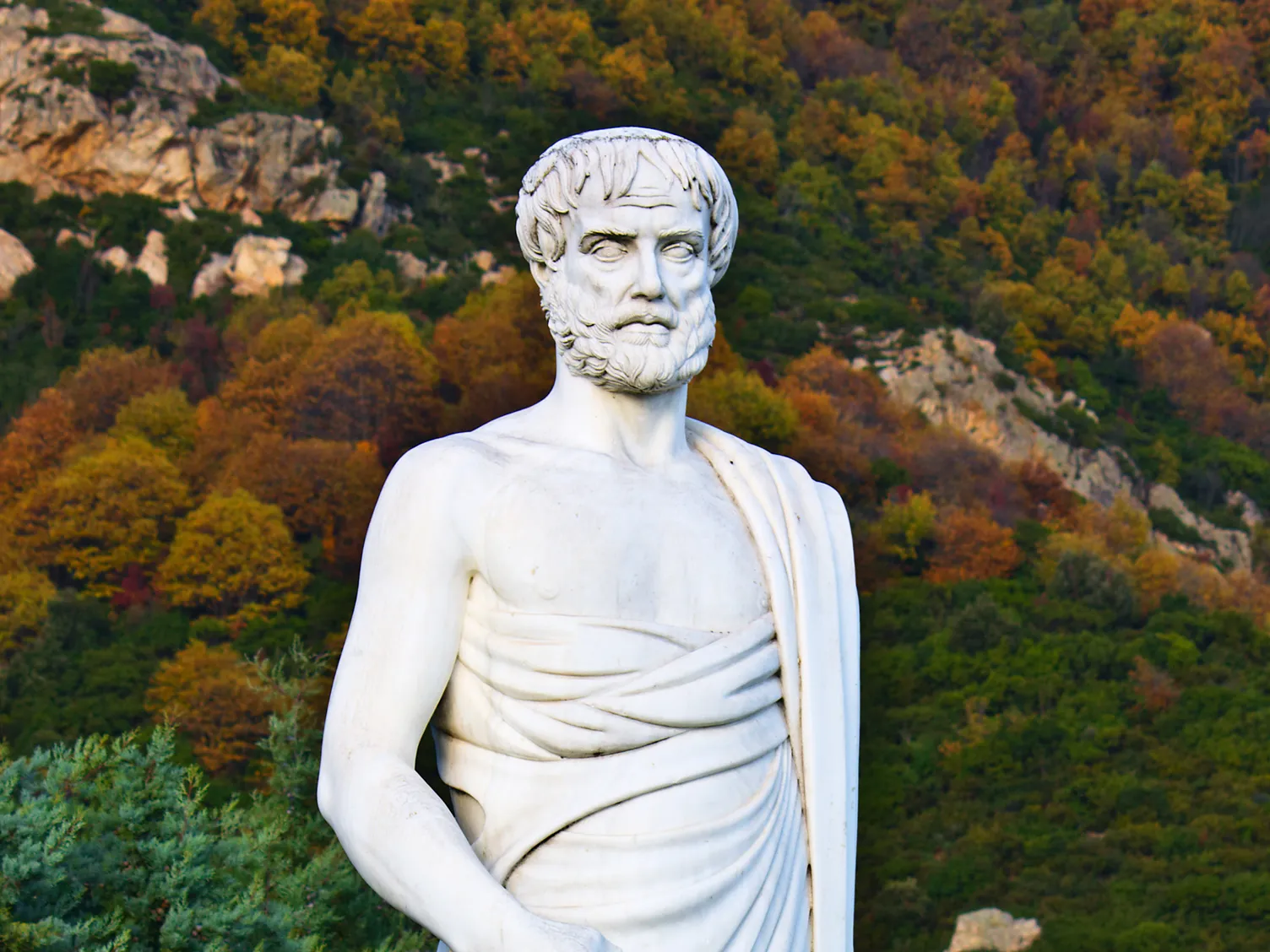
Georgiades, G. Aristotle. 1990. Bronze. Olympiada Square, Olympiada, Greece.
The style is a modern interpretation of the classical Roman copies of the lost bronze original by Lysippos (c. 330 BCE).
Location: It stands in the main square of Olympiada, which serves as the gateway to the ruins of Ancient Stagira.
The statue in your image is the modern bronze monument of Aristotle located in the village of Olympiada, Greece, adjacent to the archaeological site of Ancient Stagira, the philosopher’s birthplace.
While the statue itself is a modern commemorative work, its location is of immense art historical and archaeological significance:
Ancient Stagira: Founded in 655 BCE, the city was destroyed by Philip II of Macedon but rebuilt specifically because of Aristotle’s influence as tutor to Alexander the Great.
The “Aristoteleion” (The Tomb of Aristotle): In 2016, archaeologist Kostas Sismanidis announced that he had likely discovered Aristotle’s tomb within the Stagira site. According to literary sources, the people of Stagira brought Aristotle’s ashes back from Chalcis (where he died in 322 BCE) and placed them in a bronze urn within a structure called the “Aristoteleion,” which became a site of hero-worship.
Museum Records: Artifacts from the excavations of Aristotle’s birthplace—including Hellenistic pottery and coins from the era of Alexander the Great—are held at the Archaeological Museum of Polygyros.
Important Links: