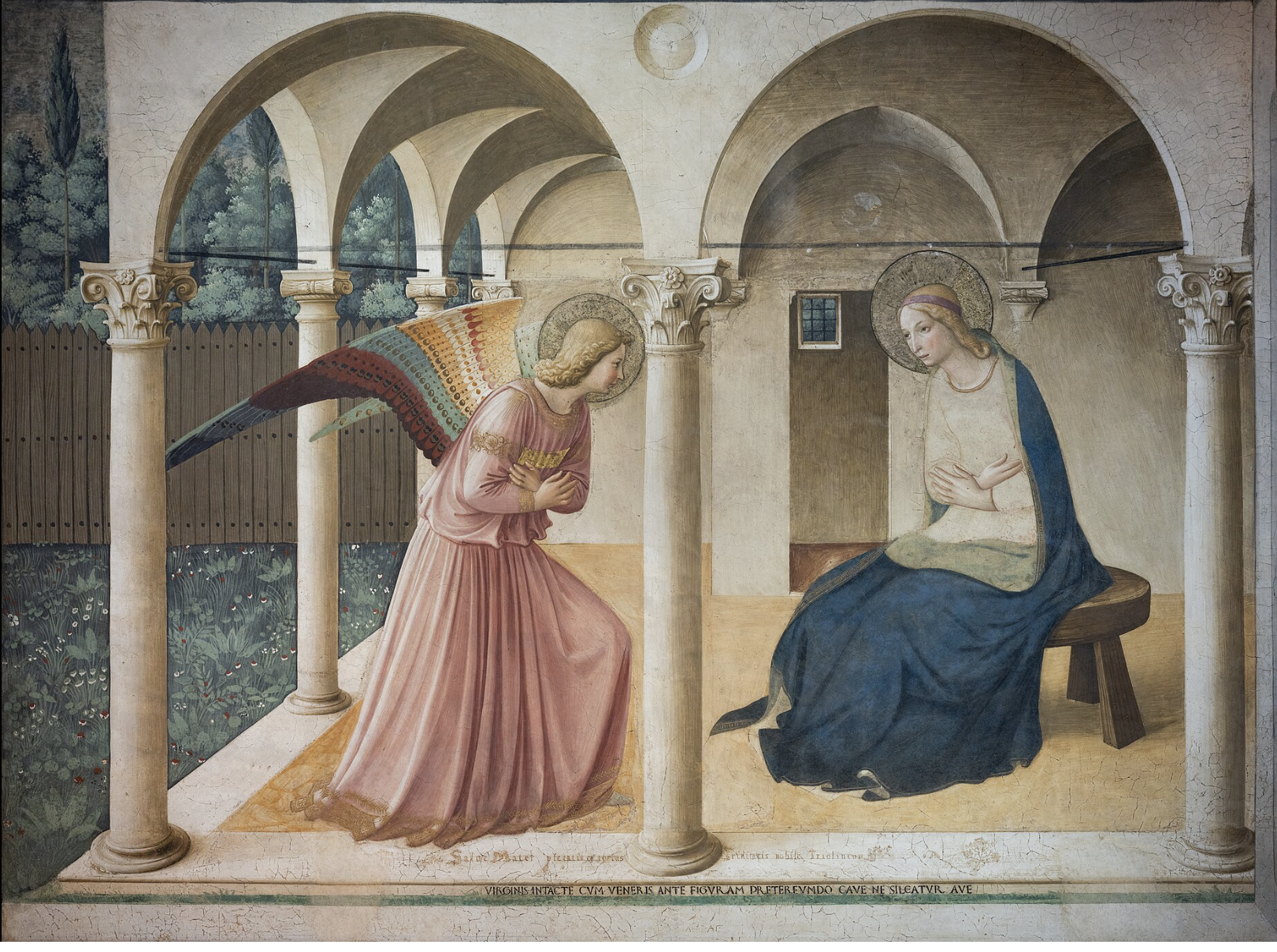
Fra Angelico’s The Annunciation
Weil, Simone Gravity and Grace
Two forces rule the universe, light and gravity.

Two forces rule the universe, light and gravity.
It is beyond the power of philosophy to destroy the political myths. A myth is in a sense invulnerable. It is impervious to rational arguments; it cannot be refuted by syllogisms. But philosophy can do us another important service. It can make us understand the adversary. In order to fight an enemy you must know him. That is one of the first principles of a sound strategy. To know him means no only to know his defects and weaknesses; it means to know his strength. All of us have been liable to underrate this strenth. When we first heard of the political myths we found them so absurd and incongruous, so fantastic and ludicrous that we could hardly be prevailed upon to take them seriously. By now it has become clear to all of us that this was a great mistake. We should not commit the same error a second time. We should carefully study the origin, the structure, the mehtods, and the technique of the political myths. We should see the adversary face to face in order to know how to combat him. p.296
Since Hegel. and particularly through the work of Marx and Kierkegaard, the Christianity of this bourgeois-Christian world has come to an end. This does not mean that faith which once conquered the world perishes with its last secular manifestations. For how should the Christian pilgrimage in hoc saeculo ever become homeless in the land where it has never been at home?

Husserl, Edmund. The Crisis of European Sciences and Transcendental Phenomenology: An Introduction to Phenomenological Philosophy. Translated by David Carr. Evanston, IL: Northwestern University Press, 1970.
The fundamental concept of his theory of motion, the concept of conatus, appears first in his analysis of appetite.

The difficulty arises from the fact that I think of my relation with my body on the analogy of my relation with my instruments — whereas in fact the latter presupposes the former.
The specific political distinction to which political actions and motives can be reduced is that between friend and enemy.

The multitude has suddenly become visible, installing itself in the preferential positions in society. Before, if it existed, it passed unnoticed, occupying the background of the social stage; now it has advanced to the footlights and is the principal character. There are no longer protagonists; there is only the chorus. p.13