Before the world was created, the Word already existed; he was with God, and he was the same as God. From the very beginning the word was with God. Through him God made alll things; not one thing in all creation was made without him. The Word was the source of life and this life brought light to mankind the light shines in the darkness and the darkness has never put it out.
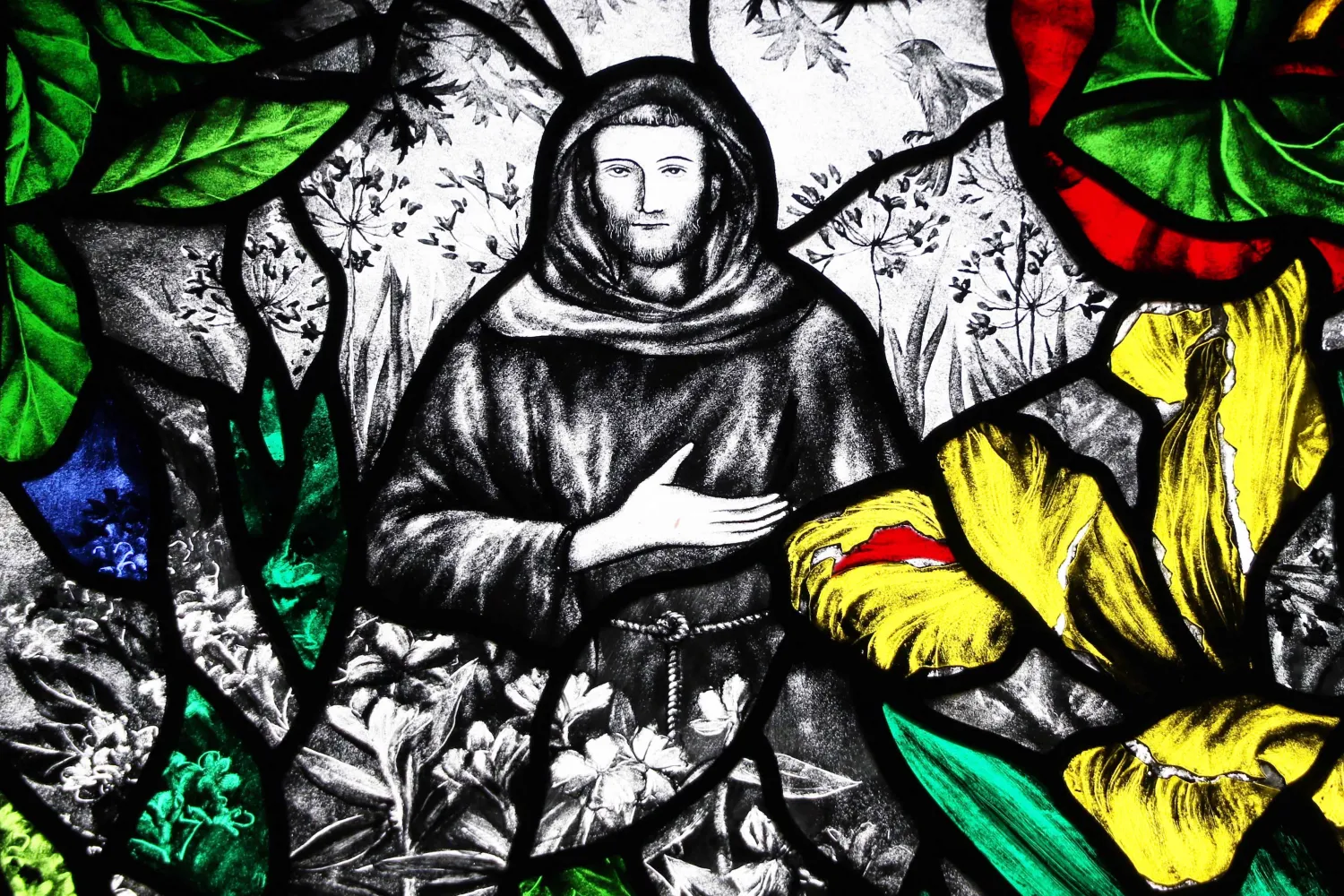
On the Featured Image
VITA images. Stained Glass at the Church Gallery Depicting St. Francis with the Stigmata of Jesus. 2022. Stained glass. Church Gallery, Church of St. Francis of Assisi, Singapore. Photographed for Beatrice Decruz, “Let There Be Peace on Earth,” Catholic News SG 72, no. 22 (October 30, 2022). https://catholicnews.sg/2022/10/30/let-there-be-peace-on-earth-2/.
Location: Church Gallery, Church of St. Francis of Assisi (Jurong West, Singapore)
Official Parish Link: Church of St. Francis of Assisi, Singapore
Publication Source Link: Catholic News SG (Archdiocese of Singapore)
Provenance
Origin & Site: Permanently installed in the Church Gallery of the Church of St. Francis of Assisi in Jurong West, Singapore.
Photographic Record: Photographed by VITA images in 2022.
Publication: Selected to accompany an article by Beatrice Decruz titled “Let There Be Peace on Earth,” published in Catholic News SG, Volume 72, No. 22, on October 30, 2022.
Art Historical Scholarly Literature
Chatterjee, Paroma. “Francis’s Secret Stigmata.” Art History 35, no. 1 (2012): 38–61.
The opening of the Book of John is a statement on Plato’s Timaeus, Aristotle’s Metaphysics, and Genesis at once.
It inserts itself into the philosophy of first things in the first line.
It places the beginning of the history of Jesus at the beginning of history.
It inspired Philo’s attempt to unify Greek and the Hebrew Bible.
It is also the line that most resists a simplistic division between reason and faith.
In Aristotle, Logos is a philosophical activity, to give an account. The word is associated with reasoning.
The highest activity of the mind is contemplation. And later becomes contemplatio dei.
Its a little oddly Aristotle over Plato if the highest activity for Aristotle was logos, if it were a Platonic reference it would use the term nomoi instead.
Greek philosophy at the beginning of Christianity, which also continuously refers to its relation to the Hebrew Bible.
The Western Tradition has to do with the citations to, the references between texts that belong to different “peoples”.
John is citing the heaviest Greek and Hebrew works in the first line of the gospel.
Articles that
Stoicism and the Gospel of John
What does the book of John have to do with the history of political thought?
Well the Leviathan of Thomas Hobbes gives the first account of the coming to be of the modern sovereign state. Out of the 30 Years War but also on the shadow line of divine right, he had to explain the confession of the state.
He says it is not more or less than Jesus is the Christ, which is a reference to the book of John 20:30-31.
It seems like a typical rhetorical technique of reminding the reader of the purpose of the text. A statement that sums up the why.
“In his disciples presence Jesus performed many other miracles which are not written down in this book. But these have been written in order that you may believe, that Jesus is the Messiah, the Son of God, and that through your faith in him you may have life.”
Far from a door shutting conclusion, this verse is a threshold to what would later become known as a high Christology.
So there was later a question in Christians minds after the life of Jesus to what extent was Jesus, God? What is the relation? The answer of the Book of John, is fully. Jesus was fully God.
So a high Christology is the idea that Jesus was fully God, and it matters because it is the threshold to all Christian mysticism.
The other reason it is important it marks a surpassing of the logic of the sacrifice.
In Euripides (check this play), the plot is set in motion by the sacrifice of the daughter. This occurs because he is trying to curry favor with the gods for good luck. Or other sacrifices to find favor with the gods, or obey the gods or what have you.
This is the major worldview innovation of Christianity past the Greek.
Well, it comes from the Book of John and how it answers the question to what extent was Jesus, God? And the answer in the Book of John is, fully.
In Hobbes’s materialist universe, he argues that the is no kingdom of God currently on earth because Jesus is not here in body. This leads into a tirade against the Papal power.
The tirade against the Papal authority was of course motivated by the way it competes with the throne of England.
But in saying that this phrase, directly from the Book of John, he says the most empowering, mystical note in the whole song, is the only one that would be required to be sung out loud.
Verses that lay out the case for the high Christology are
John 1:1–3: “In the beginning was the Word, and the Word was with God, and the Word was God. He was in the beginning with God. All things came into being through him, and without him not one thing came into being.”
John 1:14: “And the Word became flesh and lived among us, and we have seen his glory, the glory as of a father’s only son, full of grace and truth.”
John 1:18: “No one has ever seen God. It is God the only Son [or the only begotten God], who is close to the Father’s heart, who has made him known.”
John 5:17–18: “But Jesus answered them, ‘My Father is still working, and I also am working.’ For this reason the Jews were seeking all the more to kill him, because he was not only breaking the sabbath, but was also calling God his own Father, thereby making himself equal to God.”
John 10:30: “The Father and I are one.”
John 10:37–38: “If I am not doing the works of my Father, then do not believe me. But if I do them, even though you do not believe me, believe the works, so that you may know and understand that the Father is in me and I am in the Father.”
John 14:9: “Jesus said to him, ‘Have I been with you all this time, Philip, and you still do not know me? Whoever has seen me has seen the Father.'”
In the Greek text, Jesus uses the absolute phrase Ego Eimi (“I am”), echoing the divine name revealed in Exodus 3:14 and the Isaiah traditions (LXX).
John 8:24: “I told you that you would die in your sins, for you will die in your sins unless you believe that I am he (ego eimi).”
John 8:58: “Jesus said to them, ‘Very truly, I tell you, before Abraham was, I am (ego eimi).'”
John 13:19: “I tell you this now, before it occurs, so that when it does occur, you may believe that I am he (ego eimi).”
John 18:5–6: “Jesus answered, ‘I am he’ (ego eimi)… When Jesus said to them, ‘I am he,’ they stepped back and fell to the ground.”
John 17:5: “So now, Father, glorify me in your own presence with the glory that I had in your presence before the world existed.”
John 17:24: “Father, I desire that those also, whom you have given me, may be with me where I am, to see my glory, which you have given me because you loved me before the foundation of the world.”
John 20:28: “Thomas answered him, ‘My Lord and my God!’ (Ho kyrios mou kai ho theos mou).”
Another way to put it, is that the high Christology is the path from Bethlehem back to Rome.
And that, will change how you read the Leviathan. In terms of the conditions under which the need for the sovereign state dissolves.
At the end of the story, there is a feast. Before you can eat something with scales, the scales have to come off.
Wearing the right clothes at the unexpected wedding feast. You don’t see the end coming, (like the character who is unexpectedly invited to the wedding) its a revelation, so the most you can do is get ready.
But when it happens, that is the end of the sovereign state. It is eaten by the righteous. This means the people cease to be scales on the animal body of the state.
So Hobbes draws Leviathan into relation with the Bible. The beginning of the state and then it ends, the sovereign’s personation of God ends when the world ends, it won’t be needed anymore.
There are three references to the lamb in the book of John
1:2929 The next day John saw Jesus coming toward him and said, “Look, the Lamb of God, who takes away the sin of the world! 30 This is the one I meant when I said, ‘A man who comes after me has surpassed me because he was before me.’ 31 I myself did not know him, but the reason I came baptizing with water was that he might be revealed to Israel.
1:36 35 The next day John was there again with two of his disciples. 36 When he saw Jesus passing by, he said, “Look, the Lamb of God!”
21:15 15 When they had finished breakfast, Jesus said to Simon Peter, “Simon son of John, do you love me more than these?” He said to him, “Yes, Lord; you know that I love you.” Jesus said to him, “Feed my lambs.”
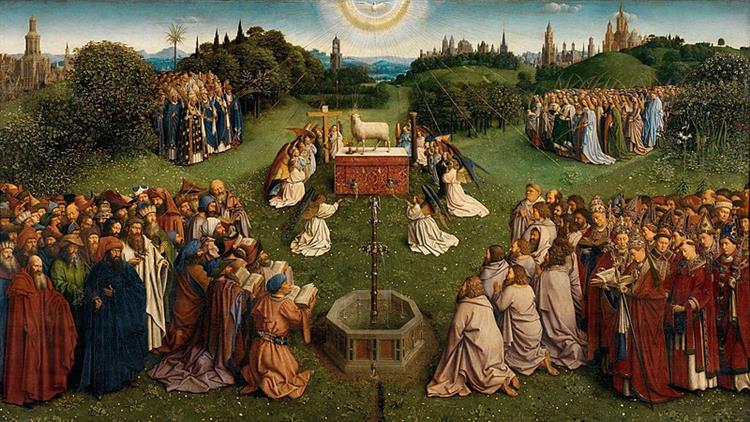
On the image below
Location: Saint Bavo’s Cathedral (Sint-Baafskathedraal), Ghent, Belgium.
Official Cathedral Site: Saint Bavo’s Cathedral — The Ghent Altarpiece
Scholarly Digital Repository: Closer to Van Eyck (Royal Institute for Cultural Heritage / KIK-IRPA & Getty Foundation)
Provenance
Commission & Installation (1420s–1432): Commissioned by Joos Vijd, churchwarden of the Church of St. John the Baptist (now Saint Bavo’s Cathedral), and his wife Elisabeth Borluut for their private chantry chapel. Work was initiated by Hubert van Eyck and completed after his 1426 death by his brother Jan van Eyck, dedicated on May 6, 1432.
Calvinist Iconoclasm (1566): Dismantled and hidden in the cathedral tower to escape destruction during the Beeldenstorm.
Napoleonic Seizure (1794–1815): The central panels were looted by French Republican troops and exhibited at the Musée Napoléon (Louvre) in Paris. Returned to Ghent in 1815 following the Treaty of Paris.
Treaty of Versailles (1919): Flanking wing panels—sold in the 19th century and housed in the Gemäldegalerie, Berlin—were repatriated to Belgium as part of World War I reparations to restore the polyptych’s structural integrity.
World War II & Nazi Looting (1940–1945): Seized by German forces in 1940, intended for Hitler’s planned Führermuseum in Linz, and hidden in the Altaussee salt mines in Austria. Recovered in 1945 by the Monuments Fine Arts and Archives section (“Monuments Men”) and returned to Saint Bavo’s.
Modern Conservation Campaign (2012–Present): Underwent systematic, multi-stage restoration led by the Royal Institute for Cultural Heritage (KIK-IRPA), removing 16th-century overpaint to reveal Jan van Eyck’s original paint layer, including the original anthropomorphic features of the Lamb.
Art Historical Scholarly Literature
Dhanens, Elisabeth. Hubert and Jan van Eyck. New York: Alpine Fine Arts Collection, 1980.
Panofsky, Erwin. Early Netherlandish Painting: Its Origins and Character. 2 vols. Cambridge, MA: Harvard University Press, 1953.
Schmidt, Peter. The Holy Lamb. Translated by Ted Alkins. Leuven: Davidsfonds, 2005.
On the image below
Zurbarán, Francisco de. Agnus Dei. c. 1635–1640. Oil on canvas, 38 × 62 cm. Museo Nacional del Prado, Madrid, Spain.
Museum: Museo Nacional del Prado (Madrid, Spain)
Inventory Number: P007293
Official Link: Museo Nacional del Prado — Agnus Dei by Francisco de Zurbarán
Provenance
Private Collection: Marquise of Socorro (Marquesa del Socorro), Madrid.
Acquisition: Acquired by the Spanish State for the Museo Nacional del Prado in 1986.
Current Status: Housed in the permanent collection of the Museo Nacional del Prado, Madrid, Spain.
Brown, Jonathan. Zurbarán. New York: Harry N. Abrams, 1974.
Pérez Sánchez, Alfonso E. “El Agnus Dei de Zurbarán.” Boletín del Museo del Prado 7, no. 21 (1986): 123–126.
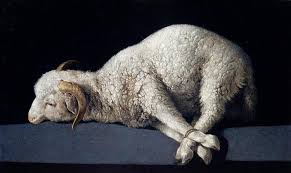
For visual references with the Book of John, I chose the lamb because it makes us reflect on the changing nature of sacrifice.
Sacrifice has a community role. It is also at the beginning of conflict so a driver of history.
Jesus is the Christ asks us to reflect on what it would mean to have a sacrifice to end all sacrifices. I want to point out that this question, in itself, is a deep critique of a Hellenistic world view, or at a minimum, a different way of viewing self in relation to history.
Mentions of harvest in book of John 4:3535 Do you not say, ‘Four months more, then comes the harvest’? But I tell you, look around you, and see how the fields are ripe for harvesting. 36 The reaper is already receiving[a] wages and is gathering fruit for eternal life, so that sower and reaper may rejoice together. 37 For here the saying holds true, ‘One sows and another reaps.’
Grain of wheat 12:24 24 Very truly, I tell you, unless a grain of wheat falls into the earth and dies, it remains just a single grain, but if it dies it bears much fruit.
Community vs. Individuality
The story I retained in my brain was that individuality emerges with the birth of towns. In the medieval era, you were born into a predetermined role, and lived out that role and doing so was for the good of the community. Think Carcassonne. Then when towns emerged and people began seeing one another in town, things like personal style expressed in dress became relevant in to forge one’s own sense of identity within a larger ever morphing society. J.S. Mill expresses the sort of longing to live out one’s idiosyncratic nature without apology, and then in France at least comes this large fear of mass society of the society getting too large and the emergence of mass society. This is the typical narrative of the emergence of individuality I had in my head.
However, individuality emerges in the book of John with the direct address Jesus uses.
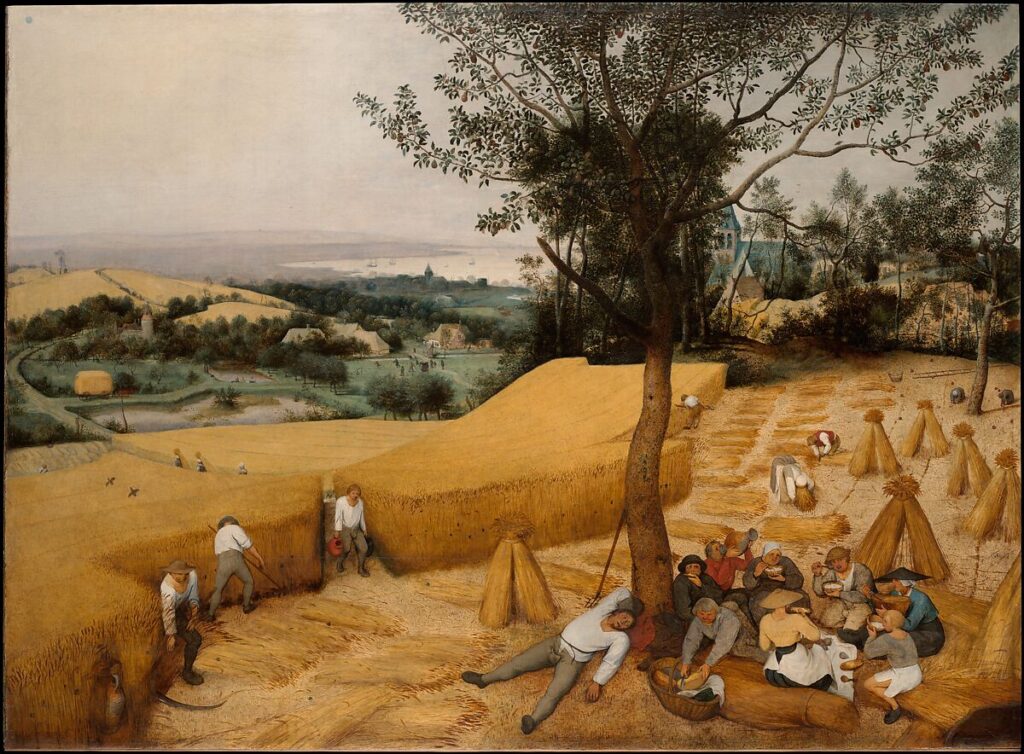
The second set of images below are about harvesting. I’m trying to trace, visually, the emergence of the protestant work ethic. Which words and images express this?
Also harvesting, reaping and sowing are among the agricultural themes that span across the Old and New Testaments. So, the relevant versus are in numerous books. Look up articles on this.
On the image below:
Bruegel, Pieter, the Elder. The Harvesters. 1565. Oil on wood, 119 x 162 cm. The Metropolitan Museum of Art, New York.
Location: The Metropolitan Museum of Art (The Met Fifth Avenue, Gallery 638, New York, NY)
Accession Number: 19.164
Official Museum Link: The Metropolitan Museum of Art — The Harvesters by Pieter Bruegel the Elder
Provenance
Commission (by 1566): Commissioned by Niclaes Jongelinck, Antwerp merchant and collector, as part of a six-part cycle representing the seasons for his suburban home in Ter Elst.
1594: Estate of Hane von Wijke, Antwerp; acquired by the Antwerp City Council and presented as a gift to Archduke Ernst, Governor of the Netherlands, Brussels.
1595–1612: Inventory of Archduke Ernst (1595, nos. 7–12); transferred to his brother, Emperor Rudolf II, Prague.
1659–1662: Collection of Archduke Leopold Wilhelm, Governor of the Netherlands, Brussels and Vienna (inv. 1659, nos. 582–586).
1662–1809: Imperial Collection, Vienna (retained through Emperor Leopold I until the Napoleonic Wars).
1809–1816: Seized during the French occupation of Vienna by General Antoine-François, Comte Andréossy, Paris (sale, Pérignon, Paris, March 11, 1816, no. 1).
19th Century: Collection of art dealer Jean-Baptiste-Pierre Lebrun, Paris; passed into private French regional collections.
Early 20th Century: Acquired by Belgian painter and restorer Paul Jean Cels, Brussels.
1919–Present: Purchased from Paul Jean Cels by The Metropolitan Museum of Art via the Rogers Fund (1919).
Gibson, Walter S. Bruegel. London: Thames and Hudson, 1977.
Silver, Larry. Pieter Bruegel. New York: Abbeville Press, 2011.
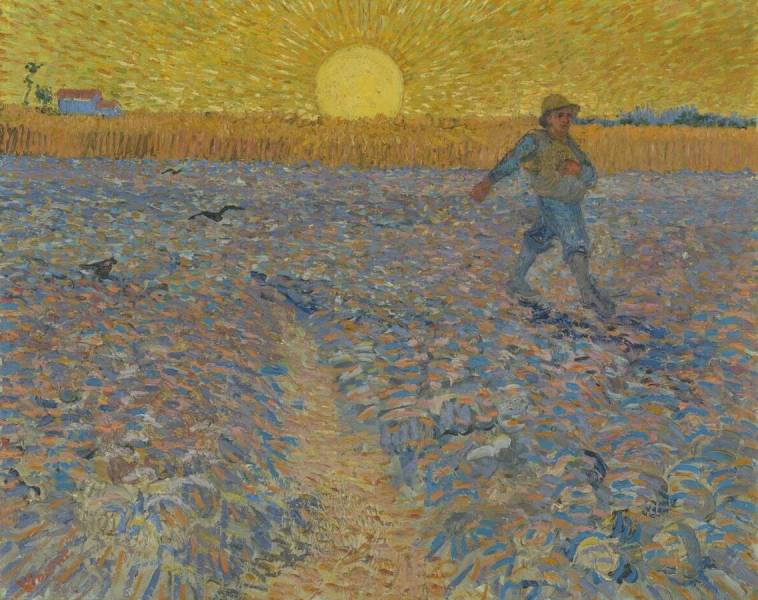
On the image below:
Gogh, Vincent van. The Sower. June 1888. Oil on canvas, 64.2 x 80.3 cm. Kröller-Müller Museum, Otterlo, The Netherlands.
Date: c. 17–28 June 1888
Location Made: Arles, France
Medium: Oil on canvas
Dimensions: 64.2 cm × 80.3 cm (25.3 in × 31.6 in)
Catalogue Identifiers: F422 / JH1470
Museum Inventory Number: KM 106.399
Repository Location: Kröller-Müller Museum, Otterlo, The Netherlands
Official Museum Page: Kröller-Müller Museum: De zaaier / The Sower
Provenance
Estate of the Artist / Theo van Gogh (1890–1891)
Jo van Gogh-Bonger (1891–1912)
Helene Kröller-Müller (Purchased May 1912)
Kröller-Müller Foundation / Kröller-Müller Museum Collection, Otterlo (Acquired 1928 / Opened 1938)
Hulsker, Jan. The Complete Van Gogh: Paintings, Drawings, Sketches. New York: Harrison House, 1986.
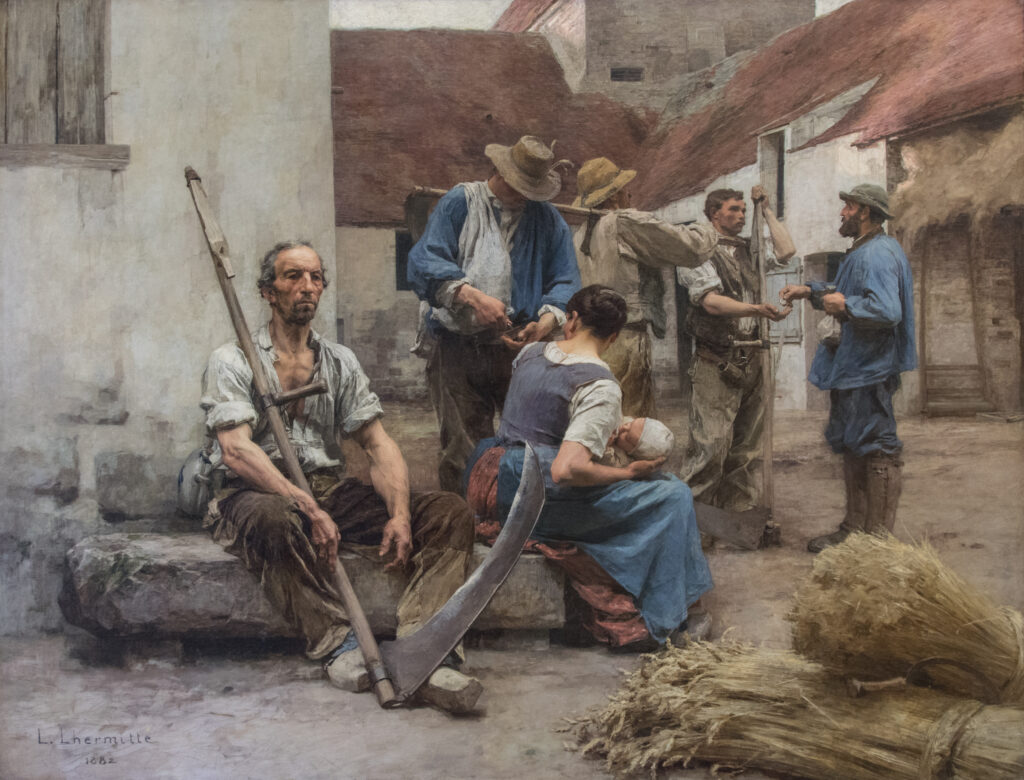
On the image below:
Lhermitte, Léon Augustin. The Payment of the Harvesters. 1882. Oil on canvas, 215 x 272 cm. Musée d’Orsay, Paris, France.
Artist: Léon Augustin Lhermitte (1844–1925)
Title: The Payment of the Harvesters (La Paye des moissonneurs)
Date: 1882
Medium: Oil on canvas
Dimensions: 215 cm × 272 cm (84.6 in × 107.1 in); framed: 268.5 cm × 335 cm
Museum Inventory Number: RF 333
Repository Location: Musée d’Orsay, Paris, France
Official Museum Page: Musée d’Orsay — La Paye des moissonneurs by Léon Lhermitte
1882: Purchased directly on the opening day of the Salon of 1882 by the French State for the Musée du Luxembourg, Paris.
1882–1929: Housed in the Musée du Luxembourg collection, Paris.
1929–1986: Transferred to the Department of Paintings at the Musée du Louvre, Paris (stored and subsequently exhibited at the Hôtel de Ville in Château-Thierry).
1986–Present: Allocated to the permanent founding collection of the Musée d’Orsay, Paris (Inv. RF 333).
Weisberg, Gabriel P. Beyond Impressionism: The Naturalist Impulse. New York: Harry N. Abrams, 1992.