When the hour came, Jesus took his place at the table with the apostles. He said to them, I have wanted so much to eat theis Passover meal with you before I suffer! For I tell you, I will never eat it until it is given its full meaning in the Kingdom of God.
Then Jesus took a cup, gave thanks to God, and said “Take this and share it among yourselves. I tell you that from now on I will not drink this wine until the Kingdom of God comes.
Then he took a piece of break gave thanks to God, broke it, and gave it to them, saying “This is my body, which is given for you. Do this in memory of me. In the same way, he gave them the cup after the supper, saying “This cup is God’s new covenant sealed with my blood, which is poured out for you.
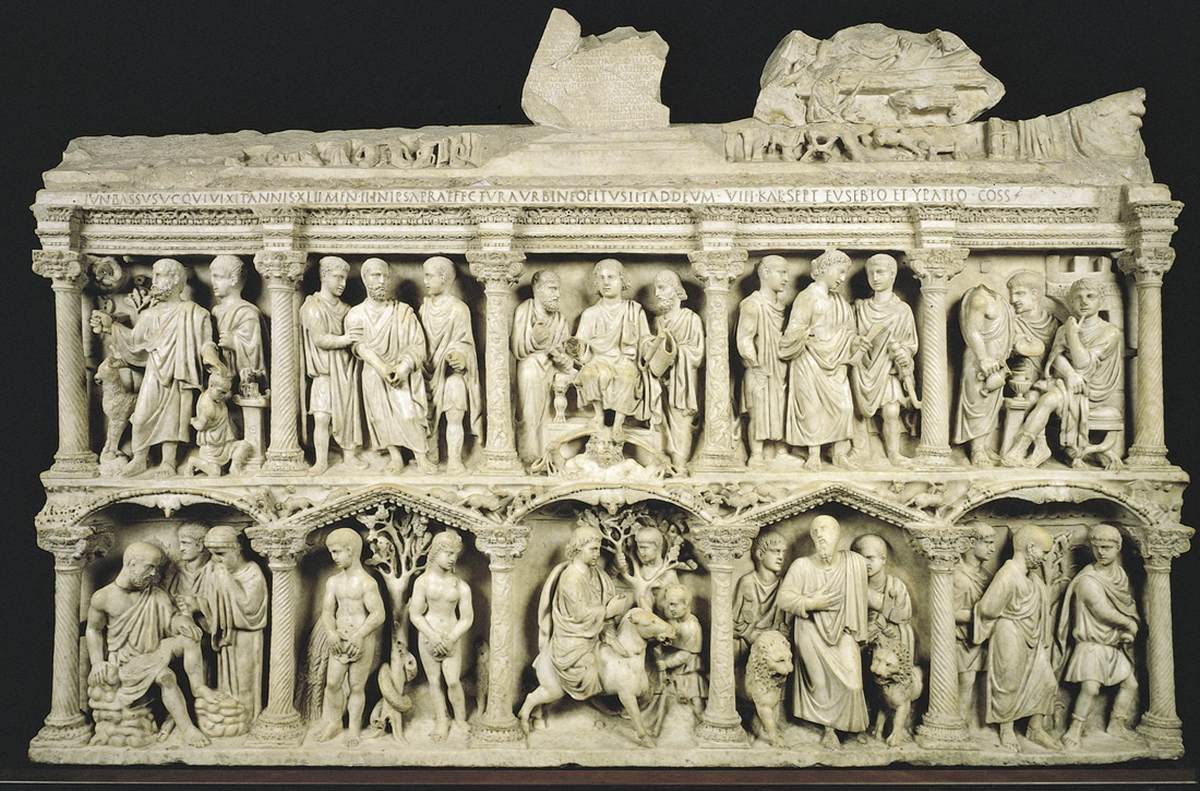
On the Featured Image
Sarcophagus of Junius Bassus. c. 359 CE. Marble, 142.2 x 243.8 cm. Museo Tesoro della Basilica di San Pietro (Treasury of Saint Peter’s Basilica), Vatican City.
Repository: Museo Tesoro della Basilica di San Pietro (Museum of the Treasury of Saint Peter’s Basilica)
Location: Vatican City
Placement: Located within the Treasury Museum rooms beneath Saint Peter’s Basilica (original discovery site near the confessio of Old Saint Peter’s).
Official Vatican Museums Link: Vatican Museums — Saint Peter’s Basilica and Treasury
Artist: Unknown Early Christian / Late Roman Sculptor
Title: Sarcophagus of Junius Bassus
Date: 359 CE (dated by the primary funerary inscription naming the consuls Eusebius and Hypatius)
Medium: Carrara / Pentelic white marble
Dimensions: 142.2 cm × 243.8 cm × 124.5 cm (56 in × 96 in × 49 in)
Inscriptions: Latin funerary inscription on the upper edge of the trough: IVN·BASSVS·V·C·QVI VIXIT ANNIS·XLII MEN·II·IN IPSA PRAEFECTURA URBI NEOFITUS IIT AD DEUM·VIII·KAL·SEPT·EUSEBIO ET YPATIO COSS (“Junius Bassus, vir clarissimus, who lived 42 years and 2 months, while holding the office of City Prefect went newly baptized to God on the 8th day before the Kalends of September [August 25], in the consulship of Eusebius and Hypatius”).
Provenance
359 CE: Executed in Rome for the burial of Junius Bassus, Senator and Prefect of the City of Rome (praefectus urbi), who died in office.
359–1597: Installed in the subterranean necropolis / confessio area beneath Old Saint Peter’s Basilica near the tomb of St. Peter.
1597: Rediscovered during architectural excavations and demolitions undertaken for the construction of New Saint Peter’s Basilica.
1940–1943: Additional fragments of the lid and inscription recovered during Vatican excavations beneath the confessio under Pope Pius XII.
Present: Retained and displayed in the permanent collection of the Museo Tesoro della Basilica di San Pietro, Vatican City.
Elsner, Jaś. Imperial Rome and Christian Triumph: The Art of the Roman Empire AD 100–450. Oxford: Oxford University Press, 1998.
Malbon, Elizabeth Struthers. The Iconography of the Sarcophagus of Junius Bassus. Princeton, NJ: Princeton University Press, 1990.
Panofsky, Erwin. Tomb Sculpture: Four Lectures on Its Changing Aspects from Ancient Egypt to Bernini. Edited by H. W. Janson. New York: Harry N. Abrams, 1964.
Spier, Jeffrey, ed. Picturing the Bible: The Earliest Christian Art. Fort Worth, TX: Kimbell Art Museum; New Haven: Yale University Press, 2007.
von Sydow, Wilhelm. “Zur Kunstgeschichtlichen Stellung des Junius Bassus-Sarkophages.” Jahrbuch des Deutschen Archäologischen Instituts 84 (1969): 206–237.
Rhetorical device that begins the book was known to both Roman rhetoricians and Jewish scholars.
Doubling
Procession into Jerusalem on a donkey. Carnivalesque of the triumphator?
Primary sources for triumphators
Livy, Ab Urbe Condita (History of Rome), 30.15.12 and 45.35–39
Livy. History of Rome, Volume VIII: Books 28-30. Translated by Frank Gardner Moore. Loeb Classical Library 381. Cambridge, MA: Harvard University Press, 1949.
Livy. History of Rome, Volume XIII: Books 43-45. Translated by Alfred C. Schlesinger. Loeb Classical Library 396. Cambridge, MA: Harvard University Press, 1951.
Plutarch, Life of Aemilius Paullus, 32–34.
Plutarch. Lives, Volume VI: Dion and Brutus. Timoleon and Aemilius Paullus. Translated by Bernadotte Perrin. Loeb Classical Library 98. Cambridge, MA: Harvard University Press, 1918.
Dionysius of Halicarnassus, Roman Antiquities, 2.34.
Dionysius of Halicarnassus. Roman Antiquities, Volume I: Books 1-2. Translated by Cary Earnest. Loeb Classical Library 319. Cambridge, MA: Harvard University Press, 1937.
Appian, The Punic Wars (The Foreign Wars), 8.66.
Appian. Roman History, Volume III: The Punic Wars. The Numidian War. The African War. The Illyrian War. The Syrian War. The Mithridatic War. Translated by Brian McGing. Loeb Classical Library 4. Cambridge, MA: Harvard University Press, 2019.
The Fasti Triumphales (Triumphal Lists).
Degrassi, Attilio. Inscriptiones Italiae, Vol. XIII, fasc. 1: Fasti Consulares et Triumphales. Rome: Libreria dello Stato, 1947.
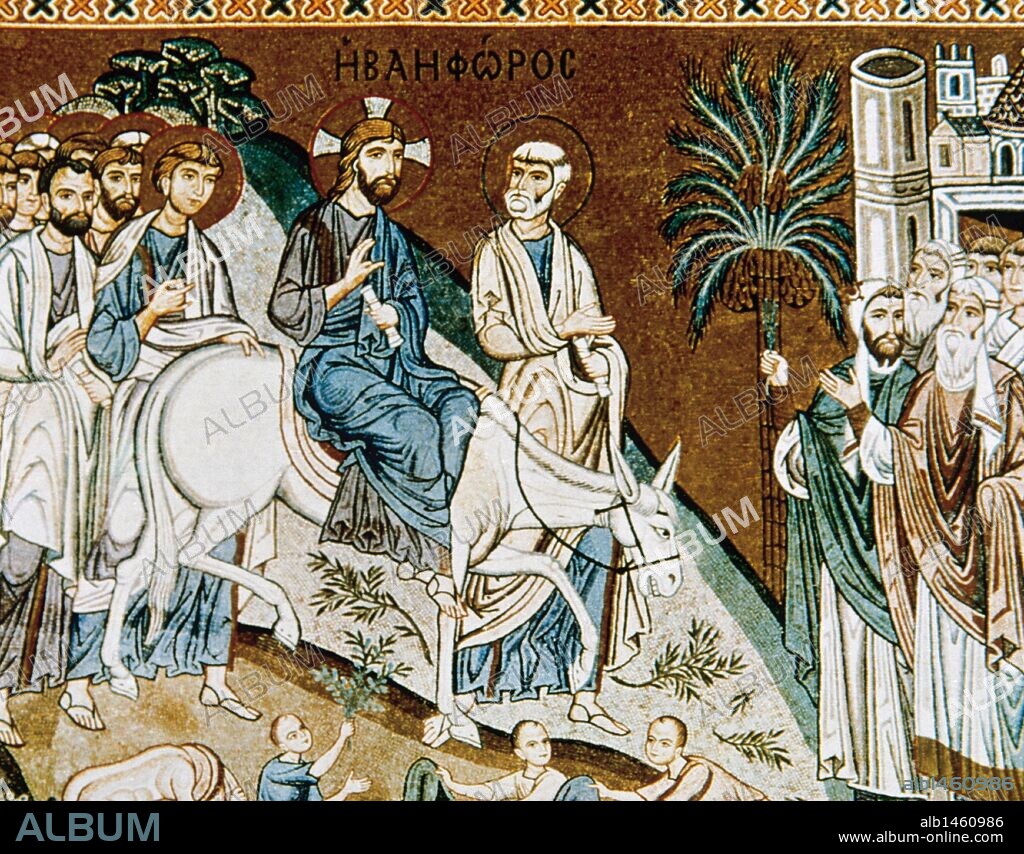
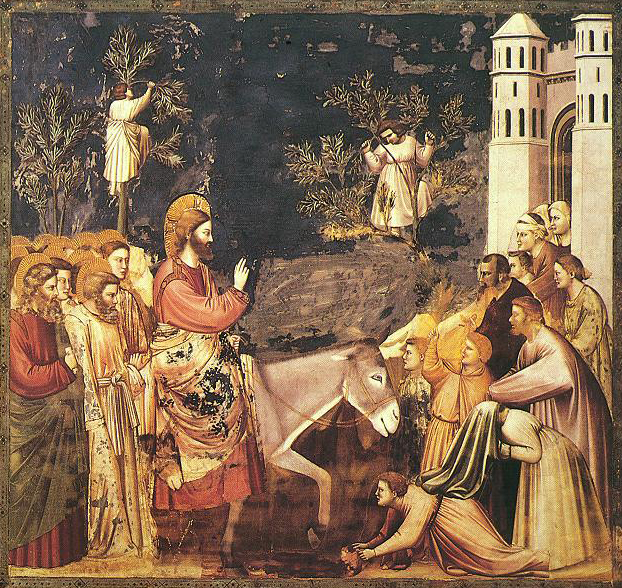
Here in the Gospel of Luke we get the visual of Jesus’ entry into Jerusalem on a donkey or two.
To be enthroned in Jerusalem, the location accords with Jewish tradition. However, why would a Jewish King arrive in a Roman way, that’s weird.
And what would a Roman think and feel? The triumphator the deification that had been witness stirred feelings related to civic religion. What feelings did this stir? A donkey is not a horse like in the triumphator. Why would a poor criminal be riding in like a consul. Is it a sick joke? The low is being made high.
Fast forward to Mikhail Bakhtin
On the featured image above:
Entry into Jerusalem. c. 1140–1170. Gold and glass mosaic. Cappella Palatina (Palatine Chapel), Palazzo dei Normanni, Palermo, Sicily, Italy.
Anonymous (Byzantine and Italo-Norman mosaicists). The Entry into Jerusalem (Ἡ Βαϊοφόρος / Palm Sunday). c. 1140–1170. Gold and glass mosaic, south wall of the sanctuary/transept. Cappella Palatina (Palatine Chapel), Palazzo dei Normanni (Palace of the Normans), Palermo, Sicily, Italy.
Site Location: Cappella Palatina, Palazzo Reale / Palazzo dei Normanni, Palermo, Sicily, Italy
Placement: South transept / sanctuary wall, middle tier (Christological cycle)
Official UNESCO & Site Link: Fondazione Federico II — Cappella Palatina, Palermo
Digital Archival Resource: Web Gallery of Art — Cappella Palatina Mosaic Cycle
Provenance
c. 1132–1140: Chapel commissioned by King Roger II of Sicily following his royal coronation in 1130.
c. 1140–1170: Execution of the sanctuary and transept Christological mosaic programs under King Roger II and continued under William I and William II.
Late 12th–19th Century: Retained in situ as the private royal chapel of the Norman, Hohenstaufen, and Bourbon rulers of Sicily.
19th Century: Underwent structural and mosaic consolidation by restorer Rosario Riolo following localized seismic and environmental deterioration (a 19th-century oil copy/draft of the panel by Riolo is held in the Victoria & Albert Museum, London).
1920s–Present: Integrated into the state preservation system of the Region of Sicily / Palazzo dei Normanni; inscribed as part of the UNESCO World Heritage Site Arab-Norman Palermo and the Cathedral Churches of Cefalù and Monreale in 2015.
Demus, Otto. The Mosaics of Norman Sicily. London: Routledge & Kegan Paul, 1949.
Kitzinger, Ernst. The Mosaics of St. Mary’s of the Admiral in Palermo. Washington, DC: Dumbarton Oaks Research Library and Collection, 1990.
Kitzinger, Ernst. I mosaici del periodo normanno in Sicilia. Fasc. 1: La Cappella Palatina di Palermo: I mosaici del presbiterio. Palermo: Accademia Nazionale di Scienze Lettere e Arti di Palermo, 1992.
Tronzo, William. The Cultures of His Kingdom: Roger II and the Cappella Palatina in Palermo. Princeton, NJ: Princeton University Press, 1997.
Borsook, Eve. Messages in Mosaic: The Royal Programmes of Norman Sicily (1130–1187). Oxford: Clarendon Press, 1990.
On the image below:
Giotto di Bondone. The Entry into Jerusalem. c. 1303–1305. Fresco, 200 x 185 cm. Scrovegni Chapel (Arena Chapel), Padua, Italy.
Repository: Cappella degli Scrovegni (Scrovegni / Arena Chapel), Musei Civici di Padova
Location: Padua, Veneto, Italy
Placement: Middle tier of the north wall (Life of Christ sequence, Scene 26 / Frame 10)
Official Website: Musei Civici di Padova — Cappella degli Scrovegni
Date: c. 1303–1305
Medium: Fresco (buon fresco with tempera secco additions)
Dimensions: 200 cm × 185 cm (78.7 in × 72.8 in)
1300: Site of the ancient Roman arena in Padua purchased by the Paduan banker Enrico Scrovegni.
1303–1305: Execution of the fresco cycle commissioned by Enrico Scrovegni for the private family chantry chapel dedicated to Santa Maria della Carità.
March 25, 1305: Consecration of the Scrovegni Chapel.
1881: Acquired by the Municipality of Padua (Comune di Padova) to prevent private destruction and integrated into the Musei Civici di Padova.
Present: Permanently conserved in situ within the Scrovegni Chapel, Padua.
Derbes, Anne, and Mark Sandona, eds. The Cambridge Companion to Giotto. Cambridge: Cambridge University Press, 2004.
Ladis, Andrew. Giotto’s O: Narrative, Figuration, and Pictorial Space in the Arena Chapel. University Park: Pennsylvania State University Press, 2008.
Stubblebine, James H., ed. Giotto: The Arena Chapel Frescoes. New York: W. W. Norton & Company, 1969.
White, John. “Giotto’s Use of Architecture in ‘The Expulsion of Joachim’ and ‘The Entry into Jerusalem’ at Padua.” The Burlington Magazine 115, no. 844 (1973): 439–447.
Zanardi, Bruno. Giotto e Pietro Cavallini: La rivoluzione della pittura italiana fra Roma e Padova. Milan: Skira, 2002.
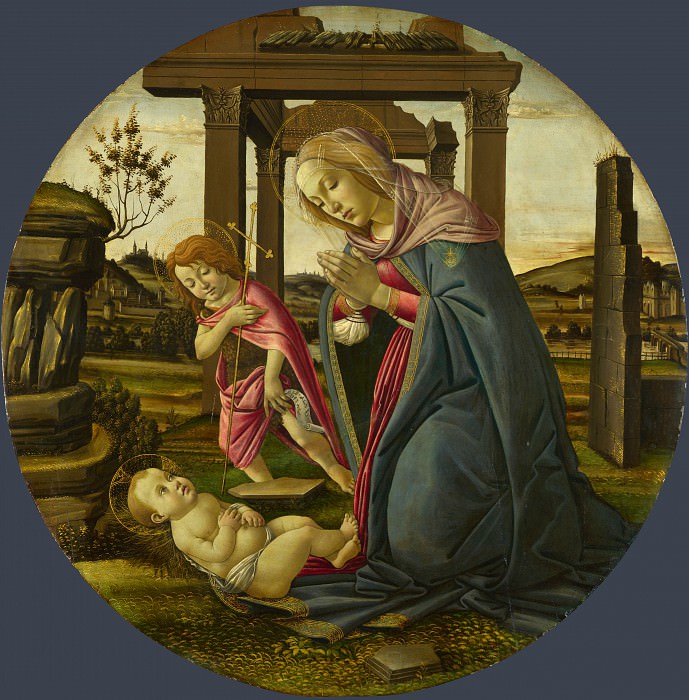
Botticelli, Sandro. The Virgin Adoring the Child with the Infant Saint John the Baptist. c. 1490. Tempera, oil, and gold on wood, diameter: 115.3 cm. National Gallery of Art, Washington, DC.
Repository: National Gallery of Art, Washington, DC
Collection: Samuel H. Kress Collection
Accession Number: 1952.2.4
Official Museum Page: National Gallery of Art – Artwork Collection Record
Artist: Sandro Botticelli (Alessandro di Mariano di Vanni Filipepi, Florentine, c. 1445–1510)
Title: The Virgin Adoring the Child with the Infant Saint John the Baptist (Cataloged at NGA as The Virgin Adoring the Child)
Date: c. 1480–1490 / c. 1490
Medium: Tempera, oil, and gold on poplar panel
Dimensions: Panel diameter: 58.9 cm (23 3/16 in.); framed diameter: 82.2 cm (32 3/8 in.)
By 1878: Charles Paravey (d. by 1878), Paris (Auctioned at Hôtel Drouot, Paris, April 13, 1878, no. 97, as by Filippo Lippi; bought in).
By 1929: By descent to Paravey’s daughter, Mme. Raynaud, Paris (Auctioned at Hôtel Drouot, Paris, December 16, 1929, no. 44, as by Filippo Lippi).
1929–1947: Wildenstein & Co., Inc., New York.
October 30, 1947: Purchased by the Samuel H. Kress Foundation, New York.
1952: Gifted by the Samuel H. Kress Foundation to the National Gallery of Art, Washington, DC.
Deimling, Barbara. Sandro Botticelli, 1444/45–1510. Cologne: Taschen, 1993.
Friedmann, Herbert. “Two Paintings by Botticelli in the Kress Collection.” In Studies in the History of Art Dedicated to William E. Suida on His Eightieth Birthday, 116–123. London: Phaidon Press, 1959.
Lightbown, Ronald. Sandro Botticelli: Life and Work. 2 vols. Berkeley: University of California Press, 1978.
Shapley, Fern Rusk. Catalogue of the Italian Paintings: National Gallery of Art. 2 vols. Washington, DC: National Gallery of Art, 1979.
Suida, William E. Paintings and Sculpture from the Samuel H. Kress Collection: Acquired Between 1945 and 1951. Washington, DC: National Gallery of Art, 1951.
The account of the Lord’s Supper starting at verse 14 reminds us of the book of Matthew with the repetition of Kingdom of God.
But perhaps the most important line is when he called this cup the new covenant sealed in his blood.
This is the fulfillment of the prophesy in Jeremiah 31:31 The Lord says, “The time is coming when I will make a new covenant with the people of Israel and with the people of Judah. It will not be like the old covenant that I made with their ancestors when I took them by the hand and led them our of Egypt. Although I was like a husband to them, they did not keep that covenant. The new covenant that I will made with the people of Israel will be this: I will put my law within them and write it on their hearts. I will be their God, and they will b emy people. None of them will have to teach his fellow countryman to know the Lord, because all will know me, from the least to the greatest. I will forgive their sins and I will no longer remember their wrongs.”
The last supper as the new covenant is so radical in that it is embodied… happens in the individual’s life. The birth of the individual could be traced to this moment, in some spiritual sense, here, not later after the birth of towns.