Homer. Iliad, Books 1–12. Translated by A. T. Murray. Revised by William F. Wyatt. Loeb Classical Library 170. Cambridge, MA: Harvard University Press, 1924.
Homer. Iliad, Books 13–24. Translated by A. T. Murray. Revised by William F. Wyatt. Loeb Classical Library 171. Cambridge, MA: Harvard University Press, 1925.
Homer. Odyssey, Books 1–12. Translated by A. T. Murray. Revised by George E. Dimock. Loeb Classical Library 104. Cambridge, MA: Harvard University Press, 1995.
Homer. The Iliads and Odysses of Homer. Translated out of Greek into English by Tho. Hobbes of Malmsbury. London: Printed for Will. Crook, 1677.
Homer. The English Works of Thomas Hobbes of Malmesbury. Vol. 10, The Iliads and Odysses of Homer, Translated out of Greek into English by Thomas Hobbes. Edited by Sir William Molesworth. London: Longman, Brown, Green and Longmans, 1844.
Homer. Translations of Homer: Iliad and Odyssey. Translated by Thomas Hobbes. Edited by Eric Nelson. The Clarendon Edition of the Works of Thomas Hobbes, vols. 24–25. Oxford: Clarendon Press, 2008.
Homer. The Iliads and Odysses of Homer. Translated by Thomas Hobbes. Edited by Eric Nelson. The Clarendon Edition of the Works of Thomas Hobbes, vols. 24–25. Oxford: Clarendon Press, 2008.
The printing history of Thomas Hobbes’s Homeric translations reveals a staggered rollout by his principal Restoration-era publisher, culminating in a combined collection that remained the standard layout for centuries:
1673 (The Voyage of Ulysses): Hobbes initially published a trial translation consisting solely of Books 9 through 12 of the Odyssey, printed by William Crook at the Green Dragon without Temple-Bar.
1675 (The Odysses): Encouraged by the reception of his sample, Hobbes completed and Crook published the full twenty-four books of the Odyssey.
1676 (The Iliads): Crook issued the first edition of Hobbes’s complete Iliad, featuring a distinct title page noting it was “Printed by J.C. for W. Crook.”
1677 (The First Collected Edition): Crook issued the definitive small-format duodecimo volume titled The Iliads and Odysses of Homer, which bound the two epics together alongside Hobbes’s highly influential essay, “A Large Preface Concerning the Vertues of an Heroick Poem.”
Original 1676 and 1677 printings are held in the permanent collections of the Bodleian Library,
The Bodleian Library (Oxford)
Shelfmark Reference: Holds the primary standalone early runs of the translations, including the 1675 Odysses separate press run that preceded the combined 1677 collection.
The British Museum (London)
Department of Prints and Drawings: Houses the material text alongside associated Restoration-era broadsides, commercial frontispieces, and portrait engravings executed for William Crook’s bookshop at the Green Dragon without Temple-Bar.
Department of Prints and Drawings: Houses the material text alongside associated Restoration-era broadsides, commercial frontispieces, and portrait engravings executed for William Crook’s bookshop at the Green Dragon without Temple-Bar.
the Folger Shakespeare Library. Throughout the nineteenth century, William Molesworth preserved this exact presentation in Volume 10 of his landmark compilation, The English Works of Thomas Hobbes (1844).
Accession Context: Preserves the complete 1677 duodecimo volume containing the full text of both epics bound together with Hobbes’s theoretical treatise, “A Large Preface Concerning the Vertues of an Heroick Poem.”
On the featured image
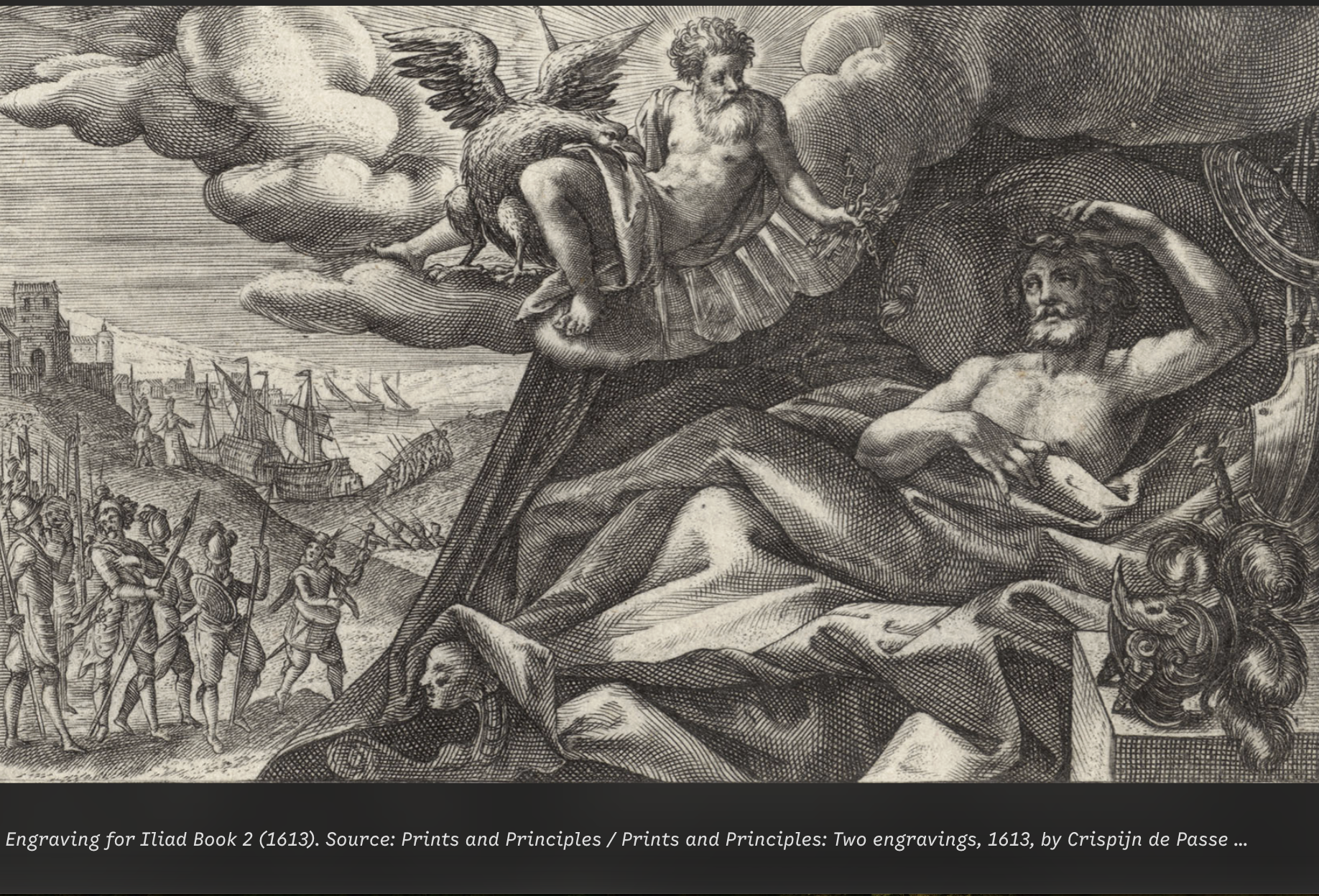
Passe, Crispijn de, the Elder. Speculum Heroicum Principis Omnium Temporum Poetarum Homeri, Id Est Argumenta XXIV Librorum Iliados Homeri. Utrecht: Ex officina Typographica Crispini Passaei, 1613.
Provenance and Repository Information
The British Museum (London): Holds a complete, beautifully preserved bound run of the original twenty-four Speculum Heroicum prints (Museum numbers 1948,0410.4.1 through 1948,0410.4.24), acquired via the collection of the late Baroness Lucas.
The Rijksmuseum (Amsterdam): Houses loose impression leaves from the first 1613 Utrecht press run (Inventory RP-P-OB-24.364), cataloged within their master indices of Early Modern Dutch graphic arts.
Art History and Emblematic Context
While woodcuts were becoming less common in high-end book production by Thomas Hobbes’s lifetime, the emblematic mode of visual storytelling remained highly influential. Crispijn de Passe the Elder’s 1613 Speculum Heroicum (The Heroic Mirror) represents the pinnacle of this approach for the Iliad.
Each of the twenty-four books of the epic is condensed into a single copperplate engraving. These plates are paired with brief Latin and French verse arguments, structured exactly like a Renaissance or Baroque emblem book.
In his engraving for Book 2, de Passe captures the exact moment the False Dream (Oneiros), sent by Zeus, visits the sleeping King Agamemnon to trick him into launching an immediate, disastrous assault on Troy. The composition relies on classic emblematic shorthand: a divided frame that shows a private, psychological state on the right (the king dreaming in bed) alongside the public, external consequences on the left (the Greek troops marching out past the long ships).
Veldman, Ilja M. “Crispijn de Passe the Elder: Graphic Artist and Publisher in Utrecht.” Simiolus: Netherlands Quarterly for the History of Art 28, no. 3 (2001): 105–128.