Aeschylus. Aeschylus: Agamemnon, Libation-Bearers, Eumenides, Fragments. Translated by Herbert Weir Smyth. Loeb Classical Library 146. Cambridge, MA: Harvard University Press, 1926.
Aeschylus. The Oresteia: Agamemnon, The Libation Bearers, The Eumenides. Translated by Richmond Lattimore. Chicago: University of Chicago Press, 1953.
Aeschylus. The Oresteia. Translated by Robert Fagles. New York: Penguin Classics, 1979.
Aeschylus. Oresteia: Agamemnon, Libation-Bearers, Eumenides. Edited and translated by Alan H. Sommerstein. Loeb Classical Library 146. Cambridge, MA: Harvard University Press, 2009.
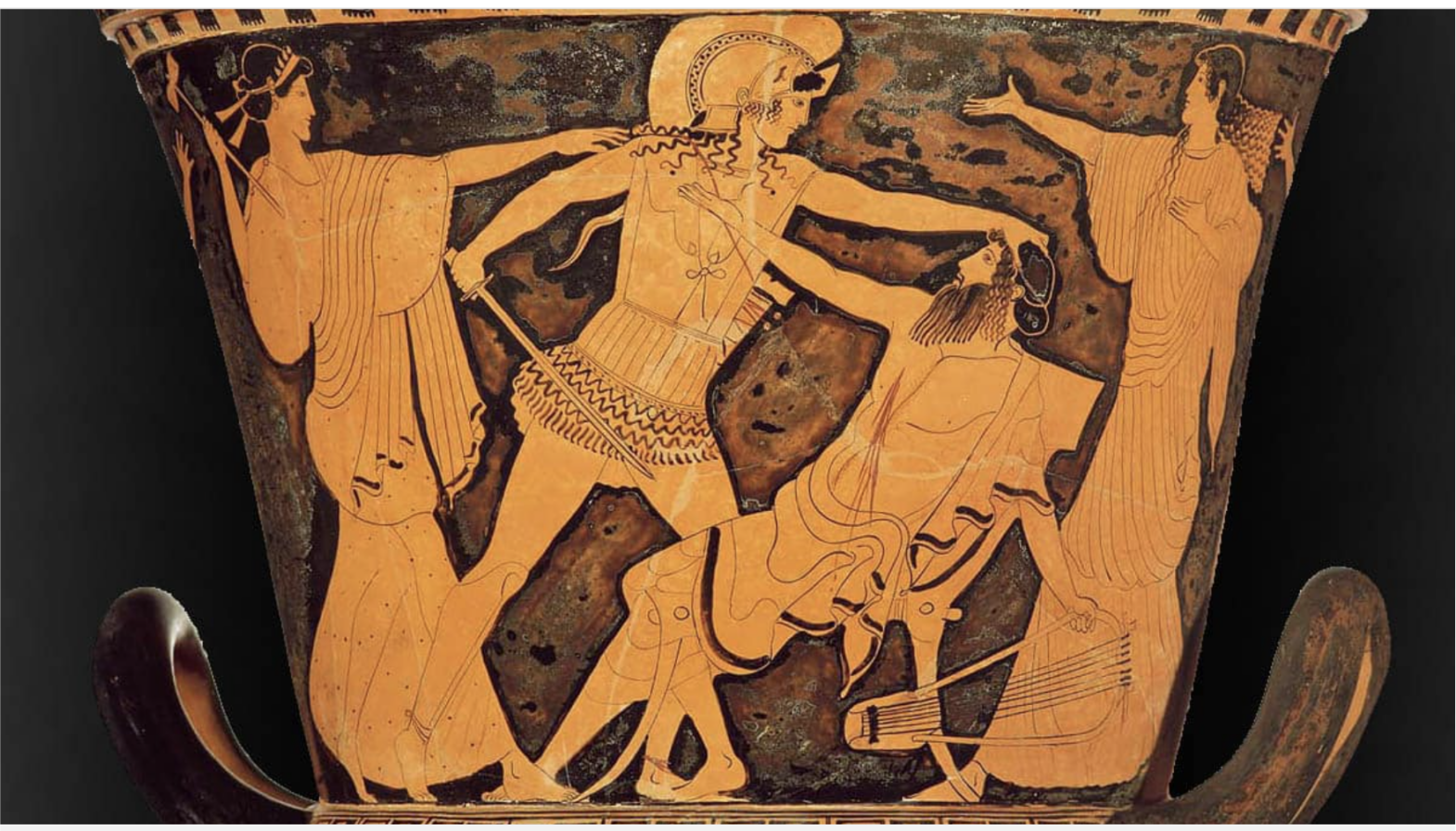
On the featured image:
Dokimasia Painter. Attic Red-Figure Calyx-Krater: The Murder of Agamemnon. c. 460 BCE. Terracotta, 48.3 x 50.8 cm. Museum of Fine Arts, Boston.
Museum/Location: Museum of Fine Arts, Boston (Accession Number: 63.1246).
Provenance: This vase is attributed to the Dokimasia Painter, an Athenian artist active during the early Classical period. It was acquired by the Museum of Fine Arts in 1963.
Art History Context: This is one of the most famous visual depictions of the Oresteia in antiquity. It captures the moment of highest tension in Aeschylus’s Agamemnon: the king is trapped in a translucent, web-like net (the “net of Hades” described by Cassandra) while Aegisthus prepares to strike with a sword. Clytemnestra stands behind them, holding an axe.