Aeschylus. Aeschylus I: The Persians, The Seven Against Thebes, The Suppliant Maidens, Prometheus Bound. Translated by David Grene. Edited by David Grene and Richmond Lattimore. 3rd ed. Chicago: University of Chicago Press, 2013.
Aeschylus. Prometheus Bound. Edited by Mark Griffith. Cambridge Greek and Latin Classics. Cambridge: Cambridge University Press, 1983.
Prometheus Bound. Translated by Joel Agee. New York: New York Review Books, 2005.
Herington, C. J. The Author of the Prometheus Bound. Austin: University of Texas Press, 1970.
Codex Laurentianus 32.9 (Manuscript M)
Location: Biblioteca Mediceo-Laurenziana, Florence.
Date: c. 1000–1050 AD.
Context: This is the most authoritative source for all seven surviving plays. It is a luxurious parchment codex that preserves the oldest traditions of the text.
Manuscript Nn.3.17.1
Location: Cambridge University Library (originally from Mount Athos).
Date: Early 14th century (c. 1325).
Context: A primary example of a Byzantine-era schoolbook containing the Triad (Prometheus, Seven Against Thebes, Persians).
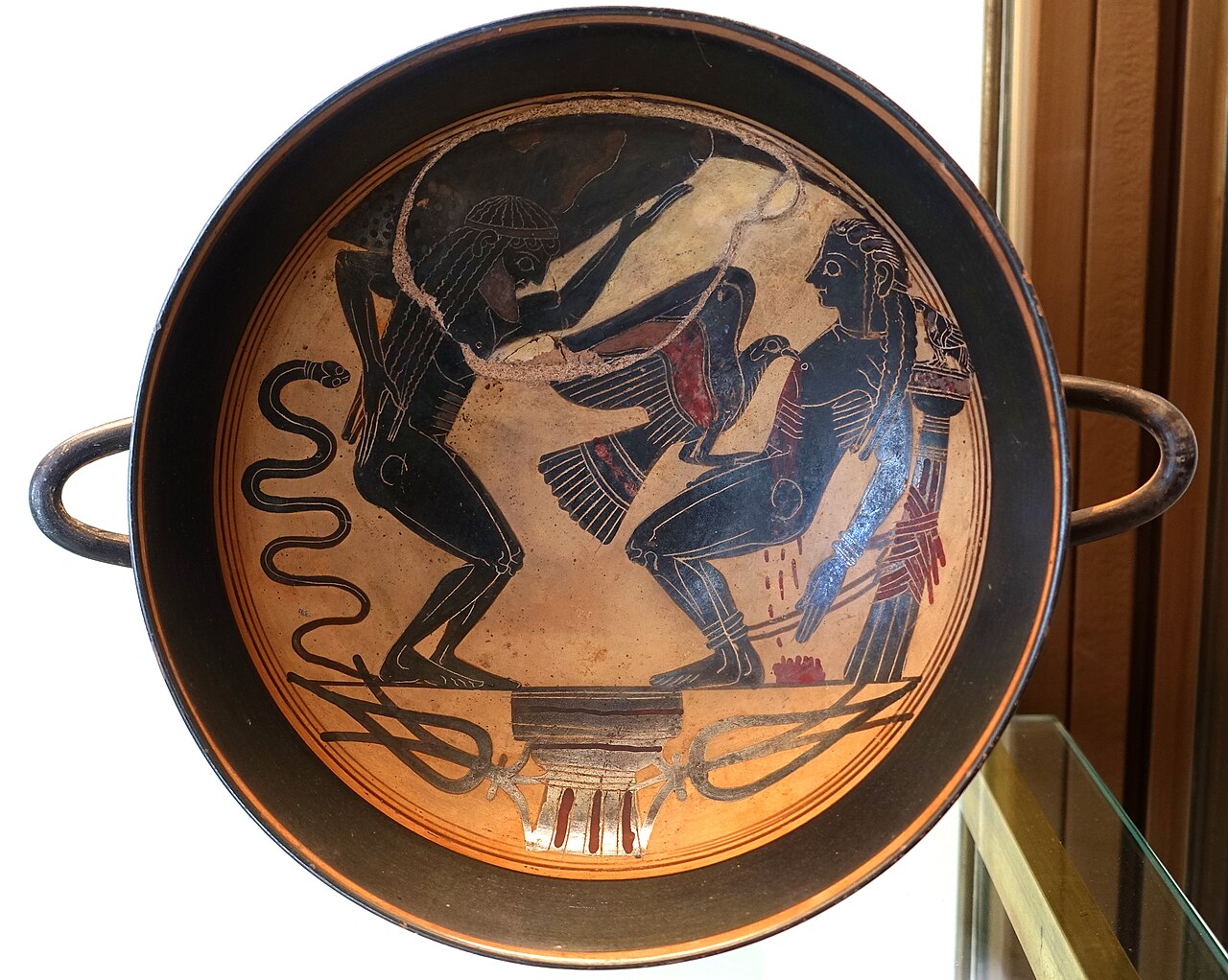
On the featured image
Stibbe, Conrad M. Laconian Vases and Their Painters. Amsterdam: North-Holland Publishing Company, 1972. (Ref: No. 196, Pl. 62).
Pipili, Maria. Laconian Iconography of the Sixth Century B.C. Oxford: Oxford University Committee for Archaeology, 1987.
Lane, E. A. “Lakonian Vase-Painting.” The Annual of the British School at Athens 34 (1933): 99–189.
Vermeule, Emily. “The Mythology of the Underworld.” In Aspects of Death in Early Greek Art and Poetry, 145–209. Berkeley: University of California Press, 1979.
Trendall, A. D., and T. B. L. Webster. Illustration of Greek Drama. London: Phaidon, 1971.
Cohen, Beth. “The Image of Prometheus in Greek Art.” In Prometheus: The Friend of Man, 23–45. Baltimore: Johns Hopkins University Press, 1995.