Plato, The Symposium, trans. Seth Benardete (Chicago: University of Chicago Press, 2001).
Plato. The Symposium. Translated by Alexander Nehamas and Paul Woodruff. Indianapolis: Hackett Publishing Company, 1989.
Plato. The Symposium. Translated by Christopher Gill. London: Penguin Classics, 1999.
Plato. The Symposium. Translated by M. C. Howatson. Cambridge: Cambridge University Press, 2008.
Plato. The Symposium. Translated by Robin Waterfield. Oxford: Oxford University Press, 1994.
Codex Clarkianus (MS. Ch. Ch. 180), housed at the Bodleian.
Manuscript Repository: The Bodleian Libraries, University of Oxford
Textual Provenance: The earliest complete manuscript of Plato’s works, copied in 895 CE for Arethas of Caesarea.
Digital Text: Perseus Digital Library – Plato, Symposium
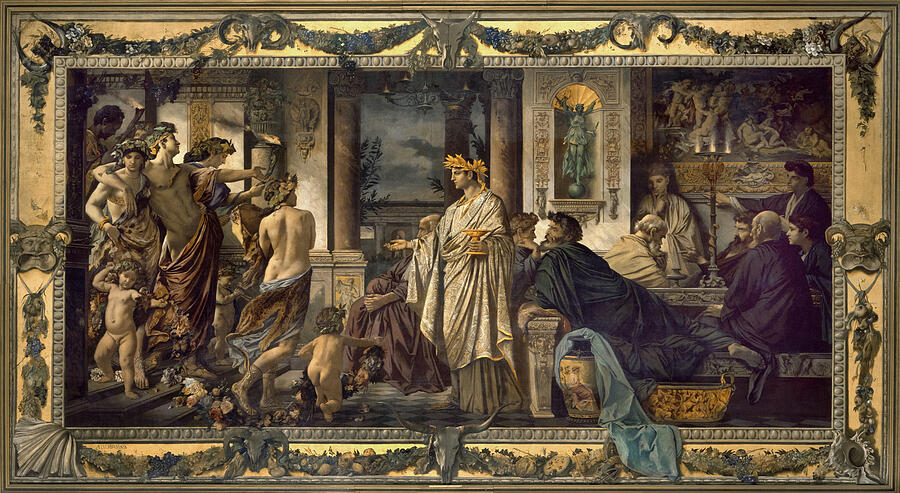
On the featured image above
Feuerbach, Anselm. The Symposium (Second Version). 1871–1874. Oil on canvas. Alte Nationalgalerie, Berlin.
Lesher, J. H. “Feuerbach’s Das Gastmahl des Platon and Plato’s Symposium.” Arion: A Journal of Humanities and the Classics 2, no. 1 (1992): 122–40.
Barolsky, Paul. “The Artist’s Hand.” In The Ideal Academy: Neoplatonism and the Arts, edited by Michael J. B. Allen, 65–82. Princeton: Princeton University Press, 2002.
Grewe, Cordula. “The Modernity of History Painting: Anselm Feuerbach’s The Symposium.” The Art Bulletin 94, no. 2 (2012): 230–55.
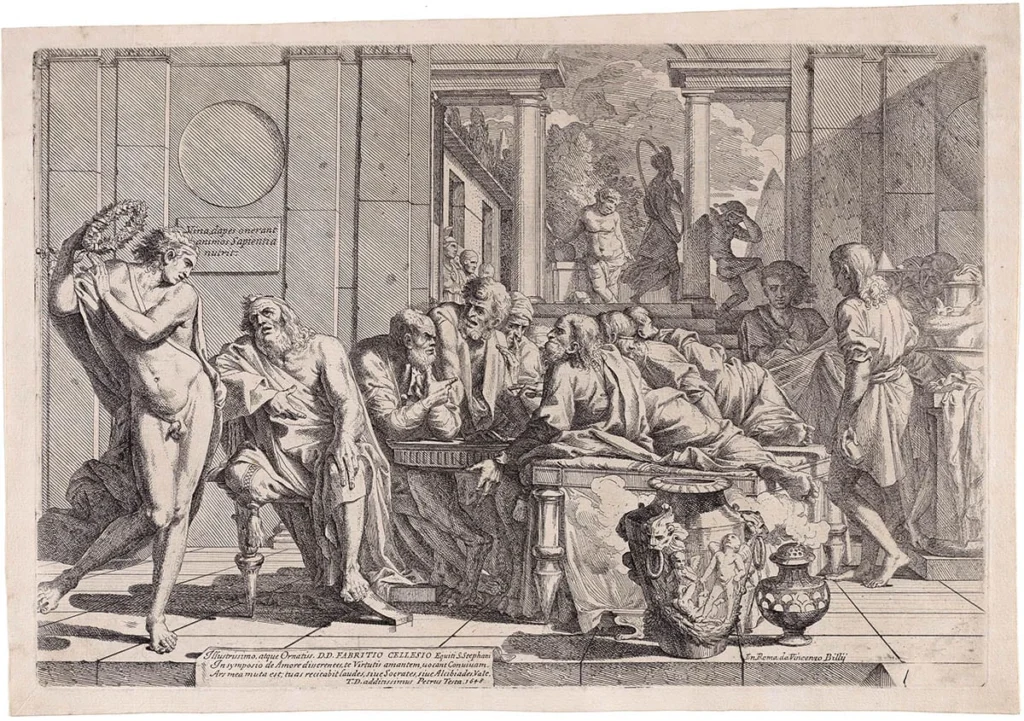
Pietro Testa’s etching is a significant Seicento (17th-century) interpretation of the dialogue, specifically capturing the moment Alcibiades crashes the party. It is a highly allegorical work that contrasts the sensory world (Alcibiades) with the intellectual world (Socrates).
Artwork Information
Artist: Pietro Testa (Italian, 1612–1650).
Title: The Symposium (also known as Plato’s Symposium).
Date: 1648.
Medium: Etching.
Dimensions: Approximately 26 cm x 38 cm (varies slightly by sheet trim).
Primary Locations: * Saint Louis Art Museum (Object Number 16:1973)
National Gallery of Art, Washington D.C. (Accession Number 2012.126.2)
The Metropolitan Museum of Art, New York (Accession Number 26.70.3(39))
Provenance (NGA Copy): Formerly in the collection of James A. Bergquist (Newton Centre, MA); purchased by the National Gallery of Art in 2012 using the Ailsa Mellon Bruce Fund.
Chicago Citation: Testa, Pietro. The Symposium. 1648. Etching. National Gallery of Art, Washington, D.C.
Scholarly Articles (Art History Focus)
The following works by art historians analyze Testa’s complex iconography and his engagement with Platonic philosophy:
Cropper, Elizabeth. The Ideal of Painting: Pietro Testa’s Düsseldorf Notebook. Princeton: Princeton University Press, 1984. (See specifically the sections on his philosophical prints).
Cropper, Elizabeth. Pietro Testa, 1612–1650: Prints and Drawings. Philadelphia: Philadelphia Museum of Art, 1988.
McGrath, Elizabeth. “The Drunken Alcibiades: Rubens’s Picture of Plato’s Symposium.” Journal of the Warburg and Courtauld Institutes 46 (1983): 228–35. (This article provides essential context for how Testa and his contemporaries like Rubens visualized this specific scene).
Key Technical Details
The etching features a Latin inscription on the back wall: “Vina, dapes onerant animos, sapientia nutrit” (Wine and feasts weigh down the soul; wisdom nourishes it). This serves as the moralizing “thesis” of the artwork, distinguishing between the types of love and nourishment discussed in the dialogue.