28 When Jesus finished speaking, the crowds were surprised at his teaching. 29 He taught them like someone with authority, and not like their teachers of the Law of Moses.
Why would a course on the history of political thought need to include the Book of Matthew?
First it is addressed to the Jewish community, which lived in the larger context of the Roman empire. So, there is the first point of interest. What is the relation of a religious community with peculiar laws in the larger context of empire with other laws.
In this doubled context, we double the discomfort with Jesus. He broke the Jewish laws, went against those authorities; but he was ultimately sentenced by a Roman judge so he must have not sit well with those authorities either.
It seems like the question of the gospels is trying to give us a picture of who Jesus was, but instead of answering, the question just gets thrown back at his audience and the reader who do you think Jesus is/was?
To understand how Jesus’s life could have changed our calendar, been the big before and after; we will have to figure out how his contemporaries thought about time. The Book of Matthew is alive with this expectation/hope attitude we get the idea that everyone is hoping for the coming Kingdom. What did that mean? Turns out, meant different things to different groups.
First Temple proto-eschatology, prophetic literature
Prophets such as Ezekiel, first and second Isaiah
Second Temple Rise of apocalyptic literature.
Academic Articles that can contextualize the Book of Matthew
Collins, John J. “The Heavenly Redeemer in Second Temple Judaism.” Journal for the Study of the Pseudepigrapha 2 (1988): 3–20.
Chester, Andrew. “The Messianic Idea and Late Second Temple Judaism.” Journal for the Study of the New Testament 13, no. 42 (1991): 47–81.
Knibb, Michael A. “Eschatological Expectations in the Second Temple Period.” Journal of Jewish Studies 40, no. 1 (1989): 1–12.
“Temple and Cult in the Apocrypha and Pseudepigrapha: Future Perspectives – Michael A. Knibb -Theological Developments, Sectarian Debates, Liturgical Transformations, Messianic Expectations, Apocalyptic Visions, Priestly Traditions, Angelology, Esoteric Cosmic Temple Imagery -RARE PAPERS EDITION -.” This Chapter Appears in the Book Flores Florentino: Dead Sea Scrolls and Other Early Jewish Studies in Honour of Florentino García Martínez, Pages 509–527, Published by Brill , n.d.
Edited volumes
Who’s coming and what is he going to do? There were various answers to this question.
OK but what were people thinking about when they were interested in this type of apocalyptic literature?
One answer is that some people felt put upon by Roman taxation, so the coming Kingdom would throw off the authority of the Roman empire to tax.
The Kingdom of Heaven is really the Kingdom of God and the story goes that God is coming in to break the time of crisis and begin His Reign.
So what were people doing in response to this expectation or anticipation in the air?
Apocalyptic sectarians: This people are looking for to a great big conflagration where God is going to come and get rid of the imperial powers and corrupt priests.
Other people (Pharisaic tradition) sit around trying to be as obedient as possible so God will come and redeem them.
Finally, the resistance figures looking for a leader for a physical liberation from rule.
One of the big issues is that the leader turns out to be Jesus, but he doesn’t exactly overthrow the Roman empire or stop taxation.
The larger thing to take from this is the challenge to the reader is not only Who is Jesus? But also how do I respond to eschatological literature?
People want God to come because they are mad about injustice then they get their hopes up.
This is based on such and so texts of the Old Testament, this is based on the socio-political circumstance of the age, both.
For political philosophy reasons we have the issue of justice. And the question of revolution or crisis –or the coming of justice in time, mapped onto time.
The signpost words that are over-broad, yet necessary that we are going to use first and interrogate later are Greek, Roman, Christian. So, Greek culture was highly valued by the Romans. The Old Testament translated into Greek was a literary context of those confronted with the gospels, so how can you separate Greek and Christian? And of course the story takes place in the Roman empire so how are we separating out Roman and Christian?
Greek is the history of the demos, while Rome is associated with the republic.
Greek has sacrifice to the gods as a motor of history, Christianity has a different take on sacrifice.
Roman vs. Christian — Roman believes in a demi god or Prometheus, vs the Christian as a guilt wallower or sheep.
So, its hard to make the signposts due to their overbroad character, not hermetically sealed. At the same time we are trying to make pictures in our minds of the themes both where they overlap and where they differ.
We have to get ready to read Nietzsche and also respond to Strauss.
How does Greek philosophy make its way into each gospel?
The Book of Matthew approaches the question of justice with a hard case example, one that is also described in Plato’s Euthyphro.
Matthew 22:13 depicts a scenario that Socrates finds himself addressing in Plato’s Euthyphro. So we know that the knowledge producers working on the book of Matthew knew this Platonic dialogue.
Matthew, like the Euthyphro, approaches questions of ethics and justice.
The book of Matthew is about Jesus’ place in the Jewish tradition. The book begins with an ancestral lineage, which is the rhetorical organizational clue to know its addressed to a Jewish audience. If you want to know who Jesus is, you may want to trace his ancestral lineage.
We have the political context of Rome on the one hand, becoming a multicultural empire.
Then we have the tribes of Israel who have a different relation to a different law, different commander but somehow coexist with and within the larger political state, whose laws must also be obeyed.
This question of a variety of smaller ethno-groups within a larger political organization comes back with multiculturalism debates of contemporary political philosophy.
Finally, of interest in the book of Matthew is the third layer, the individual. The direct address to the disciples regarding their choice about their life.
In the gospels, we have the question that keeps coming up Who is Jesus? There are at least three questions here. Who is he to the Romans? Who is he to the Jews? and who is he to the individual.
These are contexts of ethical inquiry, — how must I treat myself, others in cultural community, and other in political community.
We can see the study of ethics began before and has gone on since in an academic way, and Christian belief is not required for ethical behavior. My approach is not apologetic. Its is more to approach the Synoptics and the Book of John from the perspective of how they intersect with the Greek and Roman political thought.
These terms have to be simply signposts, because they are over-broad. Nevertheless, they function as directional references.
The approach I’m taking is to ask is how do each text raise the questions raised in the Western tradition of political thought, and, then, when I link the pages to one another, we will be able to see how various texts or themes are braided together.
The early modern period comes back to the covenant as one model of political agreement, the invocation of Moses as lawgiver.
So we have Jerusalem as one of the signposts, and Jesus is out of this tradition, Christianity comes up in the Jewish community in the larger political context of Rome.
We have all of the models of law and political authority in Roman history known to this point.
Why does the confluence of Jewish and Roman traditions of power and authority concern us?
This mix of
Because I put Hobbes’s Leviathan at the center of the blog. Part of an early modern tradition of imagining the foundation of the modern state in the model of a covenant. Moses is an archetype of a lawgiver mentioned by nearly all political philosophers in this tradition.
Secondly, the presence of Roman law. Students of the history of political philosophy can mine Roman history for lessons of power and authority all night long, as did Machiavelli.
In the King’s Two Bodies, Ernst Kantorwicz explores how concepts in Roman law came to permeate early modern law. For example, the idea of a corporate body that does not die, the metaphor of the body for a polity the body politic and with corporation also the concept of personhood. The idea of office and office holding and the fiscus.
Another wrench thrown by the Gospels is the universality of the message.
How could a message so personal, known by direct experience also be universal?
16:24-26 This passage is important for the history of political thought intersecting with Biblical studies because it concerns life, and saving one’s life later becomes part of sovereign legitimation discourses.
Matthew 16:24–26 (NRSVUE)
24 Then Jesus told his disciples, “If any wish to come after me, let them deny themselves and take up their cross and follow me. 25 For those who want to save their life will lose it, and those who lose their life for my sake will find it. 26 For what will it profit them if they gain the whole world but forfeit their life? Or what will they give in return for their life?”
Articles about relation between Euthyphro and Matthew
Kozłowski, J. M. (2024). “Bind him hand and foot, and throw him into…” Dependence of Matt 22:13 on Plato’s Euthyphro 4c? Verbum Vitae : Półrocznik Biblijno-Teologiczny, 42(4), 1053–1056. https://doi.org/10.31743/vv.17710
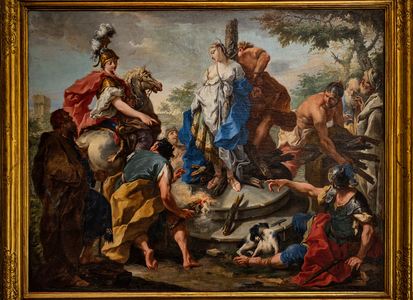
On the featured image above:
Strozzi, Bernardo. The Parable of the Wedding Banquet (fragment) [Parabola del banchetto di nozze (frammento)]. c. 1636. Oil on canvas, 183 × 126.5 cm. Gallerie dell’Accademia, Venice, Italy.
Museum: Gallerie dell’Accademia (Venice, Italy)
Catalog / Inventory Number: 2046 (Sala 5)
Official Link: Gallerie dell’Accademia — Parabola del banchetto di nozze (frammento) by Bernardo Strozzi
Provenance
1636: Commissioned as the central section of a large oval ceiling canvas representing the Parable of the Wedding Guest for the main altar of the Church of the Ospedale degli Incurabili in Venice.
1825–1865: Held in state depositories (depositi demaniali) following the secularization and dismantling of the church structure.
20th Century: Separated as a standalone fragment and held across private Italian collections.
2016–Present: Acquired by the Italian State via compulsory purchase (acquisto coattivo) at the Export Office of Bologna; allocated to the permanent collection of the Gallerie dell’Accademia, Venice (Cat. 2046).
Mortari, Luisa. Bernardo Strozzi. Rome: De Luca Editore, 1995.
On the image below:
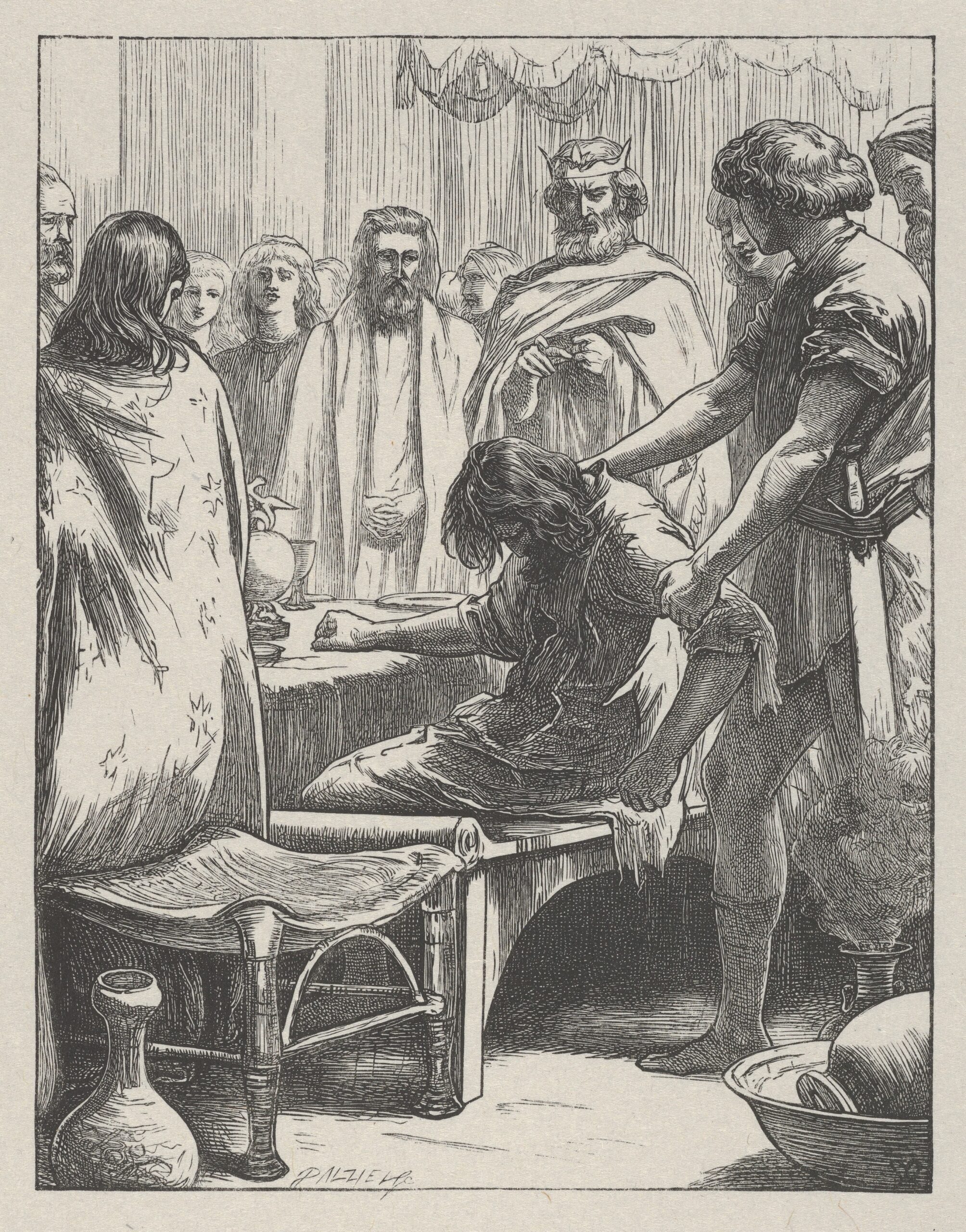
Millais, John Everett. The Marriage Feast (from The Parables of Our Lord and Saviour Jesus Christ). 1864. Wood engraving by Dalziel Brothers, 13.9 x 10.9 cm. The Metropolitan Museum of Art, New York.
Museum: The Metropolitan Museum of Art (The Met Fifth Avenue, New York, NY)
Accession Number: 21.68.4(13)
Official Link: The Metropolitan Museum of Art — The Marriage Feast (The Parables of Our Lord and Saviour Jesus Christ)
Provenance
1857–1864: Commissioned from John Everett Millais by Edward and George Dalziel (the Dalziel Brothers) for their published volume The Parables of Our Lord and Saviour Jesus Christ.
1864: Engraved on wood and printed by the Dalziel Brothers at Camden Press, London, for publication by Routledge, Warne & Routledge.
Late 19th Century–1921: Retained within the private archive and collections of the Dalziel family.
1921–Present: Acquired by The Metropolitan Museum of Art via the Rogers Fund (1921).
Kooistra, Lorraine Janzen. Poetry, Pictures, and Popular Publishing: The Illustrated Gift Book and Victorian Visual Culture 1855-1875
The art of Thomas Hardy / by Lionel Johnson; to which is added a chapter on the poetry, by J. E. Barton and a bibliography by John Lane; together with a new portrait by Vernon Hill and the etched portrait by William Strang.
On the image below:
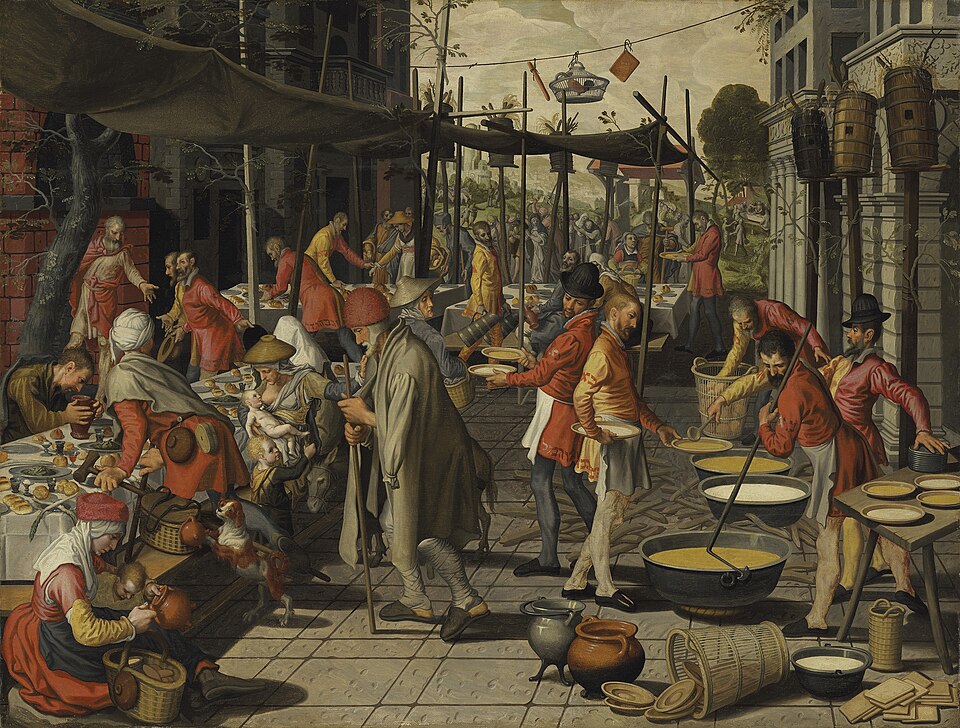
Aertsen, Pieter, and Studio. The Parable of the Royal Wedding. c. 1570s. Oil on canvas (transferred from panel), 105.4 x 139.3 cm. Private collection. Christie’s, New York, October 15, 2020, Old Masters, lot 16.
Location: Private Collection (Sold at Christie’s, New York, October 15, 2020, Live Auction 18715: Old Masters, Lot 16; Realized Price: $1,014,000 USD).
Official Auction Lot Link: Christie’s — The Parable of the Royal Wedding by Pieter Aertsen and Studio
RKD Digital Archival Entry: Netherlands Institute for Art History (RKD) — Images Database (ID 65754)
Provenance
c. 1570–1575: Executed in Amsterdam by Pieter Aertsen and workshop assistants.
Private European Collections: Retained in private continental holdings, subsequently transferred from its original oak support to canvas during conservation treatment in the late 19th or early 20th century.
Auction Sale (2020): Offered from a private collection at Christie’s, New York, October 15, 2020 (Old Masters, Lot 16), where it was acquired by a private collector.
Matthew Book 3: What is John talking about the Kingdom of heaven is near.
Meaning of Baptism
Baptism of Jesus by John
Matthew 3:16
Matthew Book 4 The Temptation of Jesus
4: 23 This is going to be interpreted by Dostoyevski in The Grand Inquisitor.
Matthew 5 Seromon on the Mount Mentions the Kingdom of heaven
On Revenge and Loving One’s Enemies
6:19 Lord’s Prayer May your kingdom come; may your will be done on earth as it is in heaven.
6:20 Riches are in the heart.
Matthew 6:34 Attitude about time Do not worry about tomorrow.
Matthew Book 7
God as Judge
About seeing clearly
Ask seek knock
interpretation of Law of Moses
Narrow Gate
Warning Against False Prophets
7:21 On Judgment Day (also see Luke 13: 25-27
7:28 Jesus wasn’t like the teachers of the Law; instead he taught with authority.
8:11 More on the Kingdom of heaven.
8:22 somehow following Jesus involves letting the dead bury the dead.
9 : 6 Son of Man has authority on earth to forgive sins.
9:13 It is kindness I want not animal sacrifices.
9:35 preaches the good news about the Kingdom
9:36 -37 sheep without a shepherd also harvest metaphor The harvest is large, but there are few workers to gather the harvest that he will send out the workers to gather in the harvest.
10:6 Go to the lost sheep of the people of Israel. Go and preach the Kingdom of heaven is Near. Heal the sick, bring the dead back to life, heal those who suffer from dreaded skin diseases, and drive out demons. You received without paying, so give without being paid. Do not carry any gold, silver or copper money in your pockets do not carry a beggar’s bag for the trip or an extra shirt or shoes or a walking stick. A worker should be given what he needs.
10:11 Hospitality
10:16 more sheep
cautious as snakes, gentle as doves
19-20 When they bring you to trial, do not worry about what you are going to say or how you wills ay it; when the time comes, you will be given what you will say. For the words you speak will not be yours; they will come from the Father speaking through you.
Everyone will hat ou because of me. But whoever hold out to the end will be saved. When they persecute you in one town, run away to another one. I assure you that you will not finish your work in all the towns of Israel before the Son of Man comes.
26 some reversals Whatever is no covered up will be uncovered, and every secret will be made known. WhatI am telling you in the dark you must repeat in broad daylight, and what you have heard in private you must announce from the housetops.
body versus soul
32 Public declaration
34 counterintuitive
35-37 probably contradicts Jewish law in a big way, right before the big teaching.
38 Whoever does not take up his cross and follow in my steps is not fit to be my disciple. Whoever tries to gain his own life will lose it; but whoever loses his life for my sake will gain it.
40 more on hospitality
11 This is the chapter where Jesus confirms John is Elijah.
Primacy of listening.
Promise of the Kingdom of Heaven involves being greater than John, but John is also the greatest man that ever lived.
So getting to the Kingdom of God involves a self overcoming so profound it would make you greater than the greatest person who ever lived.
Witnessing miracles does not make people turn away from sin.
27 This verse is important because it says knowledge of God is possible via revelation.
Revelation is an other to Reason. Did you know it by reason or revelation.
Theology takes seriously the idea of revelation, philosophy does not.
Aristotlean view of contemplation kind of an apex of reason not an other to it.
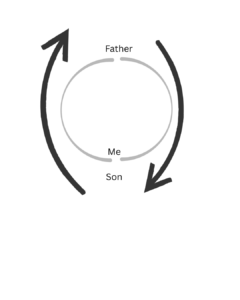
Lets draw a crude picture of verse 27
This picture is lacking the play of light and dark it would need for the concept of revelation.
Circular reasoning is not doing it right. Knowledge by revelation in a picture is circular.
28: seems to be directly addressing people who have been treated like beasts of burden. verse of comfort his yoke is easy and load light.
12: ostensible break with Jewish tradition
what is present (Jesus) is greater than the Temple
the scripture says I want kindness not animal sacrifices
(is he quoting himself and calling it scripture?)
Telling people their ideas of guilt and innocence are flawed.
Pharisees plotted to kill him.
Fulfillment of Isaiah’s prophecy
25:”Any country that divides itself into groups which fight each other will not last very long. And any town or family that divides itself into groups which fight each other will fall apart. So if one group is fighting another in Satan’s kingdom, this means that its already divided into groups and will soon fall apart.”
This is an interesting teaching that makes you want to throw political parties out the window.
But it also implies that we are now in “Satan’s Kingdom” (spiritual warfare attitude of the 1990s spiritual warfare books) in tension with another attitude about the world/earth now.
27) You say that I drive out demons because Beelzebul gives me the power to do so. Well then who gives your followers the power to drive them out? (Who is he addressing? seems like they are talking about some people who were driving out demons.)
What your followers do proves that you are wrong! No it is not Beelzebul, but God’s Spirit who gives me the power to drive out demons, which proves that the Kingdom of God has already come upon you.
This verse is so huge. He’s saying God’s spirit is what creates the healing. Also that these followers also did it. He is the “Kingdom of God” among us and followers have already imitated him.
30 It is somehow unforgivable to speak against the Holy Spirit.
34 The mouth speaks what the heart is full of
48: Non bloodline view of familial relation.
Book 13 Have the agricultural metaphor
Emphasis on listening.
Purpose of the Parable
The first line was already in Greek philosophy – You already “have” the knowledge so coming to know is akin to remembering.
Understanding problematic because it is possible to listen but not hear, look and not see so a sharp mind is something that is beyond use of the senses.
And also saying that parables somehow address this shortcoming.
some are not deep so give up the message (seed rolls away)
for some the message gets choked out by focus on this life
The agricultural imagery continues with parables of the weeds, mustard seed, yeast
use of parables to communicate knowledge (referencing the creation of the world which could be reference to earlier debates)
I will use aparbles when I speak to them; I will tell them things unknown since the creation of the world.” (Implies coincidence of knowledge and creation)
back to the parable of the weeds and then an end of the world statement that sounds like a depiction of hell.
the Son of Man will send out his angels to gather up our of his Kingdom all those who cause people to sin and all others who do evils things, and thy will throw them into the fiery furnace, where they will cry and gnash their teeth. The God’s people will shine like the sun in their Father’s Kingdom. Listen, then if you have ears!
parable of the net says something about the end times
49 It will be like this at the end of the age: the angels will go out and gather up the evil people from among the good and will throw them into the fiery furnace where they will cry and gnash their teeth.
Book 14 The Death of John the Baptist The sadness of this story was profound because Herod actually enjoyed listening to John the Baptist. It says something really damning about political life. So as to not be embarrassed in public he has a special teacher killed.
Conflict between political and ethical life felt on a really personal level.
So he experiences this deep sadness about John, and lonliness and goes on to perform the miracles of the feeding of the 5,000 and walking on water.
I feel like this part where Peter walks on water is one of the most important parts.
28: Then Peter spoke up, Lord if it is really uou, order me to come out on the water to you.
Come answered Jesus. So Peter got out of the boat and started walking on the water to Jesus. But when he noticed the strong wind, he was afraid and started to sink down in the water. Save me, Lord, he cried. At once Jesus reached out and grabbed hold of him and said, “Wha tlittle faith you have! Why did you doubt?”
Book 15 People came at him for not being super observant of traditional norms. He calls out religious hypocrisy.
How right Isaiah was when he prophiesied about you!
“These people, says God, honor me with their words, but their heart is really far away from me. It is no use for them to worship me, because they teach man made rules as thought they were my laws!”
Then Jesus called the crowd to him and said to them, Listen and understand! It is not what goes into a person’s mouth that makes him ritually unclean, rather, what comes out of it makes him unclean. … the things that come out of the mouth come from the heart, and these are the things that make a man ritually unclean. For from his heart come the evil ideas which lead him to kill, commit adultery, and do other immoral things, to rob, lie, and slander others. These are the things that make a person unclean.
Chapter 16: verse 15
What about you? he asked them, “Who do you say I am?”
Simon Peter answered, You are the Messiah, the Son of the living God.
Good for you, Simon son of John! answered Jesus. For this truth did not come to you from any human being, but it was given to out directly by my Father in heaven. (description of truth by revelation)
keys to the kingdom (doorway, threshhold image)
The as above so below is inverted as belong so above.
24: Then Jesus said to his disciples If anyone wants to come with me, he must forget himself, carry his cross, and follow me. For whoever wants to save his own life will lose it, but whoever loses his life for my sake will find it. Will a person gain anything if he wins the whole world but loses his life? Of course not! There is nothing he can give to regain his life.
For the Son of Man is about to come int he glory of his Father with his angels, and then he will reward each one according to his deeds. I assure you that there are some here who will not die until they have seen the Son of Man come as King.
Chapter 17: Transfiguration
clarification that John the Baptist was Elijah
Chapter 18: At that time the disciples came to Jesus, asking, “Who is the greatest in the Kingdom of heaven?”
So Jesus called a child, had him stand in front of them, and said, I assure you that unless you change and become like children, you will enver enter the Kingdom of heaven. The greatest in the Kingdom of heaven is the one hwo humbles himself and becomes like this child. And whoever welcomes in my name one such child as this, welcomes me.
Do not cause others to lose their faith.
People have angels
God goes looking for the lost sheep
18: 18-19 And so I tell all of you; what you prohibit on earth will be prohibited in heaven, and what you permit on earth will be permitted in heaven.
And I tell you more: whenever two of you on earth agree about anything your pray for, it will be down for you by my Father in heaven. For where two or three come together in my name, I am there with them.
book end with need to forgive your brother from your heart.
19: 16-30
20: 17 Going to get condemned
24: first/last
21 Triumphal Entry
Donkeys come from a prophesy
Scene in the temple
if you believe you will receive whatever you ask for in prayer
Question about Jesus’ authority goes unresolved
22
Many are invited few are chosen
what does it mean to pay to God what belongs to God
God of the living, not of the dead
Greatest commandment in the Law
23 Roles of Teacher, Father and Leader are reserved for the Messiah.
The greatest one among you must be your servant. Whoever makes himself great will be humbled, and whoever humbles himself will be made great.
(Kingdom of Heaven as place of reversal. The way people recognize each other on earth does not indicate a status there.
Makes you think about what it would mean to humble oneself.
God lives in the Temple as well as heaven’s throne.
Attack on the teachers of the Law goes on “you neglect to obey the really important teachings of the Law, such as justice and mercy and honesty.
calls them Blind (vision with knowledge)
invokes appearance vs reality
Rhetoric gets intense and accuses them of being like the ancestors that murdered prophets, tells them they are condemned to hell, and calls them murderers.
Love song to Jerusalem after saying they shoot the messenger.
“Jerusalem, Jerusalem! You kill the prophets and stone the meesengers God has sent you! How many times I wanted to put my arms around all your people, just as a hen gathers her chicks under her wings but you would not let me! And so your Temple will be abandoned and empty. From now on, I tell you, you will never see me again until you say, ‘God bless him who comes in the name of the Lord.”
Chapter 24
Jesus talks about the destruction of the Temple.
So the disciples ask him about the when of the revolution. “what will happen to show that it is the time for your coming and end of the age.”
The answer is false messiahs, battles, war, famine, earthquakes, and the persecution of Christians. Then there is a lot of preaching and then the end times come.
Then it will be the Awful Horror from the prophesy of Daniel. Going to have to leave your house and run away
Then there is going to be false prophets and false messiahs who are going to be performing miracles to deceive people (seems like one of the hallmarks of the Holy will turn into a tool of deception)
And then he will come like lightening.
We will have the end of the world darkness, no moon nor stars, and galactic weird behavior. The Son of Man appears people weep, there’s a trump, angles from the four cours gathering of his chosen people from one end of the world to the other.
so when you see all these things, you will know the time is near, ready to being.
The parable of the wedding banquet is found at Matthew 22:1-14
see also Matthew 8: 11-12
Luke 14: 15-24
significance has to do with the repetitive question of how the story ends. The book reads with messianic energy. Its a parable to be interpreted as a commentary on the death and resurrection of Jesus. The tomb was empty is an ending that is too pregnant with unknown unfoldings. So, the interpretation of what will it be like when Kingdom comes, is addressed by this wedding banquet parable.
Why a wedding- its a covenanting practice
Who is the groom: Jesus
Who is the bride: the church
If we had to map the balance of community vs. individual onto the gospels, Matthew would be on the community side, because Jewish thought is community oriented first, and the Book of John would be when we get a lot of address to the individual.
Why am I interested in this. Do I think prophesy has the epistemic status I’m looking for? Absolutely not.
But this parable keeps going on and on in the history of how Biblical interpretation intersects with political thought. First, its an account of a covenant. In the early modern period, covenanting was used as a model to account for the origin of a political community.
So, there’s the first odd thing about this parable. Its about the end of the world, or Kingdom Come, which is this big wedding feast. On the one hand, it is an account of the end. What happens at the end? Some people go to the wedding banquet, and others don’t, and one random guy suffers disapproval for wearing the wrong clothes, but this is kind of weird since it was a spur of the moment invite and he didn’t previously know he was going to a wedding and was also not of the correct social status to even be invited to this sort of thing, so of course he wouldn’t be wearing the right clothes.
On the other hand, this story of what happens at the end, is also a story of a beginning, because it’s a covenant– something that is undertaken with a view towards beginning a union, and its future oriented. The end of the story of time, is a story about a beginning.
The wedding banquet parable gets referred to in order to explain the state in the accounts of the legitimation of sovereign’s. This is done by mapping the sovereign and its relation to the polity onto this parable.
There are two aspects of this story that made it live on and on in discourses of legitimation.
First, its an explanation of what happens in the end, which is the answer to the question everyone wants to know. So, all eschatologies will re examine this wedding banquet.
Second, because of its important place in the plot, and the way it functions as a new beginning, people trying to describe the ideal Christian community go back to this parable and the extend the metaphor of every element.
Chapter 5 Polity Centered Kingship of Kantorowicz’s the King’s Two Bodies is about how the wedding parable was adapted for legitimation discourses of rulers.
A bishop is mystically married to his see
Huguccio of Pisa (Summa 1188), Pope Innocent IV, Hostensis
This metaphor was used to argue for the inalienability of church property.
Then we get to Lucas de Penna of 1360 Commentaria en Tres Libros Codicis who maps the metaphor onto a kingship.
Just as Christ is married to the church the prince is married to the republic.
Then we get into Jean Petit, who, you guessed it, uses this extended metaphor to justify the non distribution of property.
Echoes from the Old Testament
Isaiah (feast) 25:6-8
Proverbs (feast) 9:1-6
Zephanaiah (sacrifice and attire) 1: 7-8
Jesus as a Bridegroom and Wedding metaphors
Matthew 25: 1-13 is also about a wedding feast, also emphasizes be ready
John 3:29 reference to Jesus as bridegroom
Ephesians 5: 25-32
Second Corinthians 11:2
On the Eschatological Fulfillment
Revelation 19:7-9
A constitutive tension of the explanation of the coming Kingdom or what we don’t know.
One account: As above so below
seems to be different than
the mention of reversals
both of which can be distinguished from
the ones that end with something like “its not the logic you are thinking of”
Places in the Leviathan where he cites the Book of Matthew.
The first mention of the Book of Matthew in the Leviathan is at the opening of chapter 36 entitled Of the Word of God and the Prophets. First he discusses the meaning of the word logos.
Then he explains that Book of Matthew means that Matthew wrote it.
He wants to separate out the word (logos) from the Word of God which referred to the Doctrine of the Christian Religion.
pp.365 invokes the idea of the Teacher takes the place of all the names of offices of the Church. (This at once explains the evolution of church offices out of the original situation, and also makes that specific institutionalization irrelevant, as Teachers would exist without it).
see p. 443
Cites 4.1 Holy Ghost descending as a Dove.
He is explaining his materialist world view means these are “visions”.