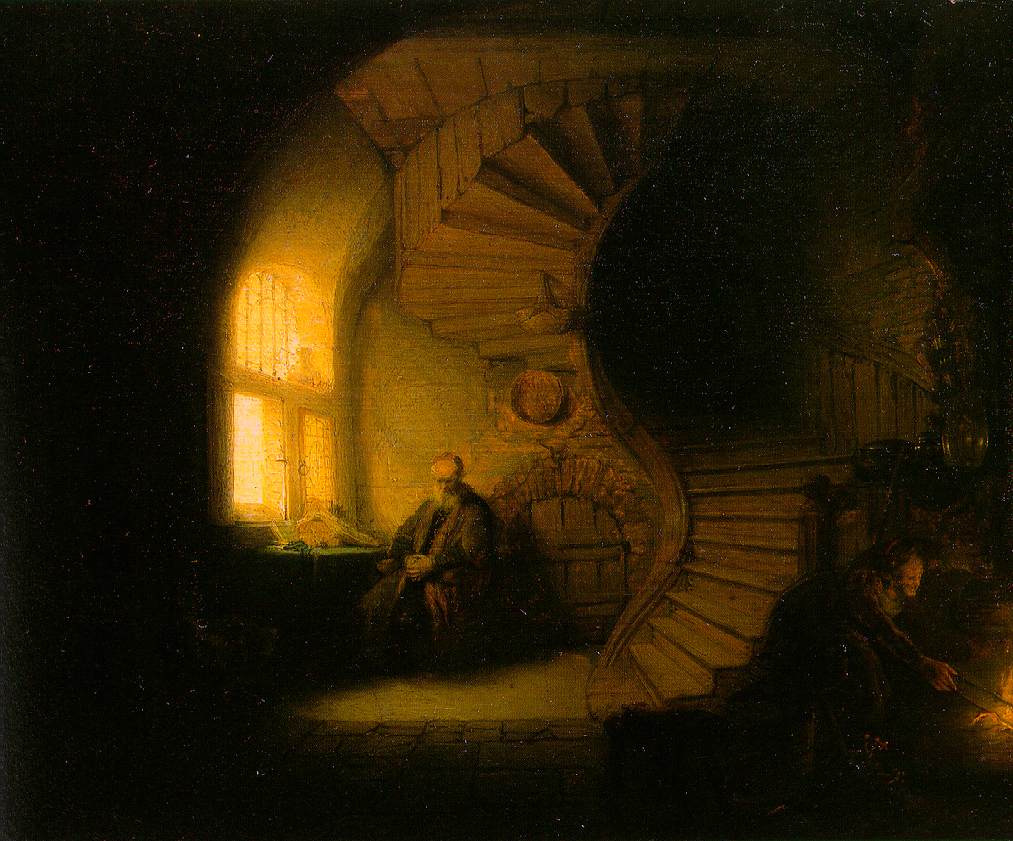
Aristotle Metaphysics
For it is owing to their wonder that men both now begin and at first began to philosophize.
Nature is a source or cause of being moved and of being at rest in that to which it belongs primarily.
We suppose ourselves to possess unqualified scientific knowledge of a thing, as opposed to knowing it in the accidental way of the sophist, when we think that we know the cause on which the fact depends, as teh cause of that fact and of no other, and, further, that the fact could not be other than is is.
Telle est donc la règle la meilleure, et tel est le critère le plus beau pour les biens extérieurs : qu’on soit empêché le moins possible par eux de servir et de contempler Dieu. This, therefore, is the end and the best limit regarding external things, so that the soul may be hindered as little as possible from the contemplation of God and His worship. Hic igitur finis sit et optimus terminus ad res externas respicienti, ut quam minime impediatur anima a contemplatione dei et cultu eius
We may now say that our discourse about the nature of the universe has an end. The world has received animals, mortal and immortal, and is fulfilled with them, and has become a visible animal containing the visible--the sensible God who is the image of the intellectual, the greatest, best, fairest, most perfect--the one only begotten heaven.
My dear Socrates, that, then, is the nature of the Spirit called Love.
This way, he said. We surely agree that is anyone recollects anything, he must have known it before?
Can you tell me, Socrates, can virtue be taught? Or is not teachable but the result of practice, or is it neither of these, but men possess it by nature or in some other way?
These encounters remind us, I believe, that there are many vantage points from which one can view and experience this thing known as modernity: as nightmare or utopia; as horrible past or future present. These contrasting views caution us against modernity’s reification and implore us to view modernity as a process of lived experience, with winners and losers, as well as strivings for redemption, recovery, retribution, and revolution, each experience tumbling into another and becoming—dare I say—history.
A freedom centered feminism would strive to bring about transformation in normative conceptions of gender without returning to the classical notion of freedom as sovereignty that all three waves of feminism have, in their different ways, at once accepted and rejected. Such feminism would be a world-building practice that changes political freedom from the "I-will" into the "I-can". This I-can is nothing other than the public persona described earlier, what Arendt called "the mask" of citizenship and the rights and duties that correspond to being a member of a political community. I-can belongs to women neither as a sex nor a gender, neither as "natural" nor a social group. I-can belongs, rather, to women as a political collectivity, and it obtains in the practice of speaking women's name (which involves speaking for others, being spoken for, and speaking back). I-can is the non-soverign freedom of feminists as citizens engaged in word and deed, who are committed to the irreducibly non natural basis of political membership. p.180